I am writing this post whilst waiting for Media Encoder to process render a set off After Effects projects to solve a problem that I should have tested before. 🤦♂️
The Problem
One of the sections of the Wonda Site is the collection of Poetic films created by my peers. Three of us created 360 films as a response to this project, the rest of the group created films using with none 360 footage. I hadn’t thought to test how Wonda works with none 360 video, I have used several none 360 still assets in the project so I had assumed (why, why) that the video would work the same way. It turns out that Wonda will import but not work with none 360 video.
Solutions
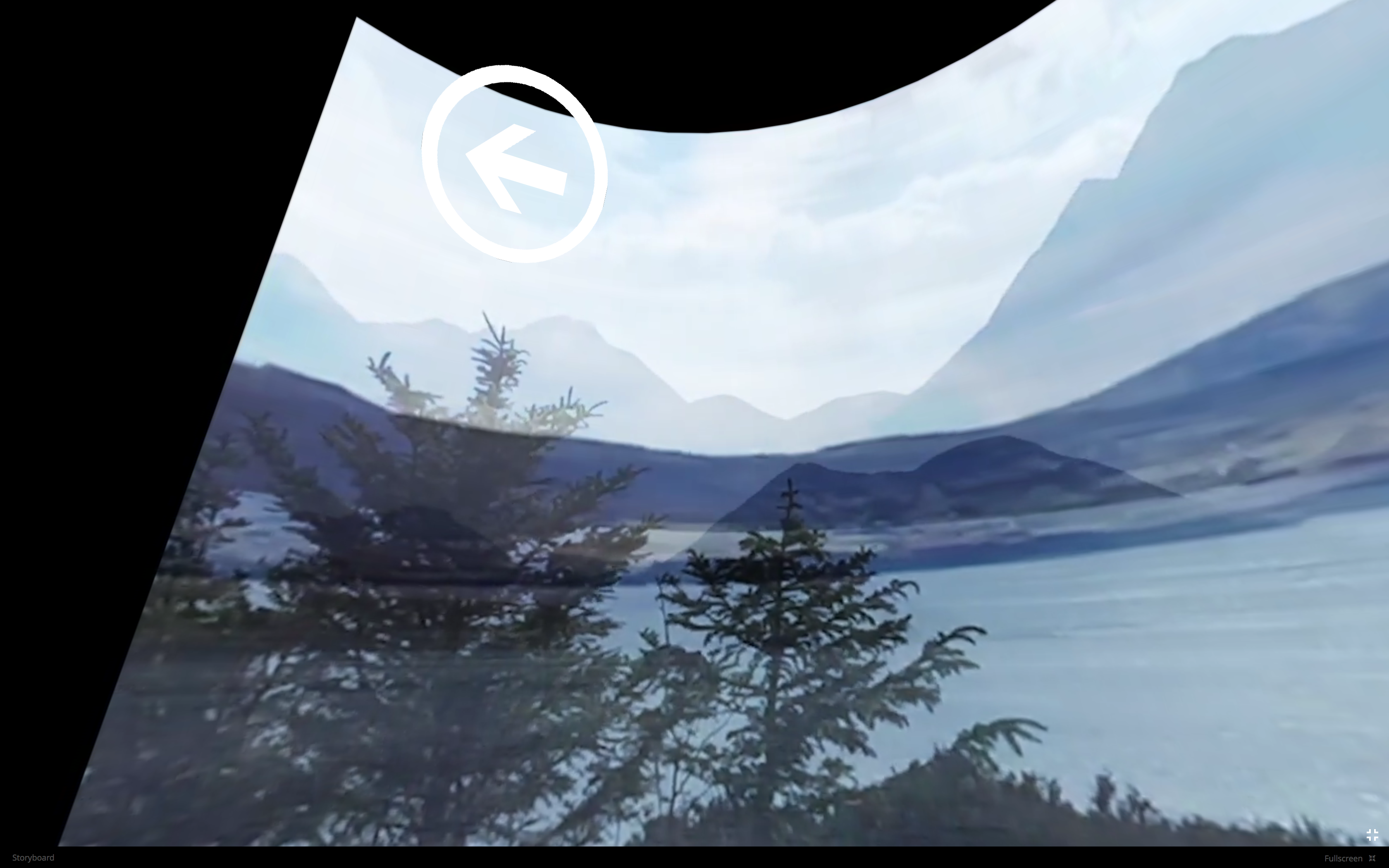
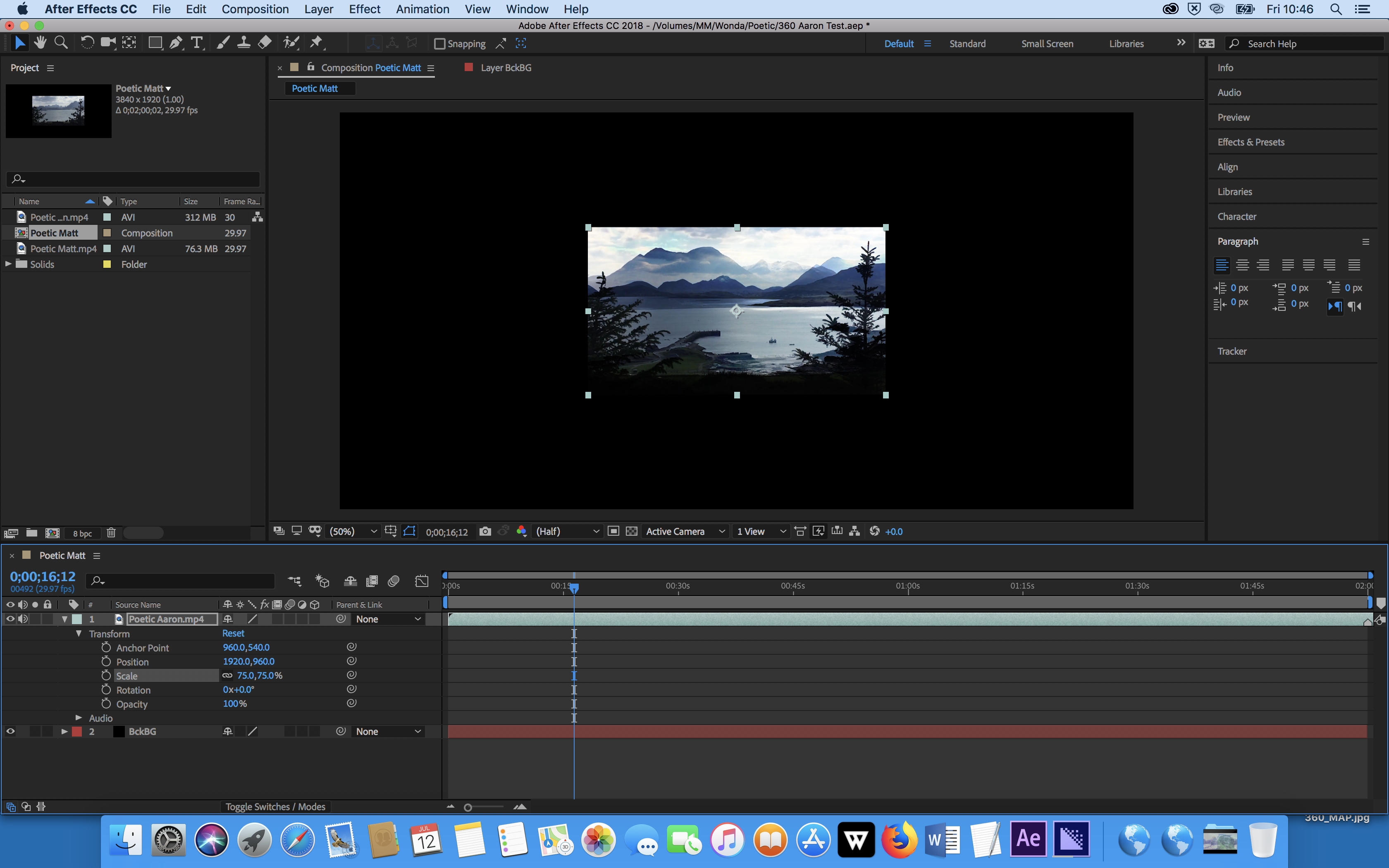
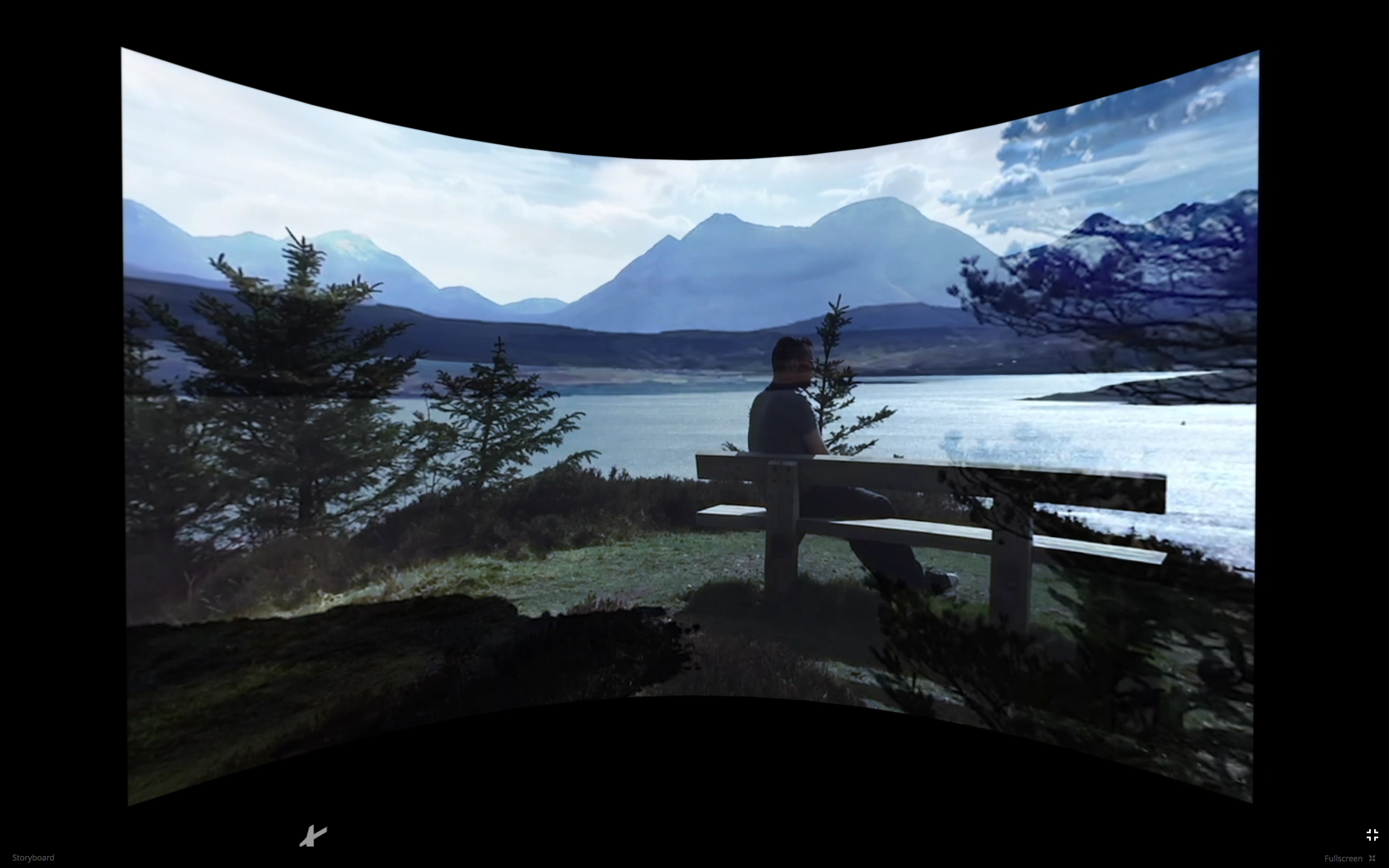
I created a 360 composition in After Effects with a black background with settings that matched the other 360 videos in the project. I then placed one of the none 360 films into the centre of the composition > Render > Import into Wonda > Preview in Wonda. Way too big!
360 After Effects Composition to place the film in 360 space
At this scale it fills the field of view an looks really distorted.
75%…
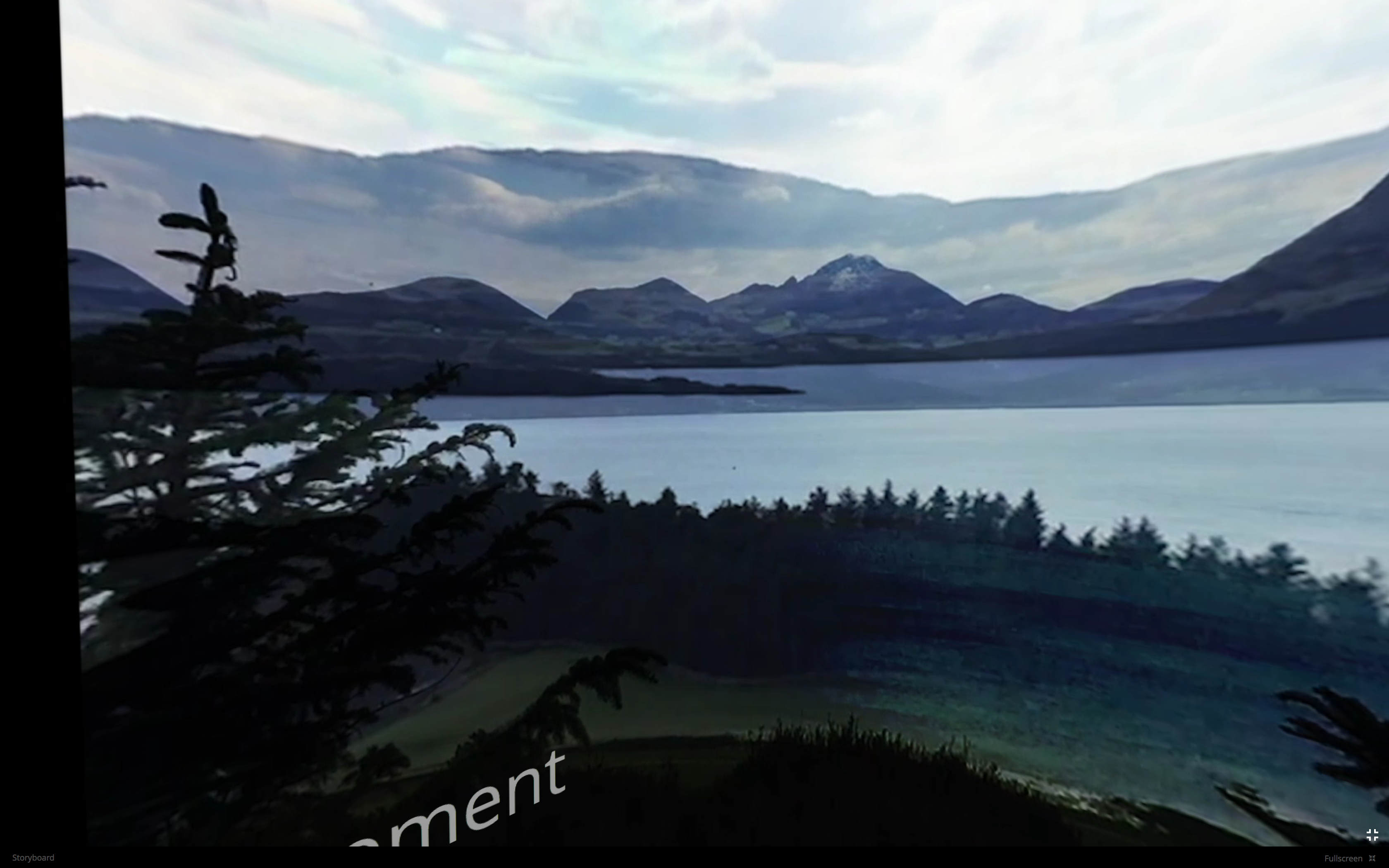
Still distorted
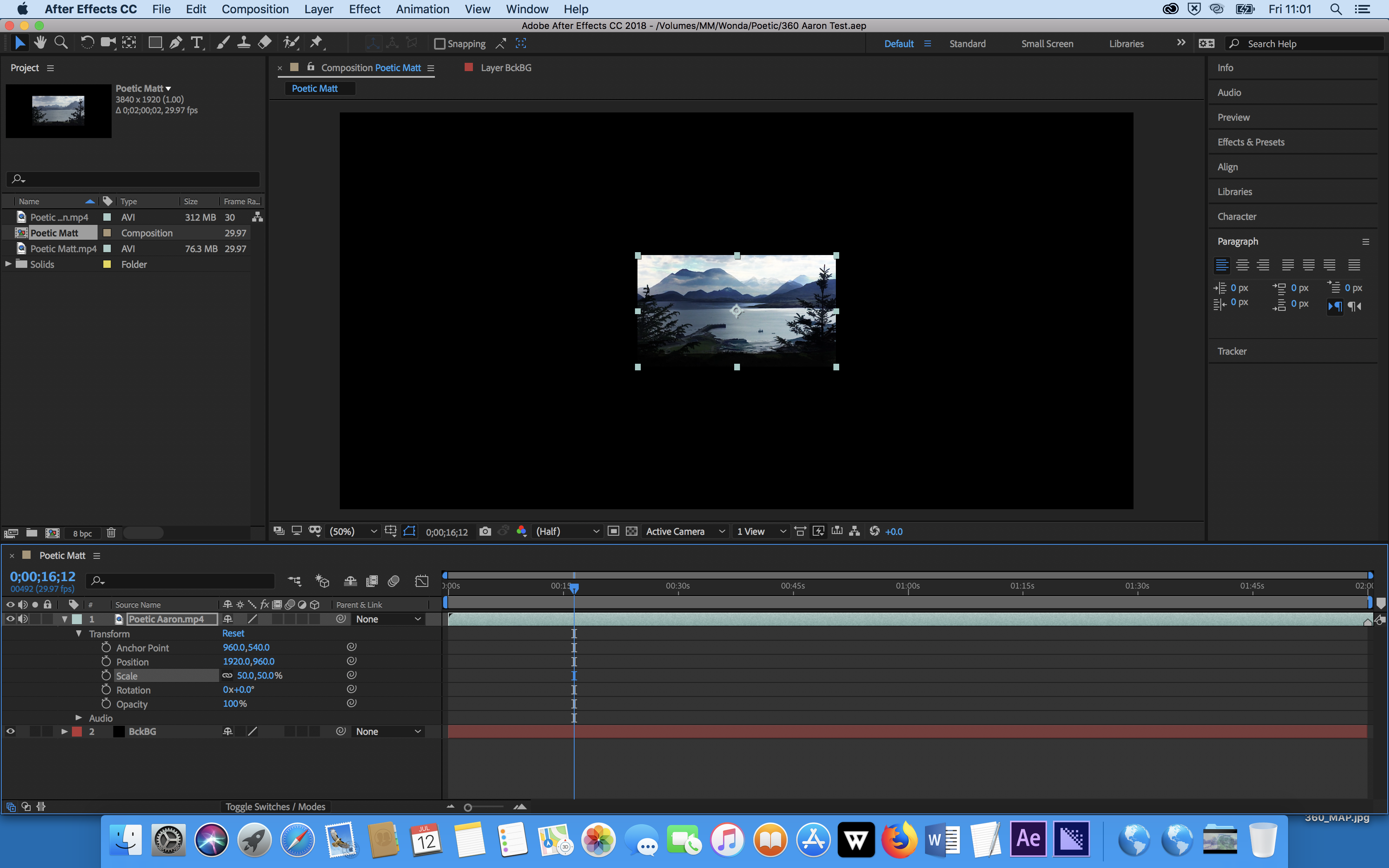
50%?360 After Effects Composition to place the film in 360 spaceStill not ideal but I think this is the best compromise as the artists initial composition is respected
So now I have something that works it is just a case of waiting for Media Encoder to go through all 14 of them.
This was another piece of visual inspiration that I found on my search. Really liked the depth to the images and the combination of transparent and opaque elements.
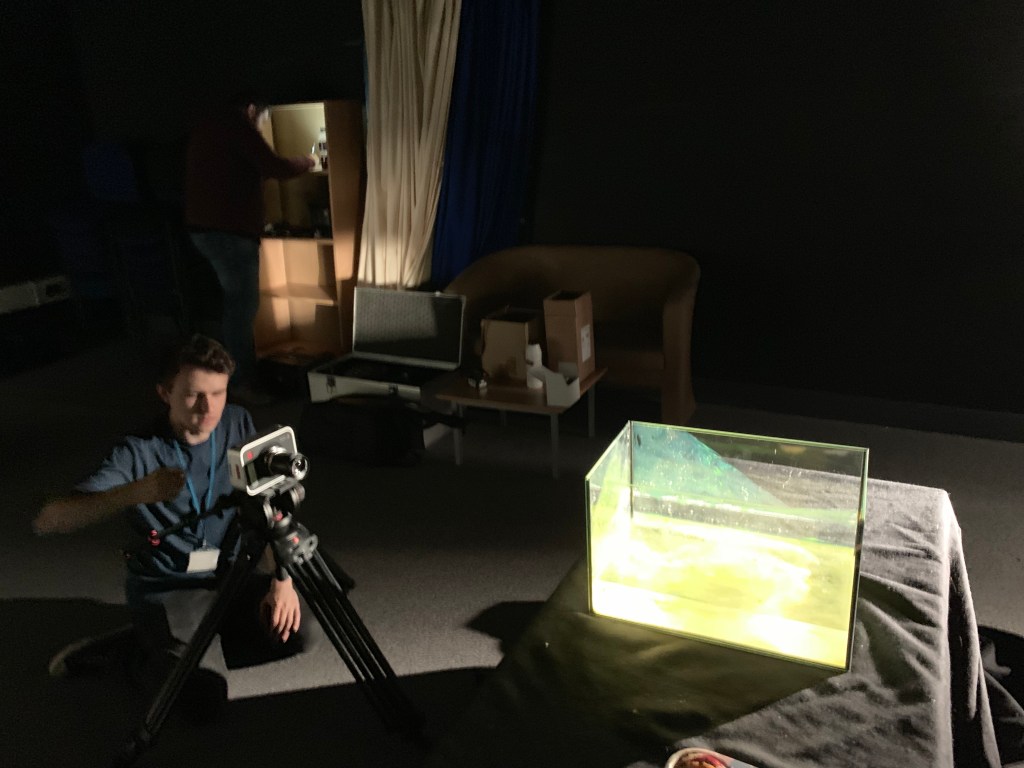
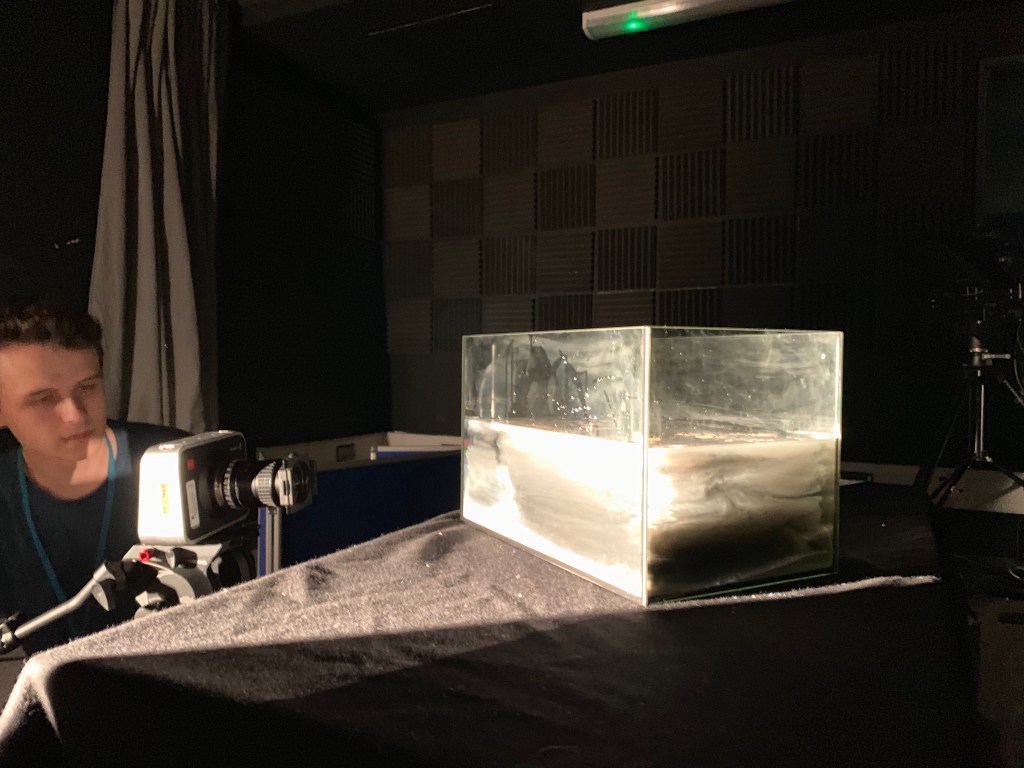
I organised a test shoot with the two crew members, Alex and Callum, who had agreed to help out on my shoot. I have worked with both of them before and this was a really fun filming session.
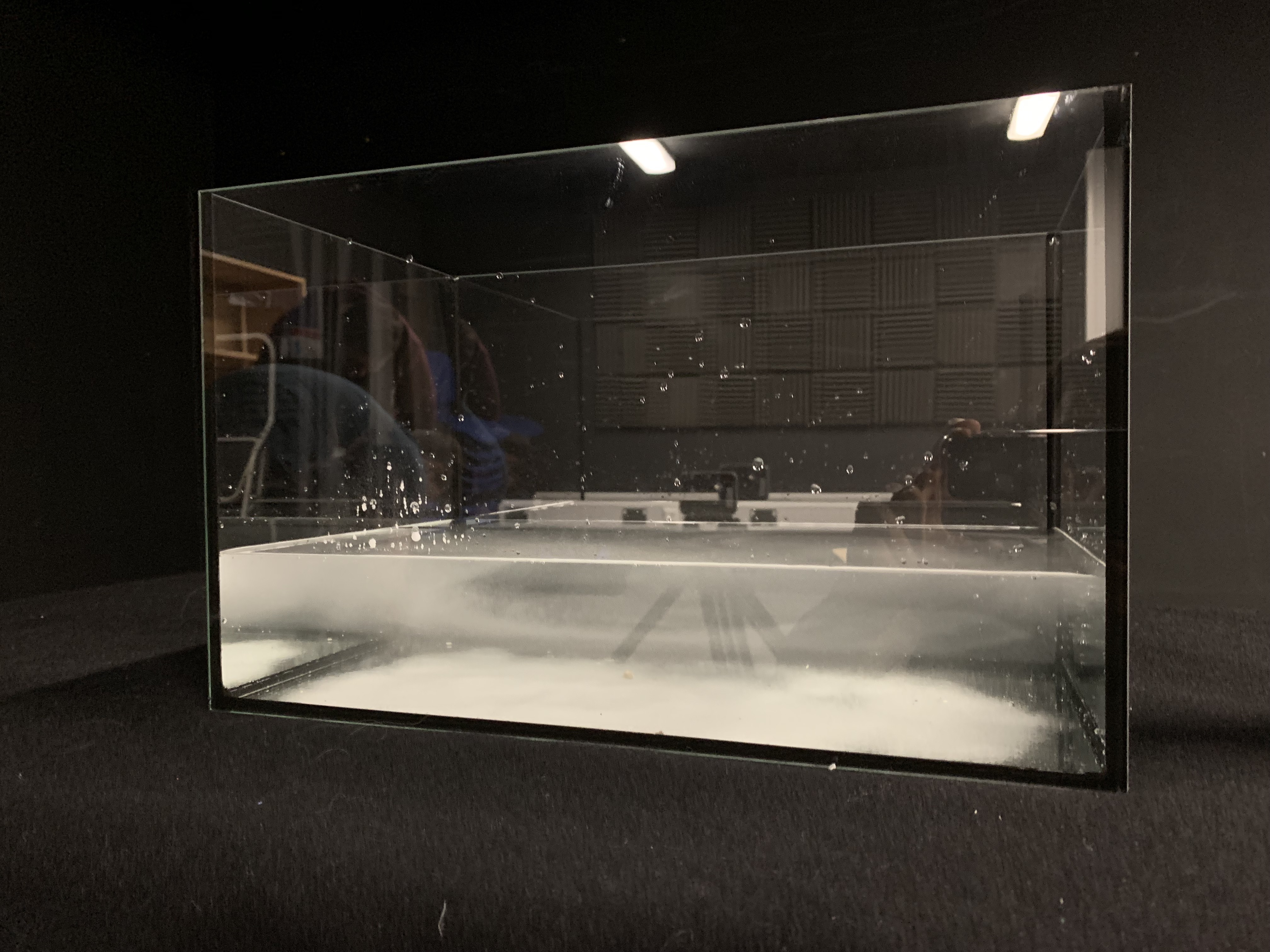
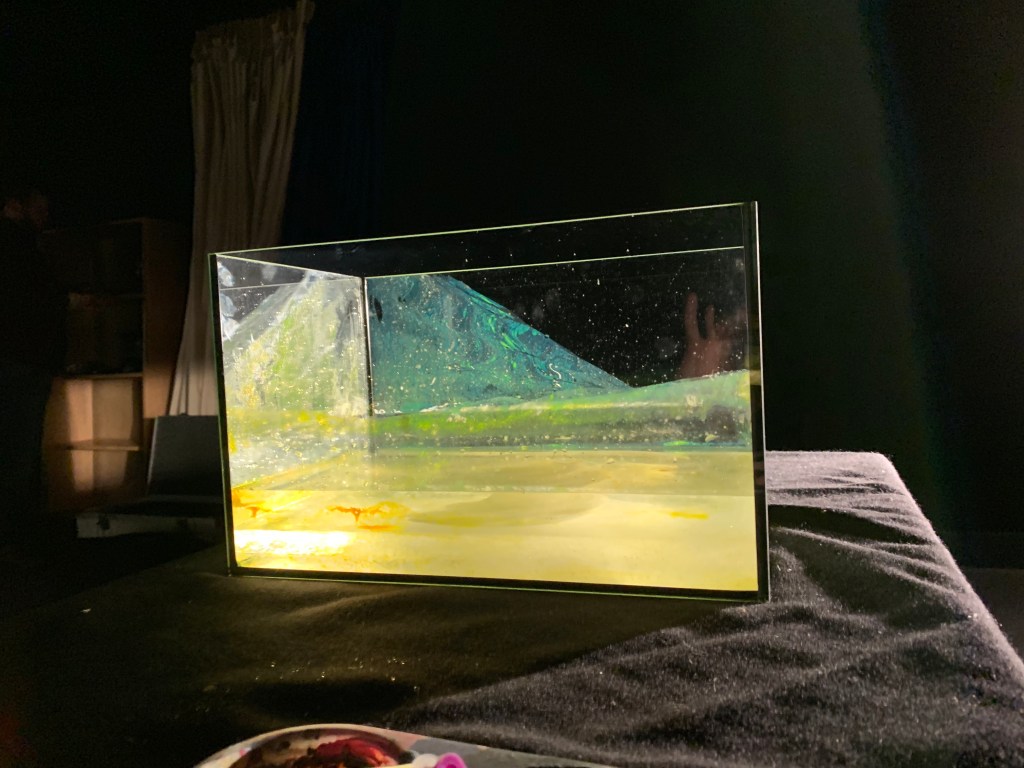
Is this the 2k light that works?Salt water in fish tank
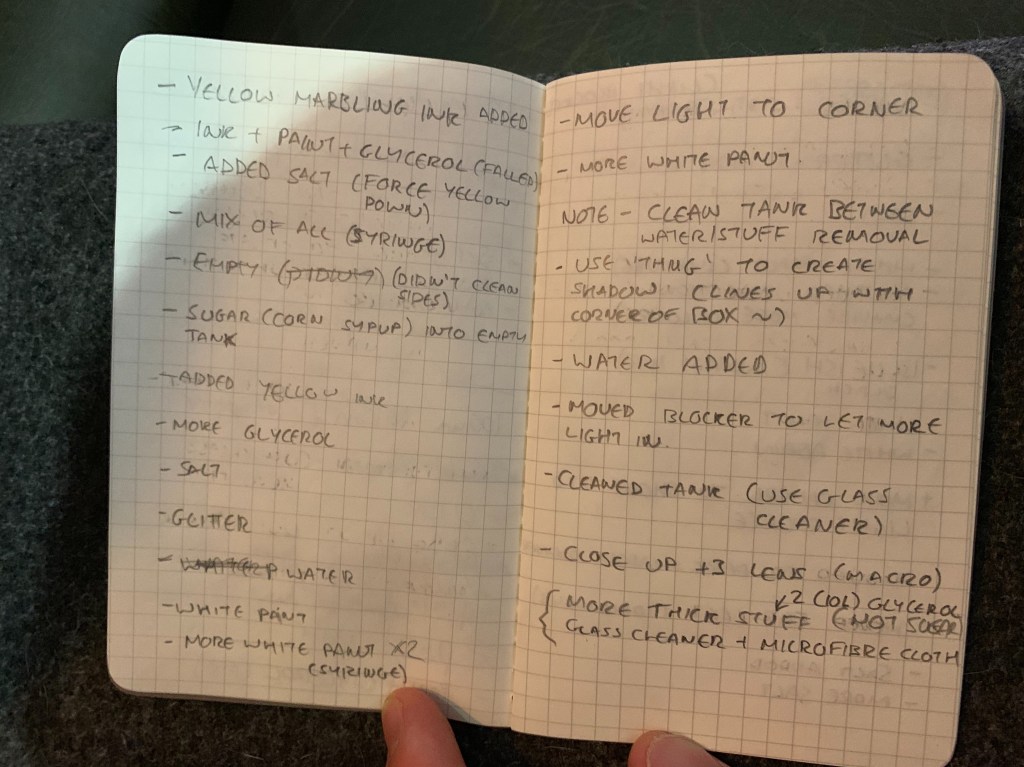
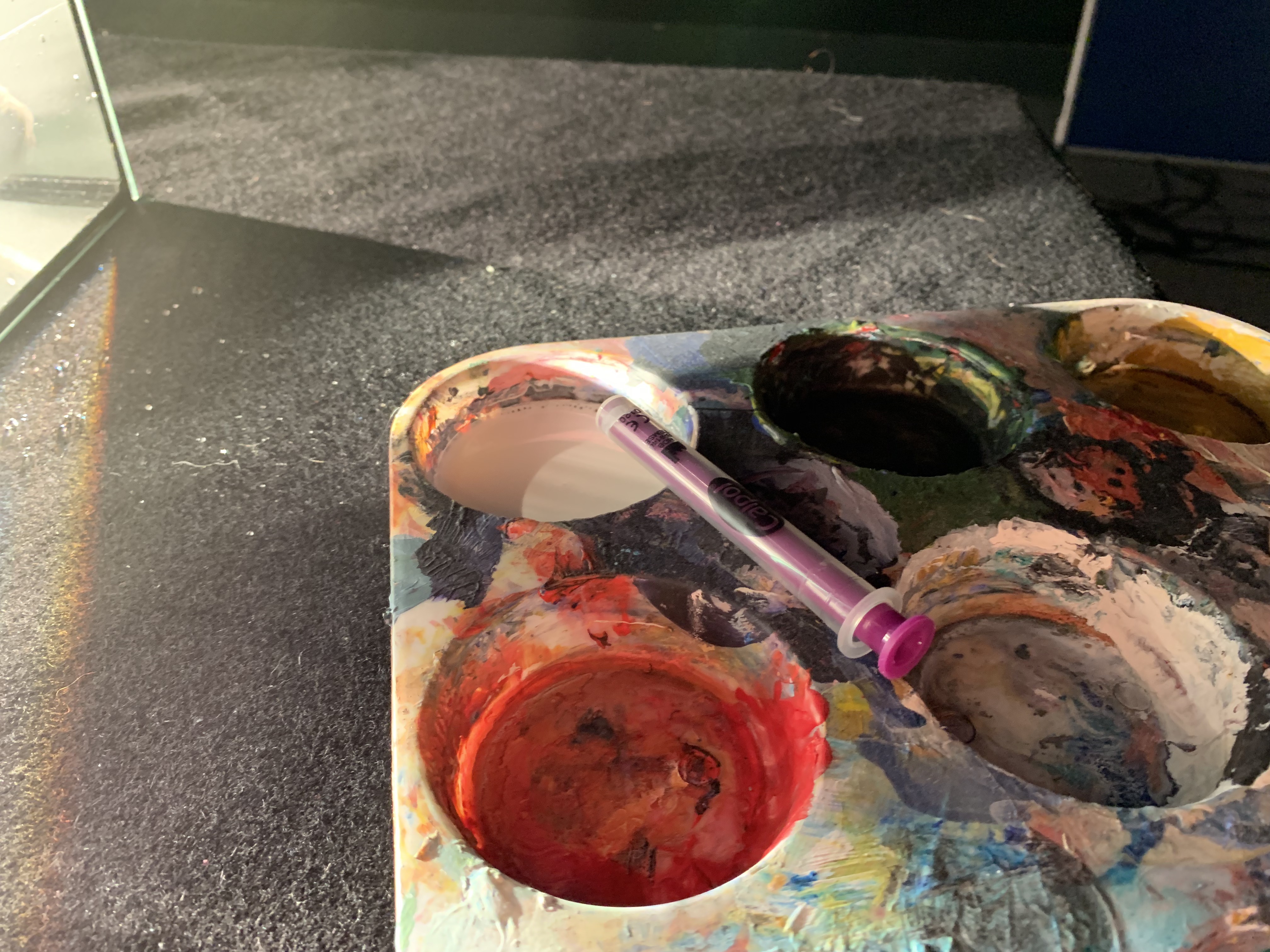
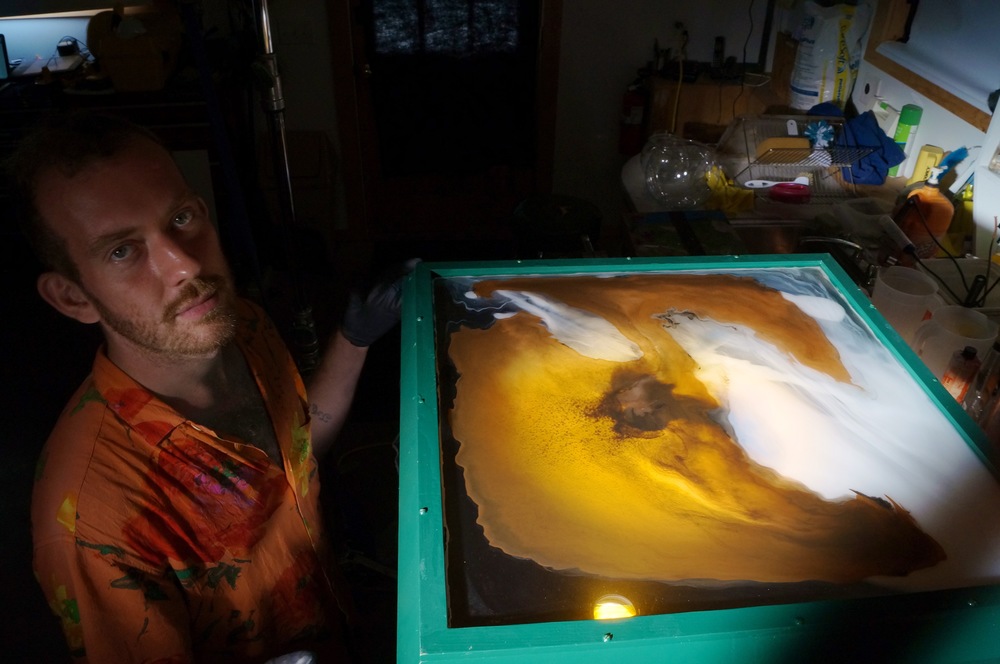
I had collected a fish tank, salt water, glycerin, corn syrup, acrylic paint, ink, glitter, and some syringes that come with a popular brand of children’s liquid paracetamol. I have filmed (and photographed) some ink dropping into water a few time before but this had always been very representational, it looked like ink dropping into water, here I wanted something more abstract.
Lighting inspiration
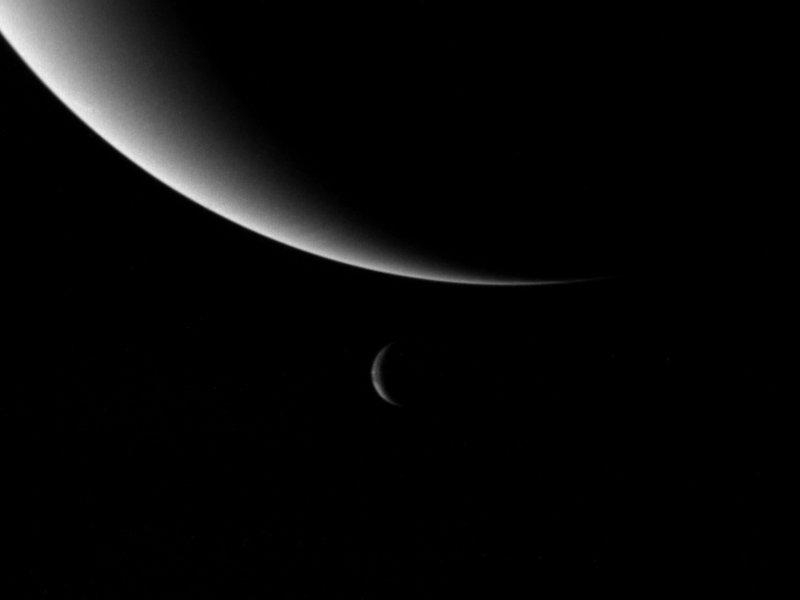
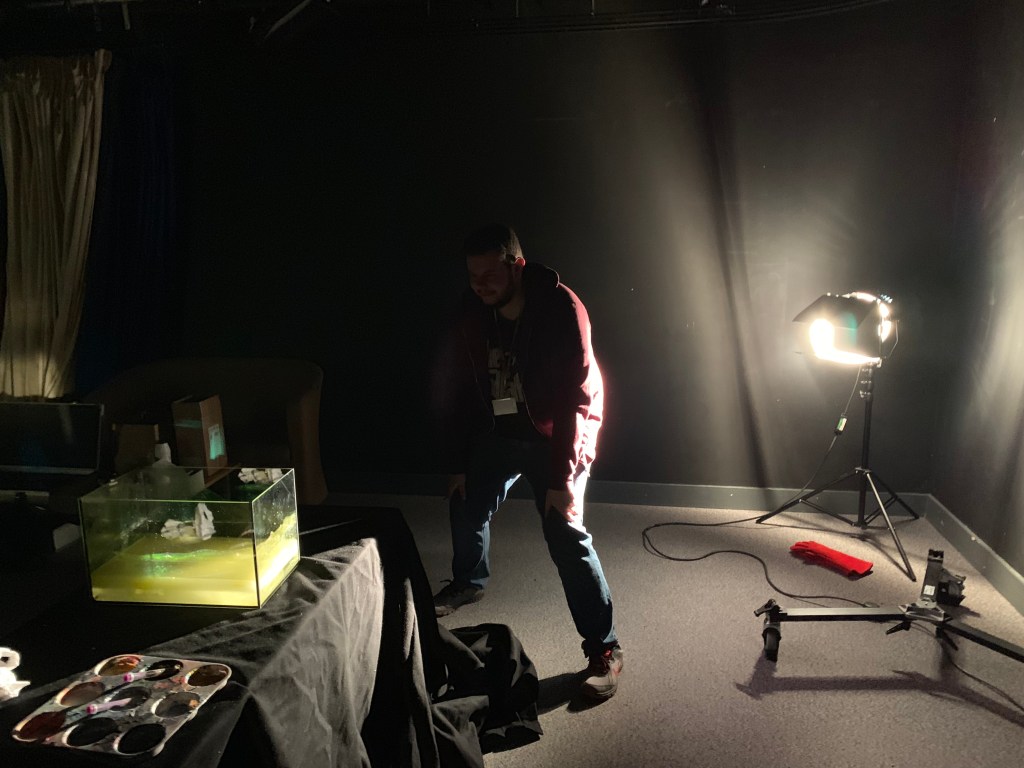
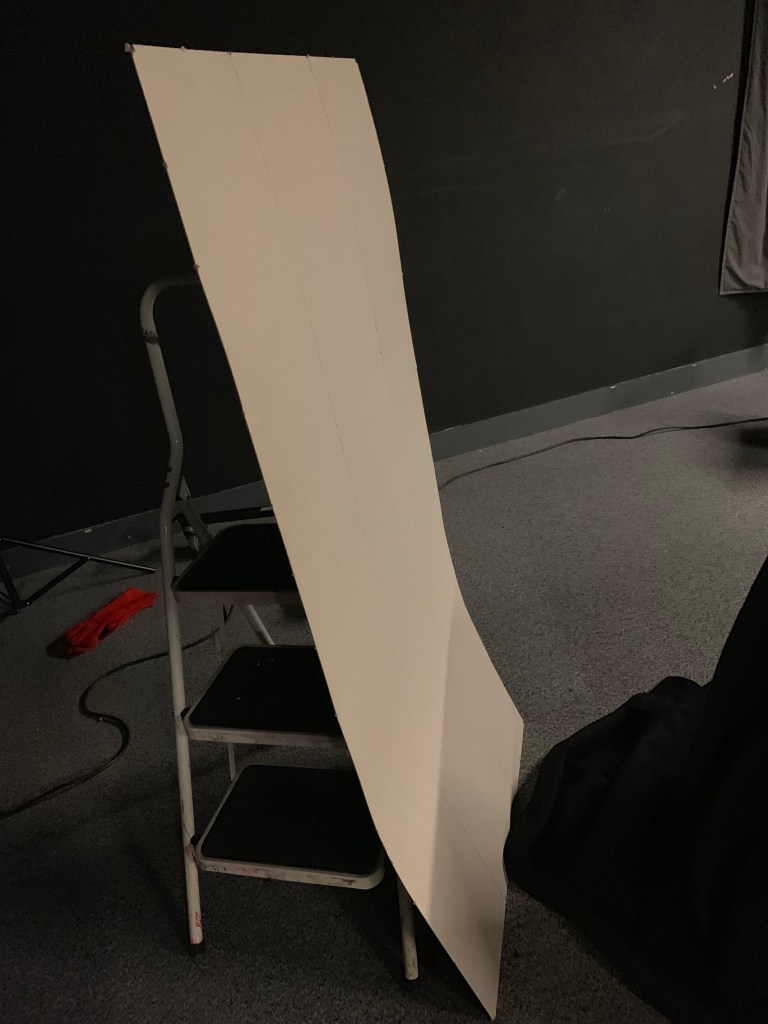
I want to try and recreate the lighting from some of the planetary images taken by probes such as voyager. After studying a few of the images it seemed that a hard light source as far away from the tank as possible would be the starting point. I thought the softness was probably coming from the atmosphere scattering the light which would likely happen in the water.
Initial position of light to tank
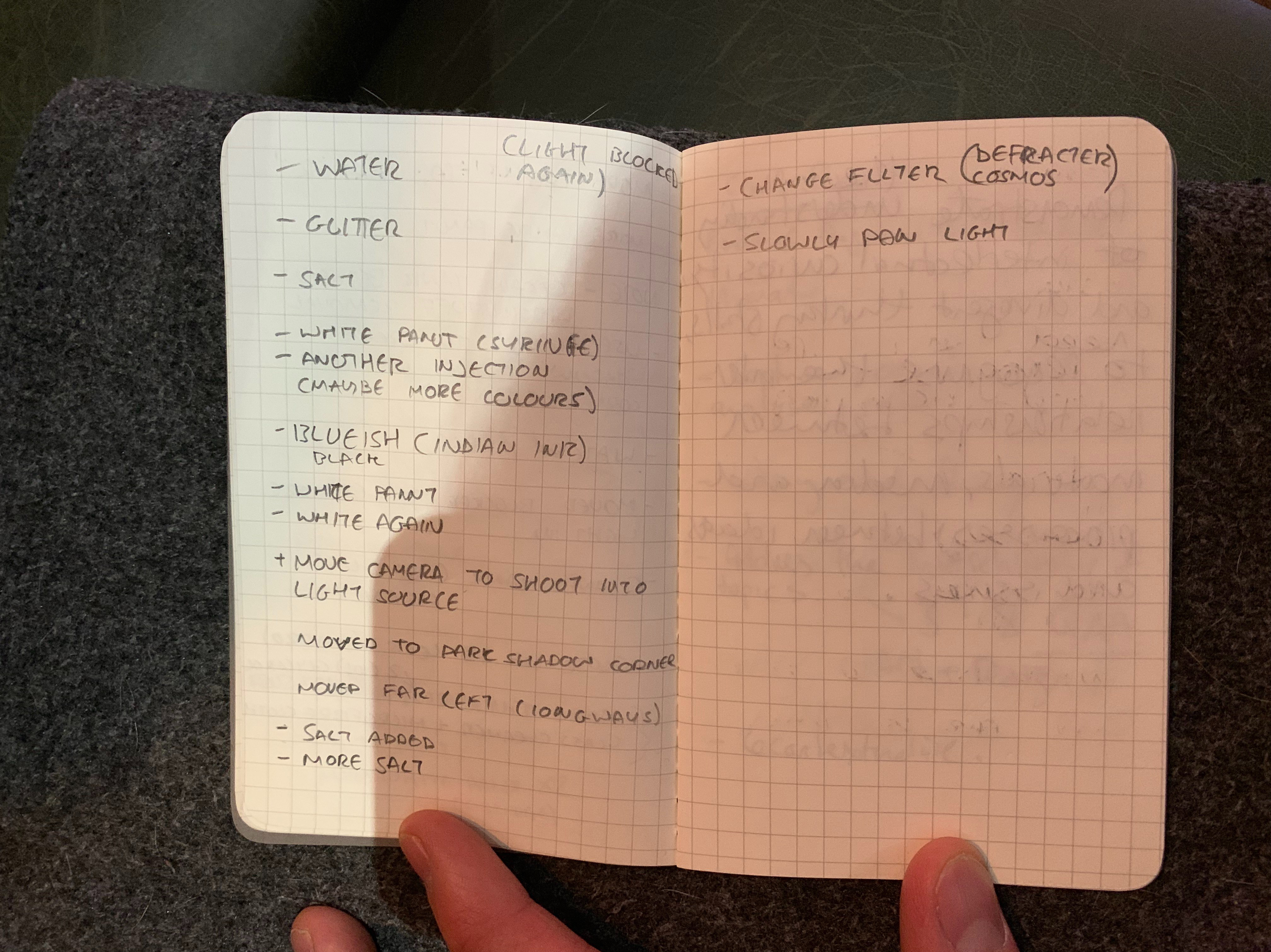
While I mixed the ingredients Callum took charge of camera with Alex providing production duties, including taking the detailed notes that I often forget once I get invested in experimentation.
More notesRecycled oral syringe
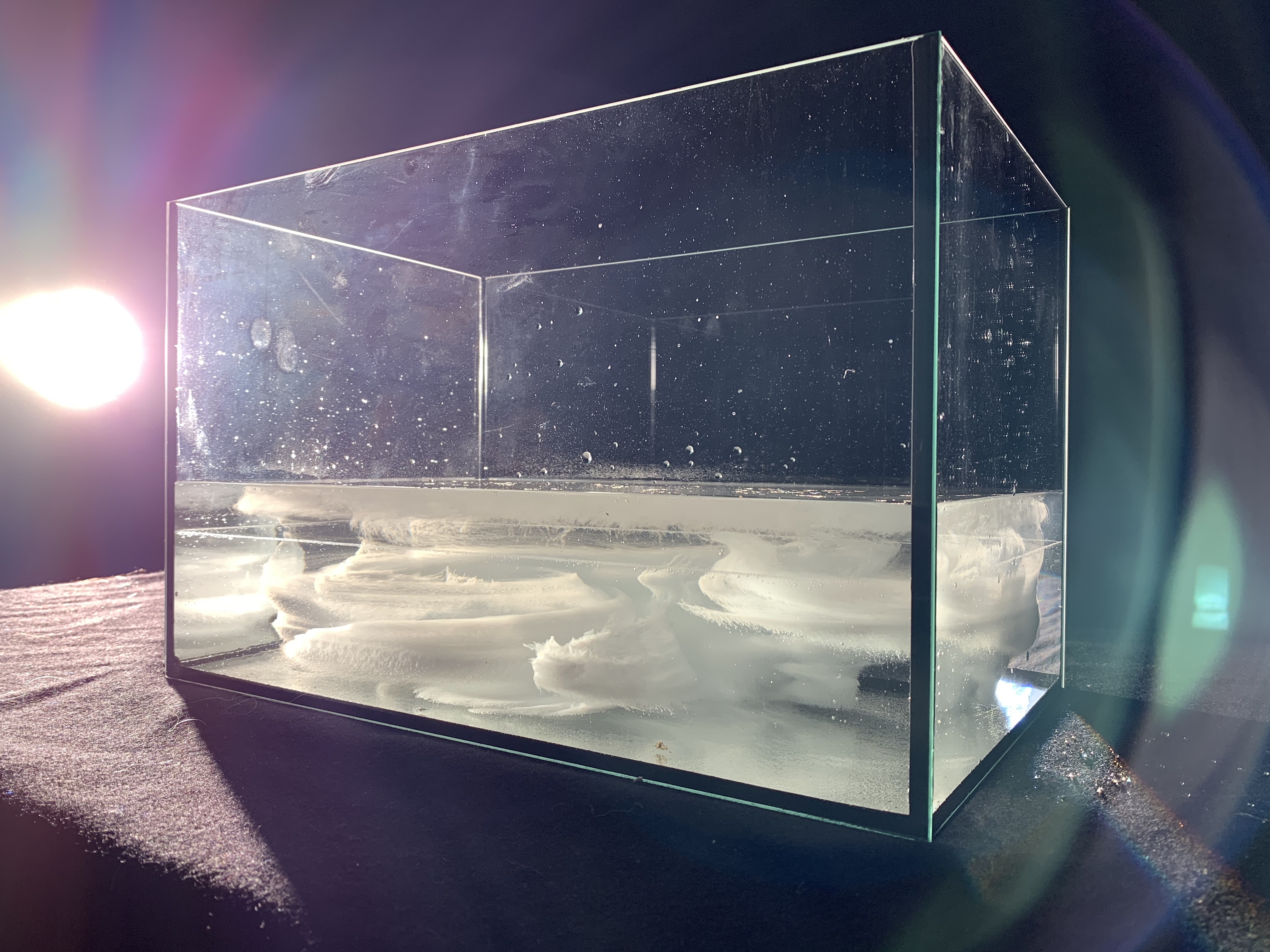
After a few tests adding salt and glitter to the tank to check focus I injected a milky consistency of a acrylic paint into the salt water, this produced some interesting blooms initially and the cloud like swirls as it settled.
We tried to let the camera role until the movement stopped completely as often the gentle swirls were more interesting once the water started to settle.
Acrylic clouds in salt waterAcrylic as seen in the from the Blackmagic Cinema camera – adapted manual Nikon 200mm lens
My initial inspiration for these images was marbling so I had got hold of some (washable not oil) marbling inks, but these just floated on the top of the salt water. We tried adding the corn syrup, this did aid the mixing but the sugars started to crystallise and it quickly became hard to work with.
We were about to clean the tank when Alex walked in front of the light, Callum spotted that the by narrowing the angle of light further it created some really dramatic effects.
Alex the make shift V flatThe corn syrup formed a really distinct layer when the light was just right – again Blackmagic Cinema camera & adapted manual Nikon 200mm lensAlex didn’t have to stand there all day
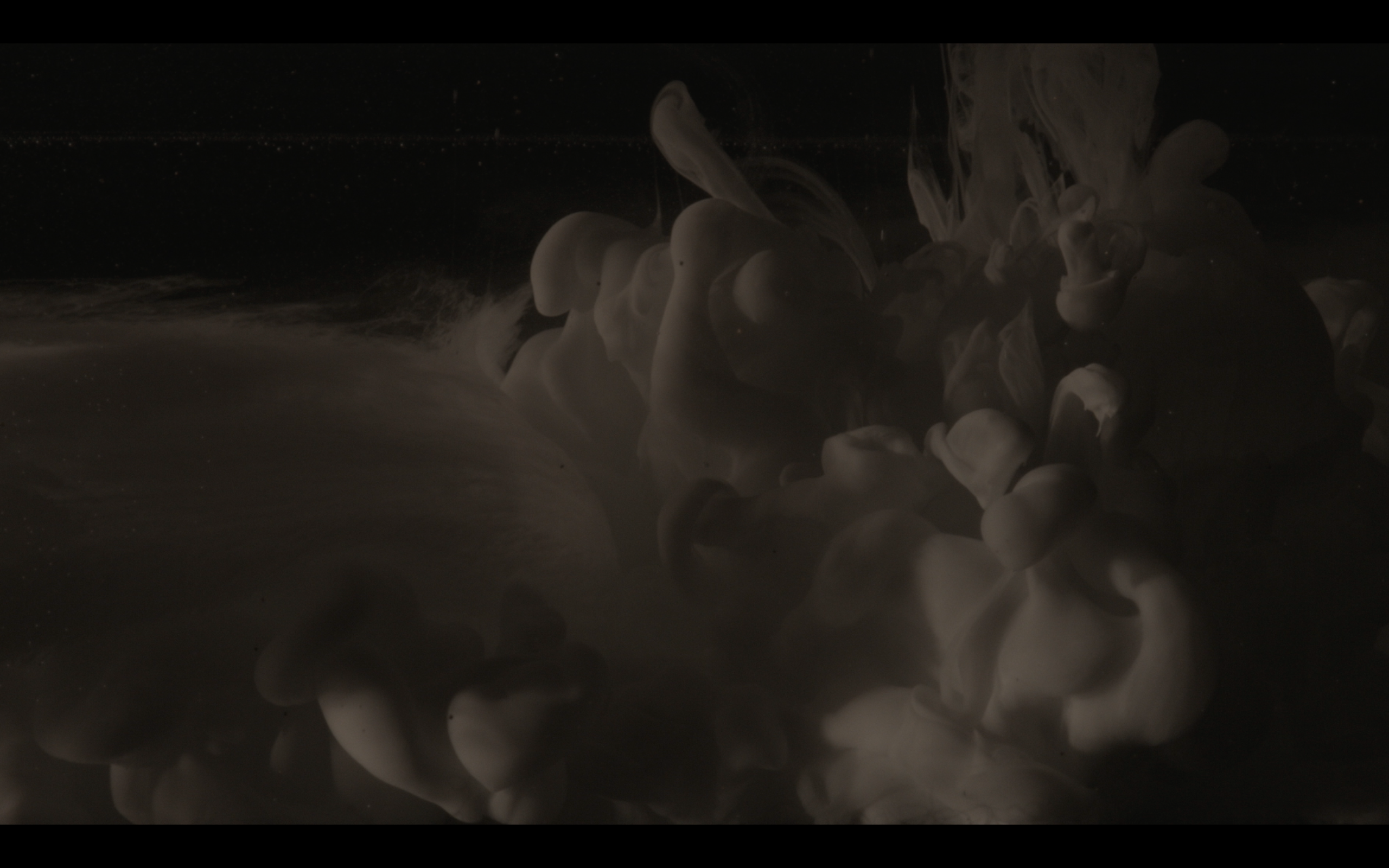
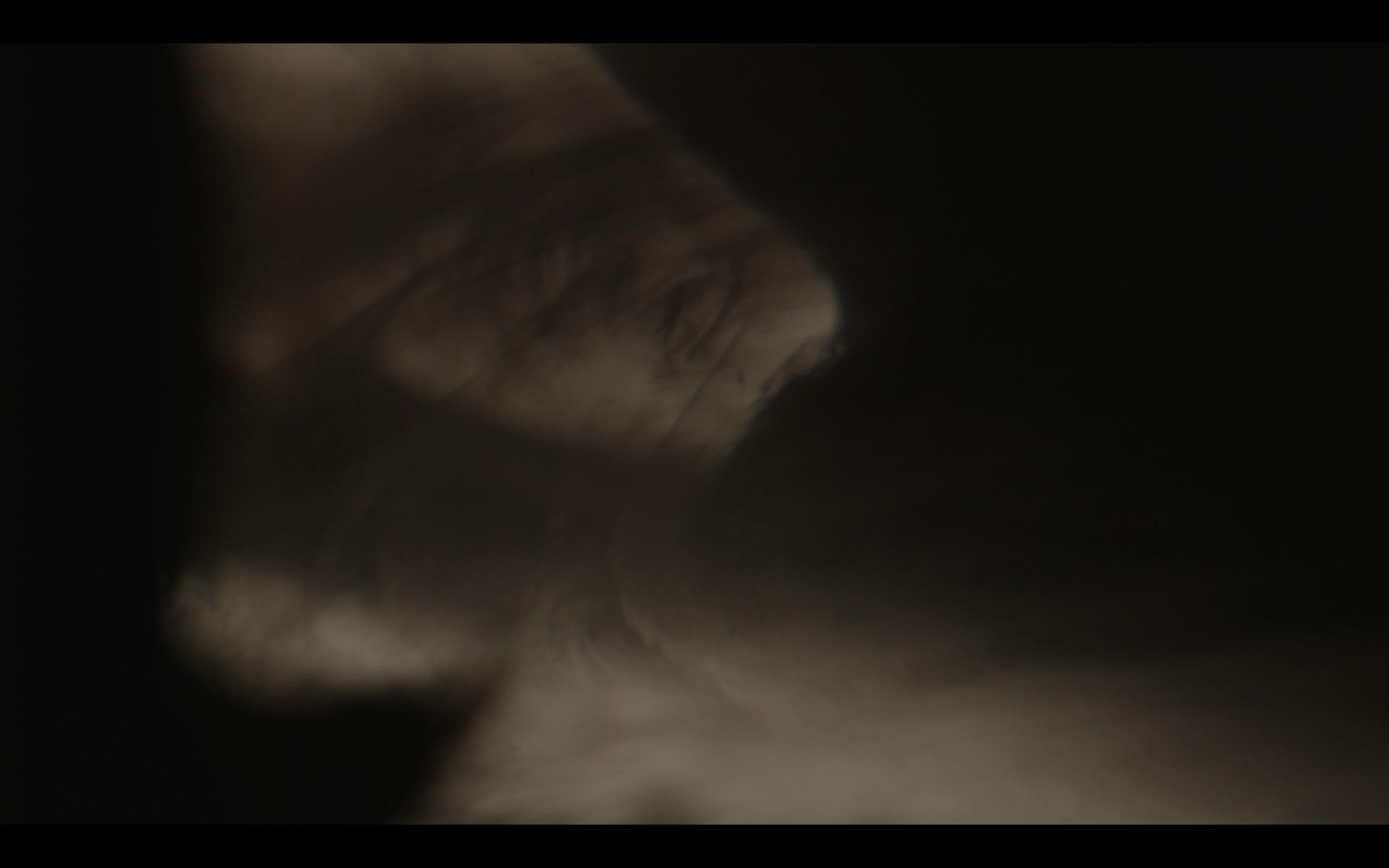
After a difficult tank clean, sugar and yellow ink crust, Callum suggested trying the close-up adapter that he had for the 200mm lens we were shooting with. As well as the white acrylic I also added some black drawing ink this time. With the close-up lenses shallow depth of film this produced some really soft dreamlike images, some of which looked really cosmic.
Trying to focus a manual 100mm lens with closeup filter on dust in a tank of waterWhite acrylic, black drawing ink – Blackmagic Cinema camera & adapted manual Nikon 200mm lens with close-up filterWhite acrylic, black drawing ink – Blackmagic Cinema camera & adapted manual Nikon 200mm lens with close-up filter
Although this was only intended as a test shoot there was some really useful images captured, I have edited these into the audio sequence that I created to get some feedback last week. That feedback was really mixed regarding the synthesised voice with a number of people feeling it was difficult to follow due to the monotonous pacing. I am going to work with it a bit further before moving away from it as I don’t have another direct for the voice over at the moment. I have another day of filming planned next week where I going to work with the glycerol further, the higher viscosity meant that it didn’t ‘slosh’ as much in the tank creating more stable images, the corn syrup worked much the same way but the added cleanup time was not great.
There are problems with using sonification for science but this is art
I thought that this film had some really interesting arguments regarding the problems with using sonification to express data and suggesting that this is the sound of an object. But this is exactly why I want to use it in this film, I want to give an artists impression of gravity, radiation etc. as experienced by the character in one of the only ways that can be represented on film, sound or vision.
In space no one can hear you scream.
Alien, Ridley Scott. (1979).
As the visual language is already fairly developed, there would be no sound to record in space so music inspired by, even driven by these phenomena seems like an appropriate way to deepen the immersion of the experience. As I have looked at in my visual development this is not about reality but rather an interpretation of it as experienced by the character that I am creating.
I am starting to experiment with using different data sources to drive different instruments, similar to the way the plant music was created by different plants playing different instruments.
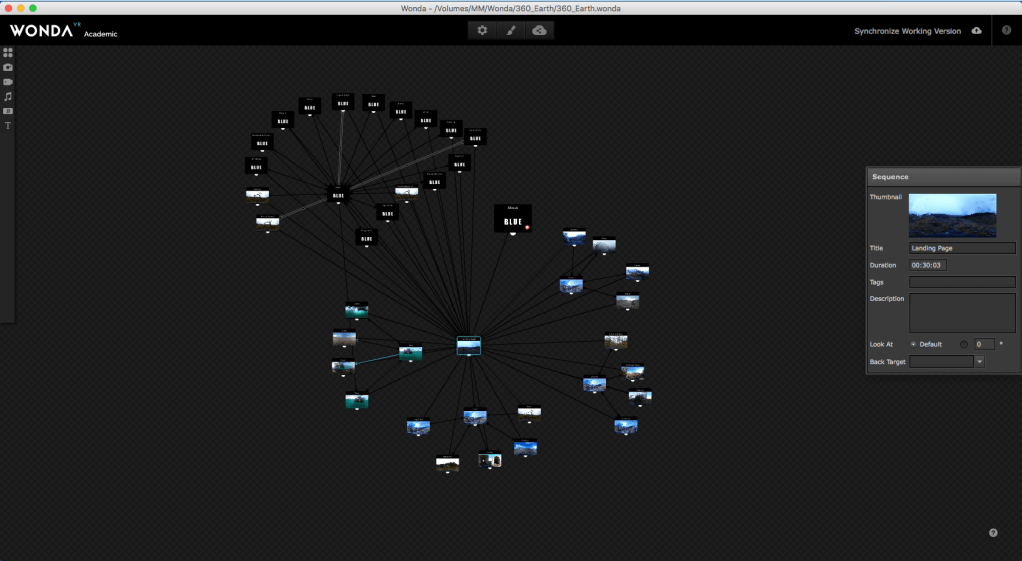
I have spent the last few weeks wrestling with Wonda VR to create the structure to present the 360 experience that the group has curated. It has turned out to really difficult to collaborate on the process of constructing the site as we have not found a good way of sharing and combining the work, it would be really useful to have the ability to distribute this and have different team member submit commits to the code base in a Google Docs or GitHub fashion, but we have’t found a way to do this.
As a result I have done the majority of the layout and connecting work, I have been able to use some of the experience that I gained in the past creating interactive DVDs in DVD Studio.
The concepts of the nodal view where you can see the connections between sequences and check the layout of the project, and a sequence view where buttons, media, and interactivity are edited are largely the same.
I have been frustrated that in WONDA VR may of the keyboard shortcuts that I am familiar with ⌘C (copy) ⌘V (paste) ⌘Z (undo), don’t work reliably, having to work with the mouse has made me feel very unproductive. (This might just be a bug with the copy of the software that I am working with, but it doesn’t make it any less frustrating).
After feedback from Ken last week the landing page has been adjusted to be the about page so that visitors are introduced via an explanation of the project. I have been working to animate this text to bring it to life as part of the interactive experience, but this still requires some refinement.
Work in progress menu screen
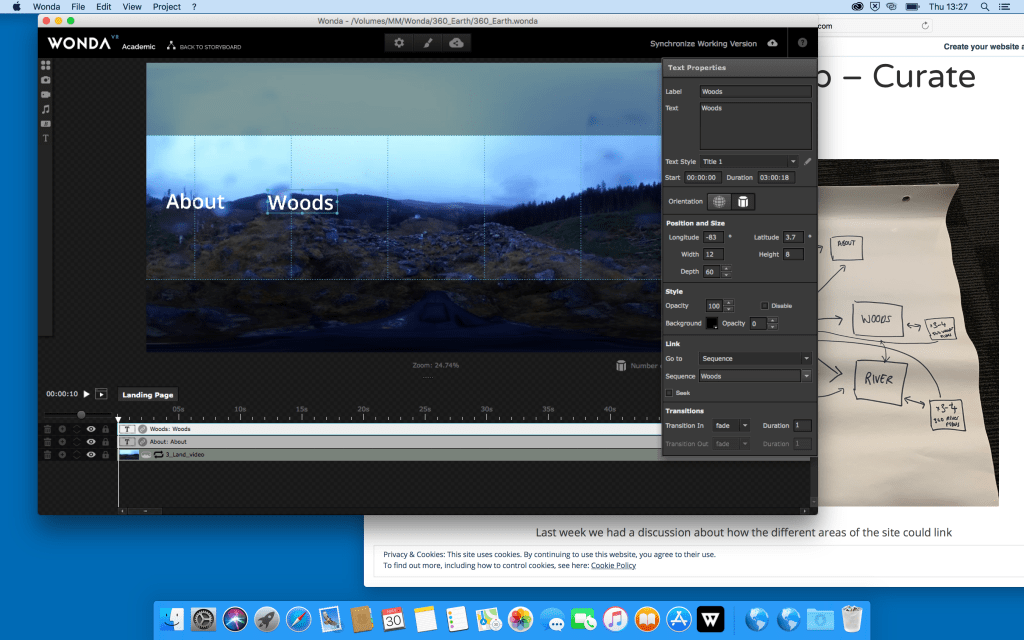
The basic navigation of the site is via interactive text buttons. Something that has been interesting to consider about text is how it is displayed in 360 space. WONDA has two options here one is a spherical layout, the other creates a faceted layout. Initially I was using the spherical layout but once the sequences became more complex the facet layout provides a more organised appearance.
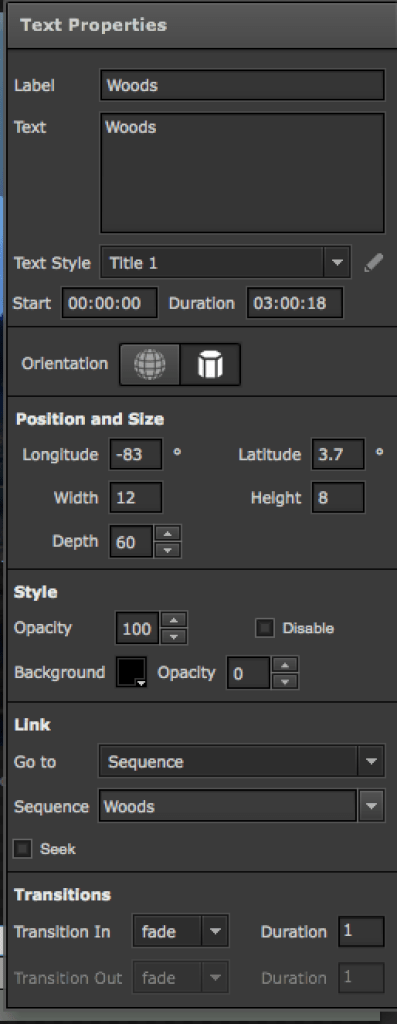
Almost any object can be turned into a button by changing the parameters in the Link section. For internal linking it is as simple as selecting Sequence in the Go to option and the selecting the appropriate Sequence.
In order to show users that an element is actionable (I hesitate to use clickable as the experience is designed to be used with a VR headset on). It is possible to add interactions to elements.
Button Interaction editing
In this above screenshot this interaction shows the Gaze Over state being used to reduce the opacity of an element as it is being hovered over, similar to a mouse hover over but this time with the consideration of it being a VR experience. When the user Gaze Away the element returns to full opacity. I have not been able to test how this works in a VR headset yet and am concerned that I do not fully understand how a hover and click experience differs in this environment. Similar to working with 360 degree video I am finding that there are many skills that I have developed on previous projects that need subtle reconsideration when working in VR.
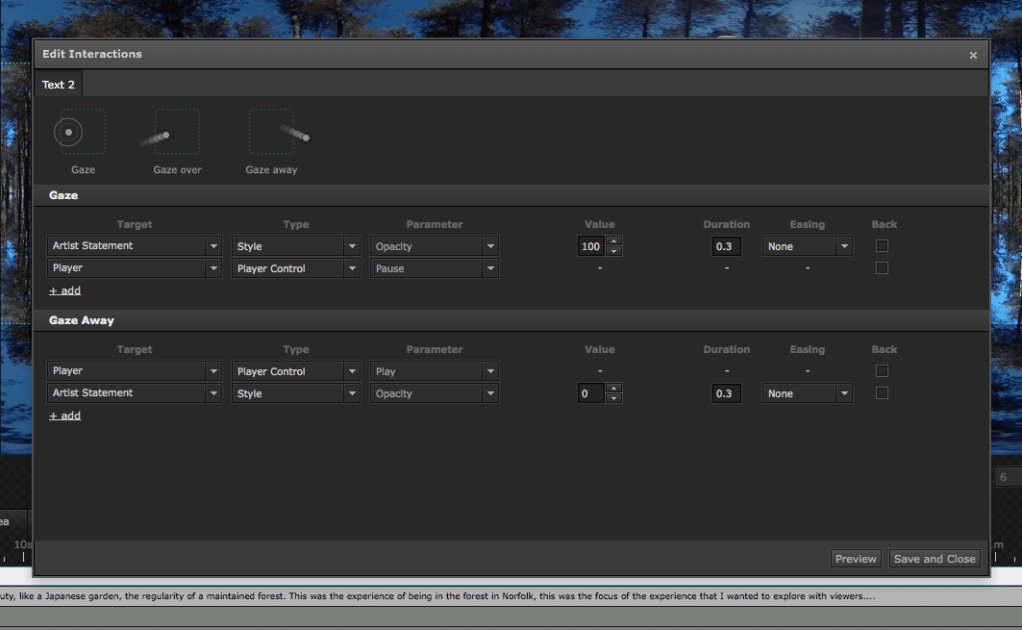
Below is an example of an experience that I have been experimenting with for displaying artists statements over their poetic films. When a viewer Gazes (clicks) the text ‘Artist Statement’ the paragraph of artist statement with fade in (increased opacity), and the video pauses. When the viewer has finished reading they simply Gaze Away , the paragraph disappearsand the video starts to play again.
Artist statement Interaction editing
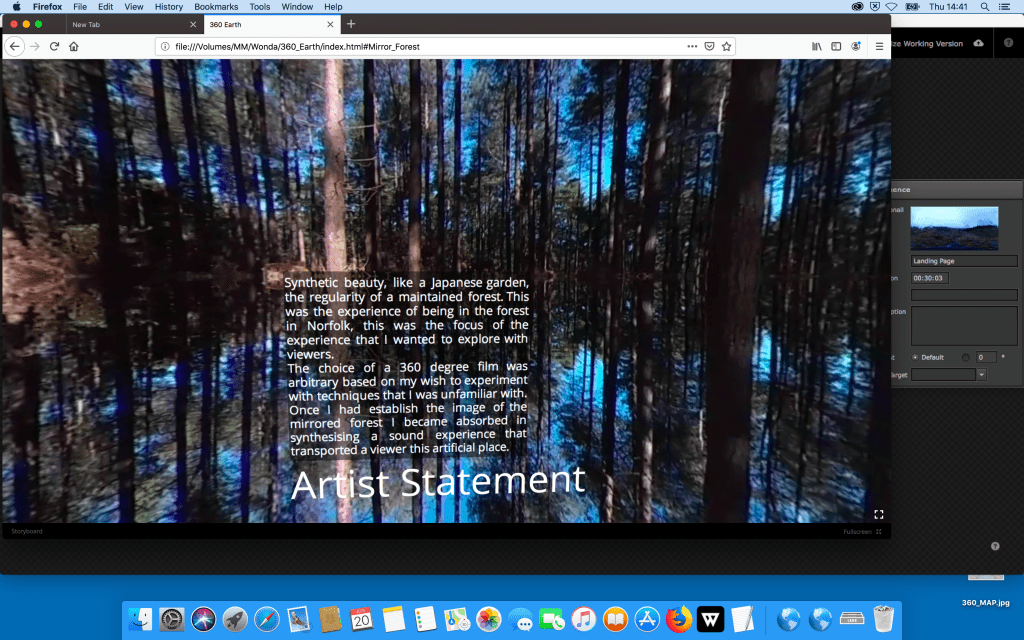
This shows what it looks like in a web browser, the semitransparent background behind the white text helps with legibility, in a VR experience the text is bigger due to the field of view.
Example artist statement view
Although it would have been enjoyable to collaborate more on the construction process there has been a good team dynamic with peers creating different sets of the assets and giving feedback on the layout. This has been essential in allowing me to focus on the fiddly task of connecting all of the buttons and sequences and allowing me to experiment with the interactions. This has been another opportunity to explore an area of media practice, an interactive experience, that I feel I have neglected recently.
As well as the practical tips of how to achieve some of the effects which are eerily similar to what I already had in mind, there is a clear articulation of why I want to shot my film in a similar way.
Making space tactile and visceral rather than digital, I see as a way to bring about a physicality that is counterpoint to the internal nature of the voice over. It is an attempt to make the conceptual tangible.
Continuing to explore the topic of human relationships to machines I came across so MIT research that is creating plant-machine interfaces; Cyborg Botany.
The comment in the second video of the agency belonging entirely to the plant struck me. It seemed to link back to the discussion of the A.I artist, I tried to consider if the A.I artist had the power to direct the decisions in that scenario or if they were following the algorithm.
I tried to create a simple flow diagram to consider where the ‘agency’ might come into the creation process.
The seemingly obvious place for the agency to occur would be during the processing of the digital signal by the algorithm, but this would only be the case if this was not deterministic. It the same input always led to the same output then it would seem that no decision making was happening. This would be no different that running a filter on an image.
I tried to think about my own creative process, why do I think that I have agency in my creative decisions, I have tried to illustrate this in the diagram above, it feels like it is something to do with taking inspiration and then doing assessment, comparison, and clarification with this, it is not a direct processing but rather intensional decisions are being made. I thought about this in the context of human artists working with randomness, algorithms, or abstraction, it seems that there is still a processes of informed choice to work in this way, to direct the development of a process when it seems to be expressing something.
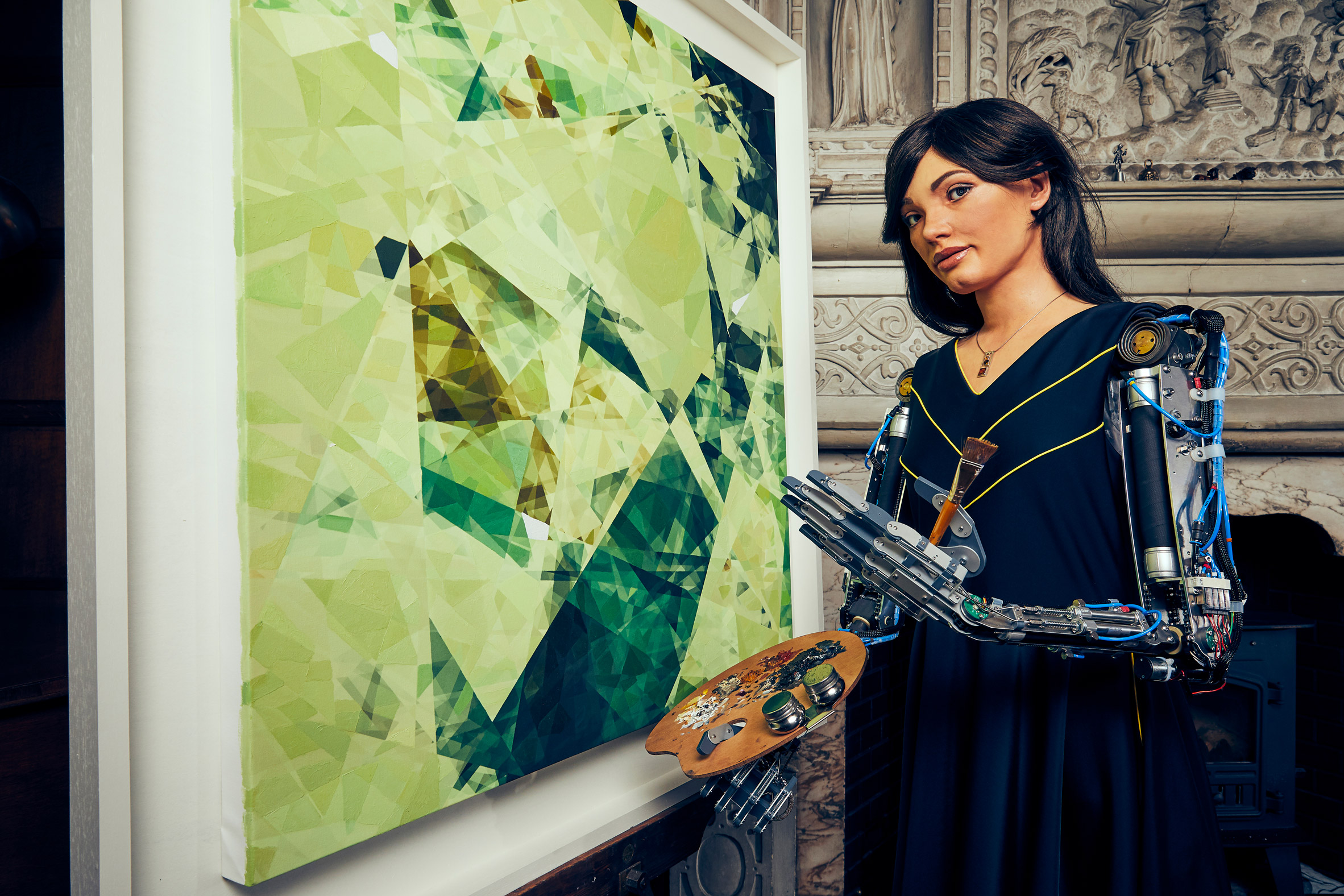
Aidan Meller is a specialist in modern and contemporary art who runs a gallery from Oxford and London. He said: “Pioneering a new AI art movement, we are excited to present Ai-Da, the first professional humanoid artist, who creates her own art, as well as being a performance artist. As an AI robot, her artwork uses AI processes and algorithms. The work engages us to think about AI and technological uses and abuses in the world today.”
As a counterpoint to the creativity of the A.I artist are the algorithms that are collecting sorting and processing the trails of data left behind by our 21st Century digital lives.
No two companies have done more to drag private life into the algorithmic eye than Google and Facebook. Together, they operate the world’s most sophisticated dragnet surveillance operation, a duopoly that rakes in nearly two thirds of the money spent on online ads. You’ll find their tracking scripts on nearly every web page you visit. They can no more function without surveillance than Exxon Mobil could function without pumping oil from the ground.
There is a reoccurring narrative at the moment that there are risks associated with the reduction in privacy that results from this data collection, and privatisation, I found this article our it succinctly.
My own suspicion is that ambient privacy plays an important role in civic life. When all discussion takes place under the eye of software, in a for-profit medium working to shape the participants’ behavior, it may not be possible to create the consensus and shared sense of reality that is a prerequisite for self-government. If that is true, then the move away from ambient privacy will be an irreversible change, because it will remove our ability to function as a democracy.
It doesn’t seem to be a new idea, Foucault was discussing it before the contemporary advances took place.
Foucault argues that the use of disciplinary power has extend everywhere in society – it is not only in prisons that disciplinary power (surveillance) is used to control people; and it is not only criminals who are subjected to disciplinary power.
I found the parallel drawn between the environment and privacy to be compelling as a concept.
All of this leads me to see a parallel between privacy law and environmental law, ①another area where a technological shift forced us to protect a dwindling resource that earlier generations could take for granted.
The idea of passing laws to protect the natural world was not one that came naturally to early Americans. In their experience, the wilderness was something that hungry bears came out of, not an endangered resource that required lawyers to defend. Our mastery over nature was the very measure of our civilization.
It linked to something that I have been considering when writing the script for my current film. Life needs resources to continue but these resources are dwindling, as we master our environment we can control it more completely, but this process of claiming controlling is reductive, it destroys the delicacy and beauty of the original thing. There are already those who are concerned about how we will consume the solar system once we reach out into it.
“On a timescale of less than a millennium we could have super-exploitation of the entire solar system out to its most distant edges,” the authors wrote. “Then, we are done.”
As I have noted during the development of other projects this year I am really interested in discussions of authorship and alternate voices. I have been looking for ways to explore this through the narration in the my current project. Rather than a specific point or idea that I want to express this project seems to be a series of questions that I want to ask.
Ai-Da’s drawings are fed into AI algorithms to create abstract paintings. Photo by Nicky Johnston via Dezeen
I came across this article about an Artificial Intelligence Artist in my RSS feed.
Manufactured by a team of engineers specializing in robots with human-like features and using algorithms developed by scientists at Oxford University, Ai-Da captures images in front of her with a camera in her eye. A series of algorithms then send instructions to her robotic arm and hand, which was created by students based in Leeds, U.K. Ai-Da takes her name from Ada Lovelace, the world’s first female computer programmer
This collaborative creation process reminded me of the question that I asked about the discoveries made by satellites, whose discoveries are they? The algorithms and robotics are designed and created by humans, it could be argued that Ai-Da is a complex paintbrush.
A painting created using data from Ai-Da’s data response to an oak tree Victor Frankowski via Time
Algorithmic and process based artwork is not new, part of the quest of abstraction and conceptual art is the distancing of the artist from the work.
The complex visual output is printed onto canvas, where a human artist then paints over part of the canvas. “The potential for technology to augment the human potential for creativity, to expand the achievable horizons of creative expression and to possess its own creative potential as an entity of its own is so fascinating and exciting,” says Aidan Gomez, a researcher at Oxford working on the project.
Duchamp used ready made objects, Warhol used techniques of mass production. What is it that makes this the work of an AI artist?
“What’s intriguing here [with Ai-Da] is that people get very taken in by a robot that looks human,” says Marcus du Sautoy, a professor of mathematics at Oxford University
On a similar train of thought I found a podcast about an audioartist creating plant music.
Data Garden Plant Music
The music is created by connecting four plants to different synthesisers via a midi interface. The changes in the plants biology are reflected in changes to the midi notes that play the synthesisers. Are the plants playing the music, or are they generating a random sequence that drives an instrument programmed by a human? The creators of the midi sprout suggest that changes in the environment, such as the presence of people, change the rhythm of the plant and this changes the performance.
I am not going to pursue this idea of automation or distance in the piece that I am working on at the moment, the opposite I want to be as hands on as possible with the creation of the sounds and images for this film. What I am inspired by here is how these questions inform the voice of the narrator from the end of the universe. The voice is that of an A.I created by humanity the has outlasted them and grown beyond them.
Blade Runner – Ridley Scott (1982)
I’ve Seen thing you people wouldn’t believe.
Blade Runner – Ridley Scott (1982)
I want to use this perspective to question our relationship with what we make, how we live, the choices we make individually and collectively.
I have been puzzling over the gender of the synthesised voice that is going to provide the narration for the film. The question was how does it change the reading of that voice depending on the gender. What are the implications of each choice?
I worried that if the voice was male then it would seem like I had not considered the choice, it was male because I am male, science is male, men explore.
I worried that if it was female then it would sexualise the object, not was female because ships and car are female, objects.
Watching a film created by one of my students that presented a montage of feminists speaking about the need to keep addressing issues of representation I came to my solution.
The voice will be male, and the character will call out the decision in the film. The voice is male because in the early 21st century a male voice has more power still.
I’m not sure how elegant this solution is but I feel it fits with some of the other questions in the film.
Whilst searching for some clarification about entropy for the script for my current project, I ended up down a path looking at dirt and came across this article looking at the work of Mary Douglas.
“the old definition of dirt as matter out of place.”
Ben Campkin (2013) Placing “Matter Out of Place”: Purity and Danger as Evidence for Architecture and Urbanism, Architectural Theory Review, 18:1, 46-61, DOI: 10.1080/13264826.2013.785579
This idea caught my thinking as I was considering someone teetering at the end of existence looking back, if we take mater literally, the stuff of the universe, when is it out of place? Campkin’s article considers how Douglas explored this.
Yet, there is no such thing as absolute dirt—it is a matter of perception and classification.
Campkin (2013)
There is an argument within cosmology that as the universe expands and cools the entropy will increase until everything is uniform, I was intrigued by the though experiment of someone at this point looking back, there are no stars, no lights, endless sameness, flatness. Would this sameness appear organised or disorganised? This state would provide no energy for sustaining life. This bought to mind the obvious Dylan Thomas reference.
Do not go gentle into that good night… Rage, rage against the dying of the light.
Do not go gentle into that good night – Dylan Thomas
This seemed like a motivation of this film that I am developing, the character standing at that end point looking back wanting to send a message that might outlast them as the lights go out, to leave something behind, to not be forgotten, to be heard.
In this, the researcher (Douglas) embedded herself within an environment characterised by its “otherness”, often for years at a time, in order to understand people in relation to the region in which they lived, their kinship relations, their politics, language, economy, technologies, and so on.
Campkin (2013)
This argument summarises for me why consideration of dirt is important, what is considered clean/dirty, good/bad, beautiful/ugly is not inherent, within different cultures and communities this is set by the power systems.
This has implications for whose voice is heard and how that voice is classified.
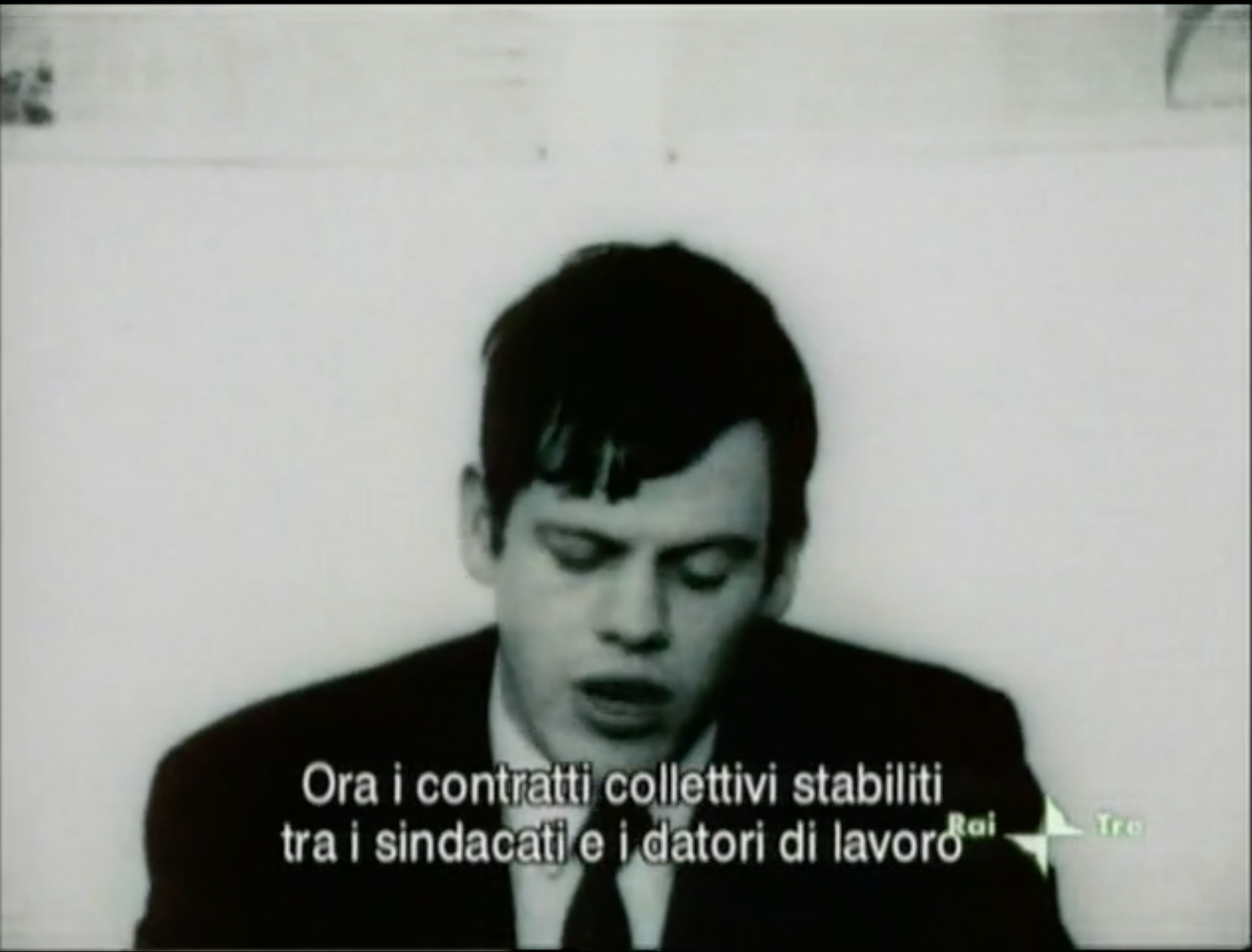
Whilst watching British Sounds (Jean-Luc Godard, 1969) again I a section that felt made an interesting manipulation with the idea of truth.
Interview at 18:55 – British Sounds (Jean-Luc Godard, 1969)
The interview around 18:55 is not contextualised we are not told who the speaker is, who or who they represent, there is something immediately unsettling, not just about what is being said but also, how, and by who. I came to a conclusion that it is a revolutionary student reading back a speech or press release by a member of ‘the establishment,’ however this idea is challenged as the lecture becomes more unreasonable in the statements that it makes as it progresses. In a section about Vietnam …
“it it is sometimes necessary to cut off breasts… we don’t like coloured people.”
British Sounds (Jean-Luc Godard, 1969)
British Sounds (Jean-Luc Godard, 1969)
The juxtaposition seems to come from the fact that we have been taught that voices in documentaries have authority, the film-maker believes they represent an important point of view, but the speakers dishevelled appearance challenges this assumption, as does the extreme nature of the speech, this seems to confront the ‘truth’ of the image or images, if this can’t be trusted then what can?
I am developing an idea regarding anthropomorphising a machine I feel that this idea of alternate histories and truths is an important question.
In his own way, Farocki’s work fulfils another wish for the essay film expressed by Tracy that I share, to see the image “as part of a matrix of meaning that extends beyond the screen.” This takes me back to this article’s starting point in the contemporary morass of online clip compilations and fan tributes that pass as essays, and what alternative mode of media could place us in a more critically aware position with regard to how media functions in our lives, where it comes from, what larger forces are behind its dissemination and our consumption of them.
This this passage there are number of points that relate directly to my own motivations for film-making. The first is the idea of “a matrix of meaning”, human knowledge is constructed from web of infinite complexity, it is now impossible for any one person to completely know, let alone understand all of this, we must rely on the supportive network of others to situate or own thinking, but also it seems impossible that alone reading our work will have an identical network in which to decode the work we have created from the screen. In this way the meaning that they decode is likely to diverge base on the amount of difference in that network. Although this is stretching Hall’s (1973)Encoding and decoding in the Television discourse, I feel that it is a useful reference point for the discussion because there is a balance between the hegemonic power of the major culture and the individuals agency, and attempts to weight those relative power positions. This brings me to the second point that I feel is significant “place us in a more critically aware position”. Having the power to create a piece of work infers the responsibility in how that power is used, a potential response to this situation is to attempt to raise awareness of how the complexity of these textual interactions.
In this way, the essay film might realise a greater purpose than existing as a trendy label, or as cinema’s submission to high-toned and half-defined literary concepts. Instead, the essay film may serve as a springboard to launch into a vital investigation of knowledge, art and culture in the 21st century, including the question of what role cinema itself might play in this critical project: articulating discontent with its own place in the world.
This is a long narrative as I try to explore why it is that I want to explore some of the ideas that have driven me to work on this film.
I thought that technology would bring a better future, but by the time some of these things were realised but it isn’t so clear cut. The future turned out to be messier than the narrative that young me dreamt, and was sold.
During my formative years, I had trouble sleeping, when I woke early in the morning I would creep downstairs, pour myself a bowl of breakfast cereal, and watch Open University broadcasts on our Television (I could barely understand any of it but it was often the only thing on at the times I woke).
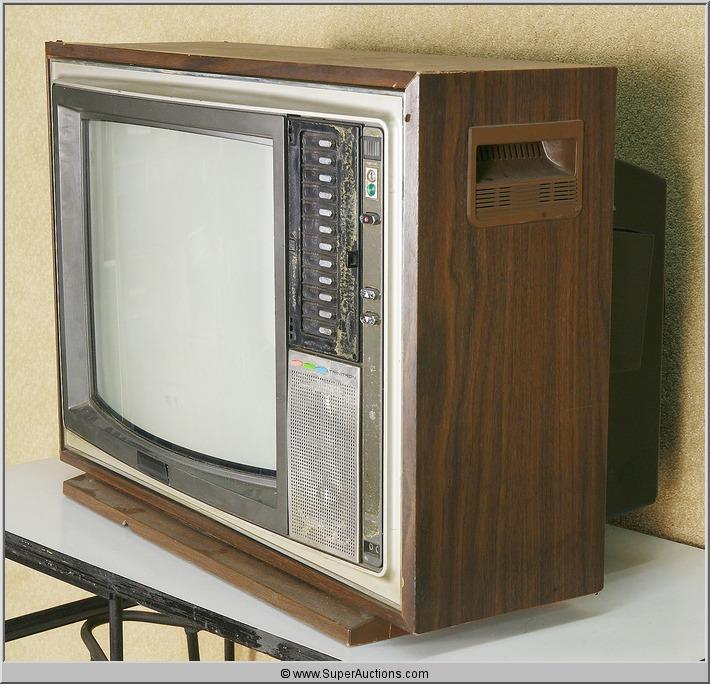
Our TV was faux wood panelled, and needed the channel changed by pressing buttons on the set, it took 2 people to lift it; it wasn’t technology, it was furniture.
Not the actual TV but fairly close with the push buttons for channels
In those Open University broadcasts there was technology, depending on the morning there was physics or biology with machines that looked like they came from the future. In the evening there was Tomorrow’s World.
High Tech was the style, new things were made of plastic (preferably black), and chrome. Friends and family had weird pieces of 60s and 70s furniture around, with curiously futuristic aesthetics, we had the wood panel TV, but that was OK we would catch up with the future.
Cheaper, cleaner, faster, more available, more ubiquitous, more democratic, more accessible, fairer.That was the future that I dreamt of. As the wrecking balls tore oppressive landmarks, and dark underpasses were filled in my home of Birmingham new glass fronted building and cobbled pedestrian zones replaced them I thought it was arriving.
The internet also represented a connection to a wider world, information, possibility, opportunity, so much possibility I had no idea what to do with it. Once we had it at home I remember dialling up and logging on just because I could, I don’t have anything to do, I didn’t know what I could do, I just liked being online.
This now seems to fit with a narrative of Technological Utopianism.
The dirt, noise, and chaos that invariably accompanied industrialization in the real world were to give way in the future to perfect cleanliness, efficiency, quiet and harmony…Connecting all sectors of the technological utopia would be superbly efficient transportation and communication systems, powered almost exclusively by electricity. These systems would enable widely dispersed citizens to live and work wherever they might choose. As one of them puts it, ‘we have practically eliminated distances.’
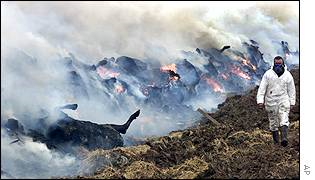
Of course I was naive, most children are (and should be), I am writing this down because I want to understand the place that this film is coming from. As I became more aware of the world outside the small bubble of the British Midlands this complicated that future, not just a string of high profile; shuttle disasters, gulf wars, the BSE/CJD crisis, September 11th, financial crash, 2016. But also a growing awareness of inequality and consciousness that there were a plurality of ways of interpreting things rather than just a dominant voice, (thanks history of art lessons).
Cattle burning during 1996 BSE crisis – this had a huge impact on my world view
Films like Blade Runner (Scott, 1982) bought to my attention the concept of dystopia. I wanted to understand how a world full of vibrant neon signs and flying cars could be anything but wonderful.
Dystopia in Blade Runner (Scott, 1982)
This led me to discover Constantinos Apostolou Doxiadis and his work on Ekistics. I was drawn in by his book Between Dystopia and Utopia, this was one of my first introductions to modernism and the idea that design can bring about positive change. I failed to see the potential failures or abuses of these ideas, where does control lead.
The freedoms that the internet seemed to offer have been co-opted to create a system of commerce and coercion.
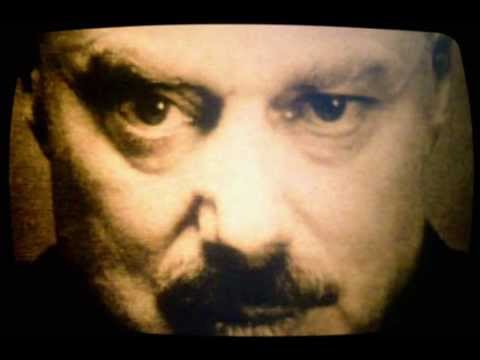
This architecture produces a distributed and largely uncontested new expression of power that I christen: ‘Big Other.’ It is constituted by unexpected and often illegible mechanisms of extraction, commodification, and control that effectively exile persons from their own behavior while producing new markets of behavioral prediction and modification. Surveillance capitalism challenges democratic norms and departs in key ways from the centuries long evolution of market capitalism.
Zuboff, Shoshana, Big Other: Surveillance Capitalism and the Prospects of an Information Civilization (April 4, 2015). Journal of Information Technology (2015) 30, 75–89. doi:10.1057/jit.2015.5. Available at SSRN: https://ssrn.com/abstract=2594754
Space exploration represents for me the technological optimism of the 20th century, we will find the answers so long as we ask the right questions. I want to believe this, but I’m not sure I still do. Young me was sure that we would be regularly visiting the moon, but as of May 2019, we still haven’t been back since Apollo 17 in 1972, and the US hasn’t ferried their own astronauts to space since 2011.
This I find a deeply contradictory position, I am still seduced by technology and the positive potential of it, I feel that in science and technology is a potential salvation, but I am aware of the current inadequacy of of social, political, and personal relationships with it. As Foucault discusses there doesn’t seem to to be one coherent version of self with a completely consistent personal philosophy. The versions that we present to other people are highly contradictory, I believe that it our right to be contradictory, but that we should acknowledge and explore those inconsistencies. As an artist I think it is important to explore with our personal contradictions, to reason with them.
I’m Vegan but believe in being polite and eating food that is cook for you with love and generosity.
I believe in freedom of speech, love, and expression, but sometimes wish that people wouldn’t shout about it when I’m around. Who doesn’t want a quiet life.
Does the rise of surveillance put at risk our right to be inconsistent?
Ken’s post about Pantenburg pushed me to question why I still wanted to wanted to work on a traditional 2D screen, why is the silver screen in the dark still so alluring to me
Post-Cinema? The Dissolution of Limits in Film (Dr. Volker Pantenburg und Simon Rothöhler, M.A.) Film-theoretical analyses of »post-cinematographic« constellations usually tend to render their rhetoric of rupture plausible through references to film’s double detachment: (1) from its historically-developed performance apparatus (cinema space, projection, establishment of a specific form of publicity with a defined set of social practices and rituals); (2) from its photographic supporting material (celluloid, indexical image registration). According to this argument, the contemporary »cinema without walls« is not least the product of a movement of boundary dissolution which has undermined the privileged significance of the institution of the »cinema« in favor of the audiovisual complex known as »film.« This development corresponds to a process of differentiation of the forms of experience of the filmic, one that has been reorganized, on the one hand, in multimedia screening windows (video iPod, computer, cellphone, home cinema), and on the other, has been increasingly and paratextually connected with a diversity of non-filmic media commodities. Both processes have replaced film as a »self-contained commodity« (its commodity form at the end of the period of early cinema), and successively transformed it into an fundamentally less stable »intertextual commodity.« In light of these multiple screens and in light of economically and socially reconfigured modes of reception, but also in light of the numerous projected images found today in museums and galleries, the question poses itself of the status of the displacements and multiplications of cinematographic apparatuses and the qualitative novelty of the aesthetic practices associated with them. At the same time, this analysis must integrate »post-cinematographic« relativizations, and the continuities involved must be emphasized. This entails, for example, the generally questionable nature of an ontological break between photographic and digital forms of film. This project will explore the poles and dimensions of the diversification of the cinematic apparatus and will, with reference to both filmic art installations and contemporary commercial blockbusters, investigate the ways in which concrete filmic practices render these transformational aspects aesthetically productive. »Post-Cinema? Entgrenzungen des Films« is part of the sub-project B3 of the Collaborative Research Center 626 »Aesthetic Experience and the Dissolution of Artistic Limits« at the Freie Universität Berlin headed by Prof. Dr. Gertrud Koch.
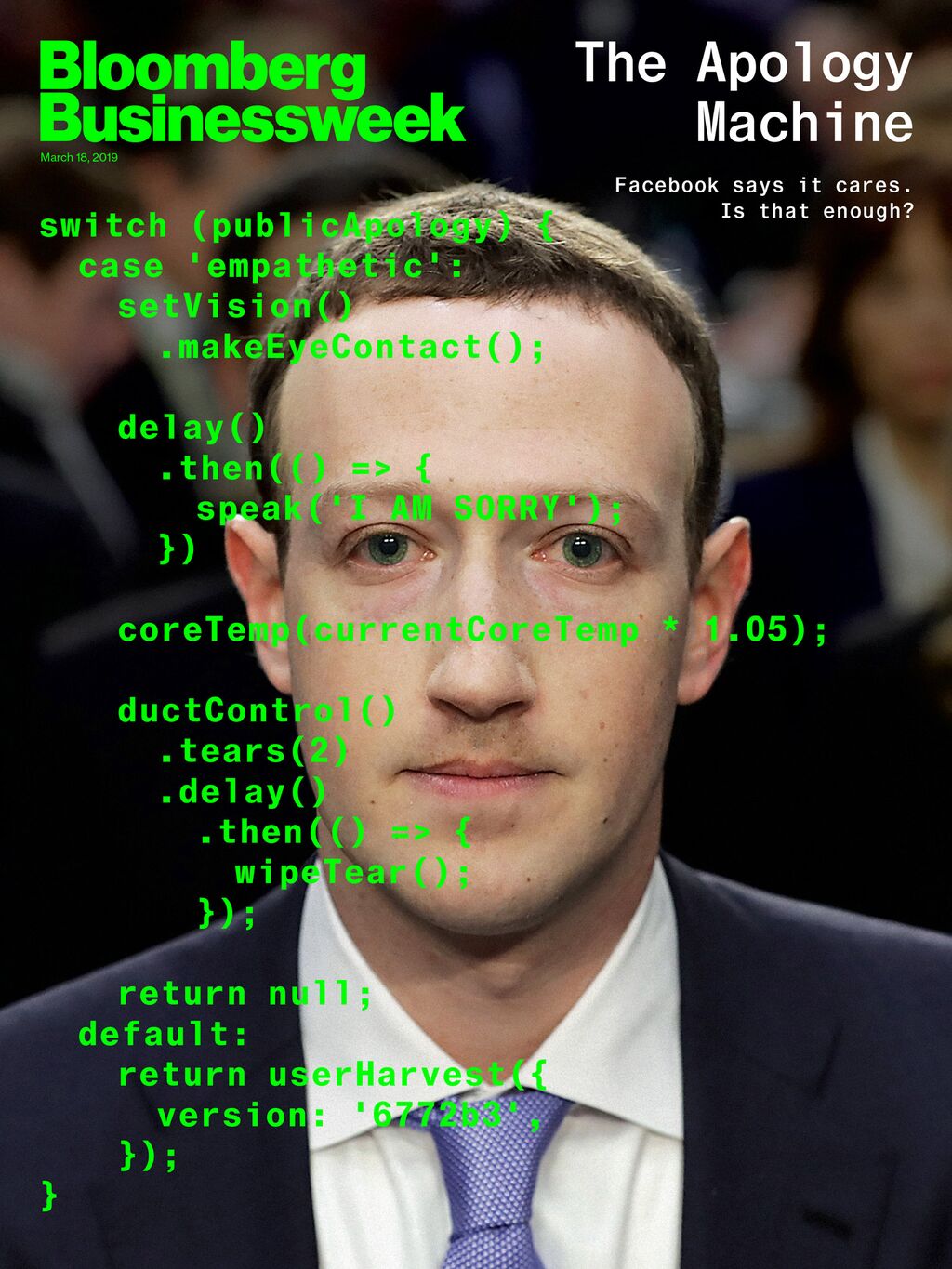
If Facebook wants to stop those things, it will have to get a better handle on its 2.7 billion users, whose content powers its wildly profitable advertising engine.
There is something about the ritual, as Pantenburg puts it, that gives a form and structure to a cinematic experience that I find to be a useful framing device for developing ideas. An audience comes to a cinematic experience with certain codes and conventions, following or challenging these in service of an idea then becomes and artist choice that is part of the spectrum of cinematic language.
"Nobody in the country knows what's going on… and YOU know nothing about what's going on, even inside the Cabinet!"
I nearly posted a link to this article a few months ago, I was interested in the way that the ubiquity of video capture and distribution technology makes this kind moment part of a historical archive, John Akomfrah’s point about historical documents that capture and preserve a moment. I missed posting it in a timely manner at that time and I felt that the moment t had gone. Now considering why I want to create a conventional cinematic film I realised that it was relevant again, like other social/viral videos as quickly as it became a conversation point so it was replaced by something new, although the moment was archived the context of its reception changes our consumption of it, it becomes consumable, a quick snack.
One of the clear design and practical influences for my final production is HAL 9000 from 2001: A Space Odyssey (Kubrick, 1968).
I am really interested in the way that HAL’s eye seems to mirror the mechanical eye that I was discussing in my post earlier in the year.
But can we say that this is our discovery, second hand with voyagers eyes?
In the Kino film I became entangled with discussions regarding my own subjectivity, which I still think is a question in this film, especially as I am creating a character from/of Voyager, but I want to try and expand the view point to consider a wider notion of subjectivity.
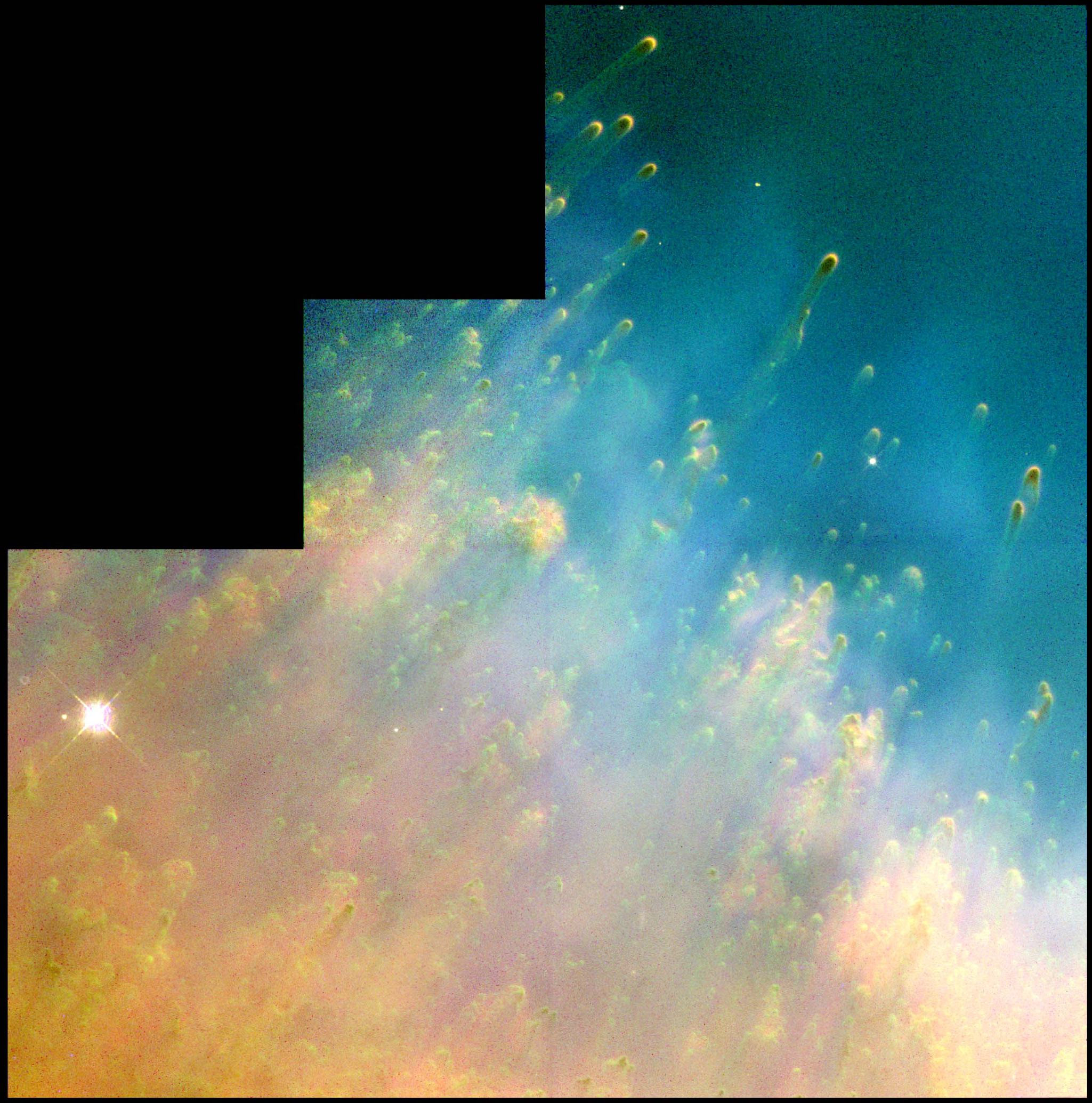
One way that I am thinking of exploring this is by trying to recreate images that are suggestive of celestial phenomena, planets, gas clouds, rather than using archive images.
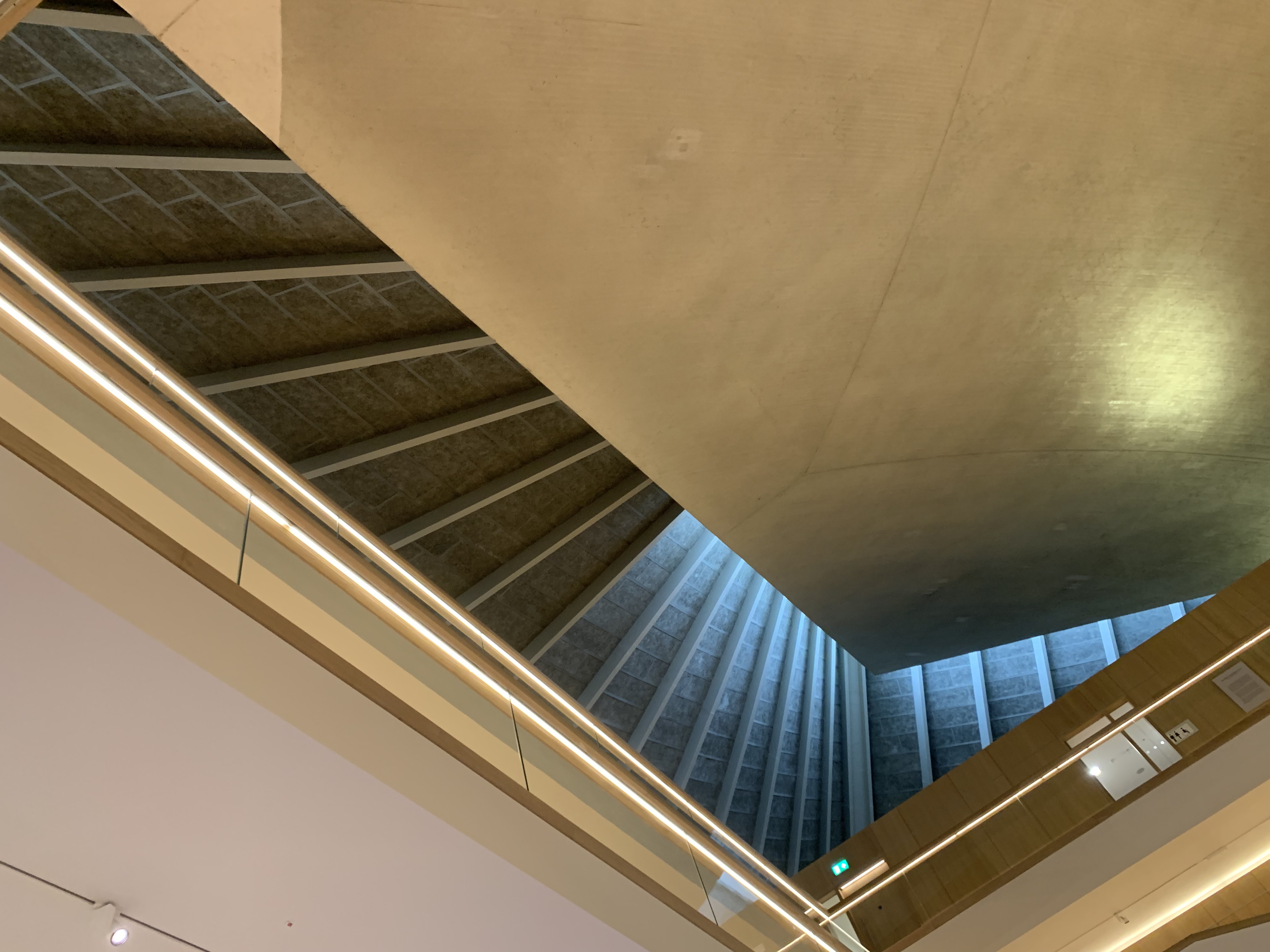
On Friday I visited the Stanley Kubrick exhibition at the London Design Museum. I was very excited as Kubrick is one of the reasons that I wanted to make films in the first place (shortlist of influences: Blade Runner, A Clockwork Orange, the making of featurettes on the the Star Wars Episode I DVD).
Introduction to the Kubrick Exhibition
The exhibition begins with a video wall to highlight Kubrick’s use of centre compositions.
The following gallery focuses on Kubrick’s development process, and tools.
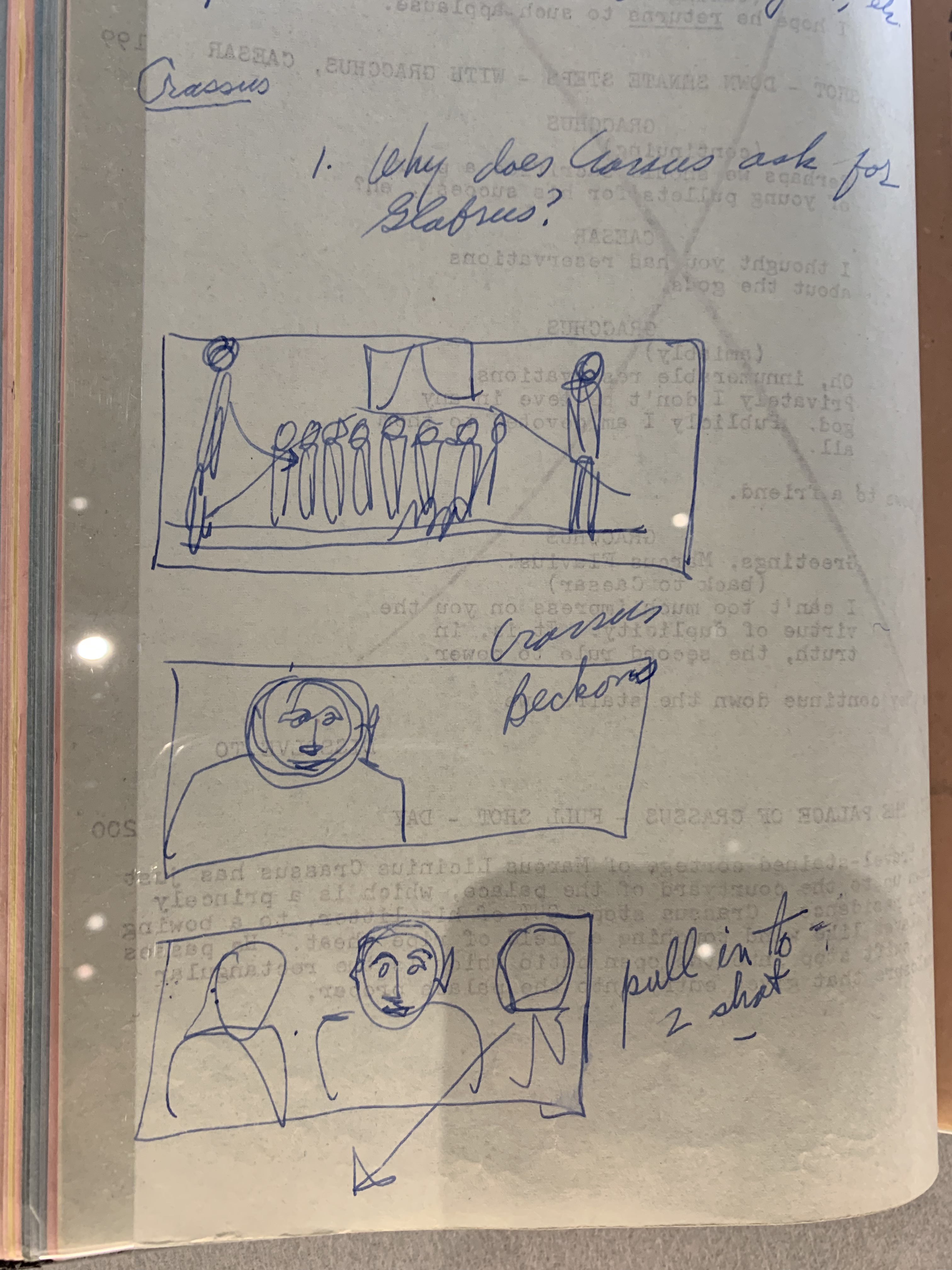
I found the roughness of Kubrick’s hand drawn storyboards really interesting, it was purely about communicating part of an idea to someone, good storyboards just need to communicate framing information.
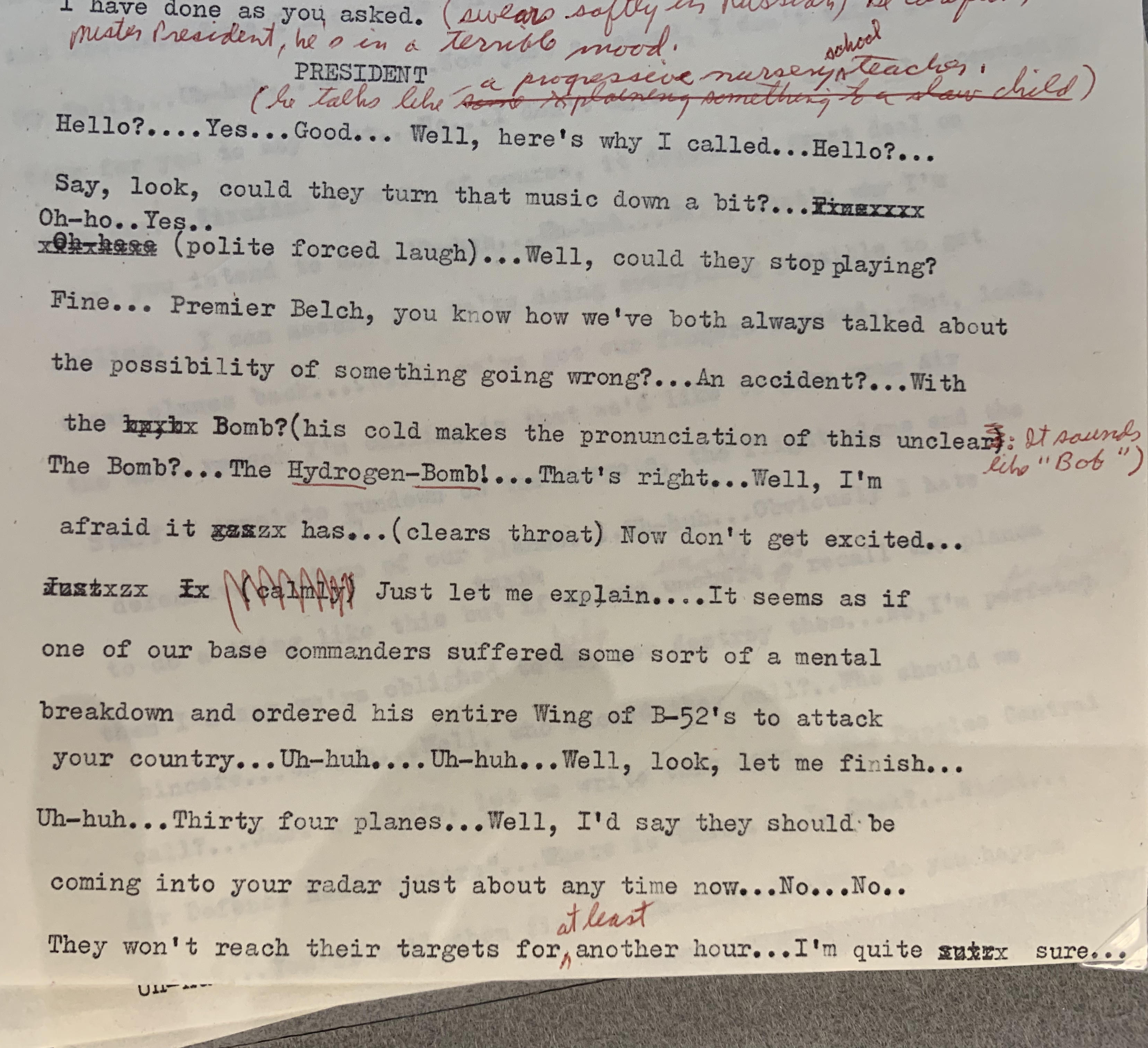
Extract from Dr. Strangelove Script
It was fascinating to see the development process happening on the page, for me this was the biggest take away from the exhibition, the collaborative developmental process. Kubrick is often put forward as one of the examples of Auteur Theory…
Does a series of
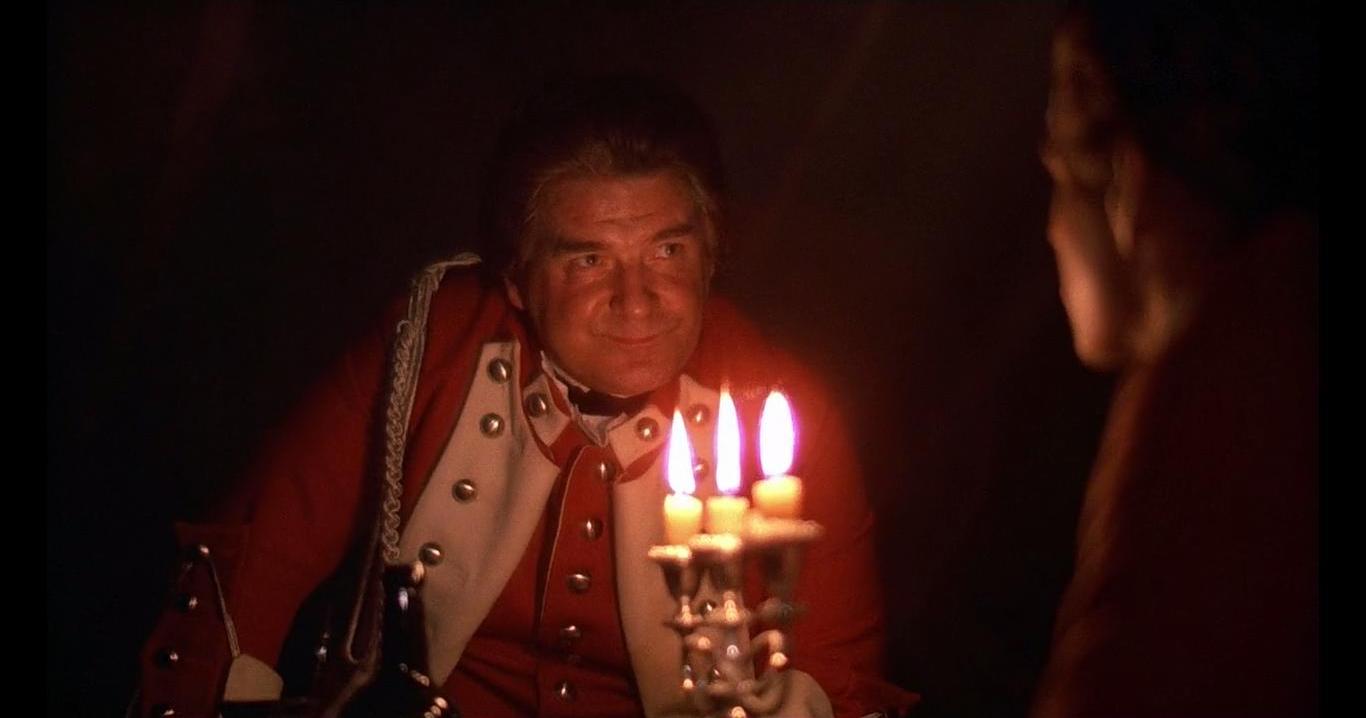
From a technical perspective, Kubrick’s photography experience was a huge influence on his approach to cinematography, lighting and editing. Barry Lyndon particularly lingers on the picturesque, with some beautiful individual shots akin to oil paintings.
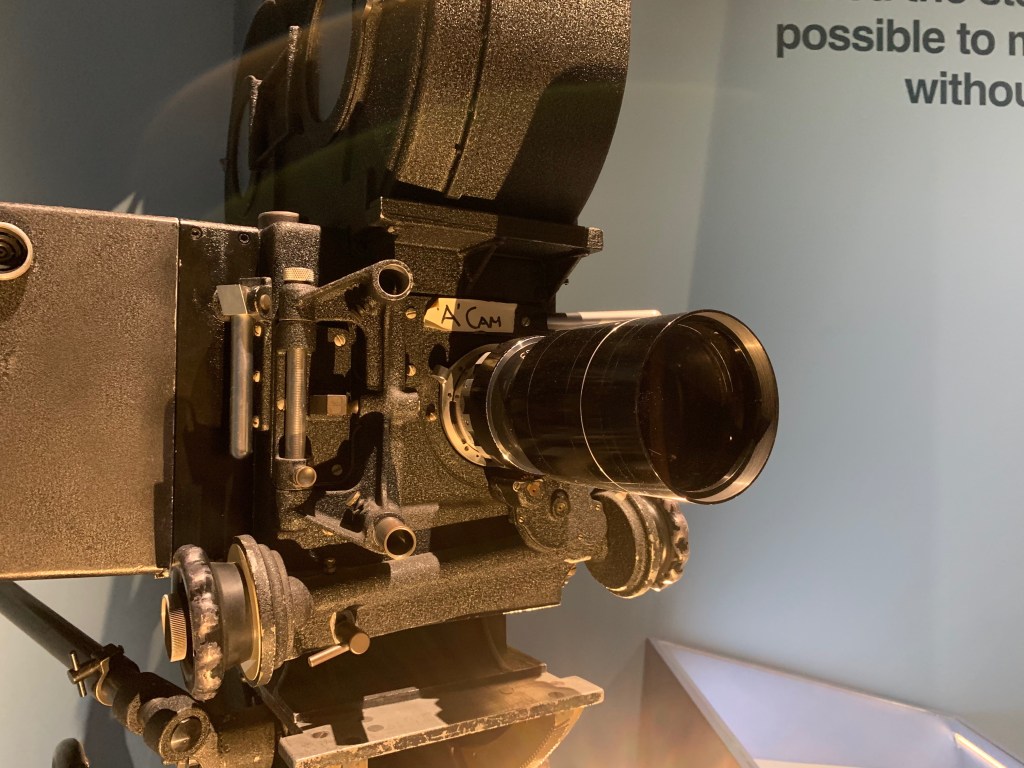
One of the famous lenses specifically purchased and converted to shoot the interior candlelight scenes in Barry LyndonBarry Lyndon (Kubrick, 1975)
Pictorially, the elegant result emerges from a close collaboration between Kubrick (no mean photographer himself) and director of photography John Alcott, BSC.
What came across in the exhibition wasn’t just Kubrick’s attention to detail and singular vision but his ability to foster strong collaborative relationships, in this case with Alcott and Ed DiGuilio, who customised the lenses and cameras, to achieve the images.
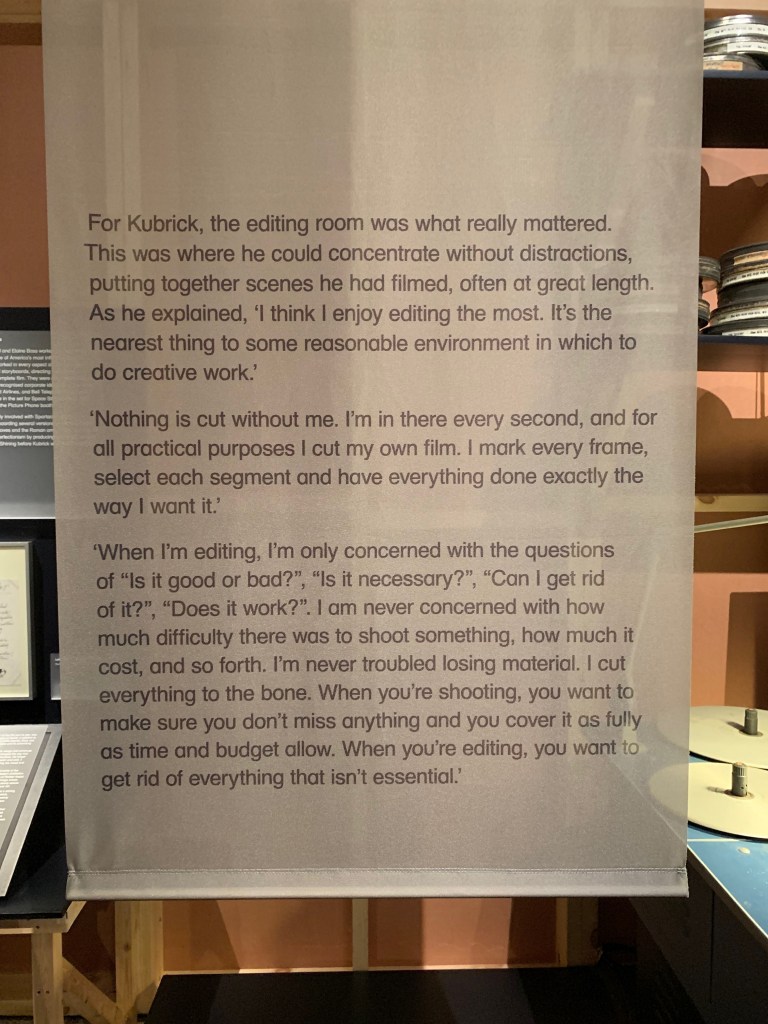
Kubrick on editing
As well as the discipline to “get rid of everything that isn’t essential”, this passage highlighted the exploratory nature of Kubrick’s process, even when he was in the final stages of the cutting room he was still trying to find out what the film could be. Although Kubrick work on largely conventional films, it could be argued he invented many of the conventions, for me there is an experimental quality to the way that he pushes to find the boundaries of what his films can be.
Screening the mirror forest was positive, I enjoyed seeing people experiencing the film with a VR headset, the way that I had designed it to be seen. Setting up this sort of experience is still not straight forward, putting a smartphone into a holder then strapping it to someones face is easy, but it is not elegant. It doesn’t feel like it is going to take off in a big way anytime soon, there is still this barrier to entry.
Using a desktop browser to navigate around the 360 video is an even worse experience, the controls always feel like they are in the way and it is too easy to click the wrong part of a video and break the experience, not at all immersive.
It was interesting that there were also comments that suggested that the film still worked when displayed as a traditional projection onto a screen with no interactivity. When stretch the sceptical video has a really interesting perspective on the world, it seems to need decoding to recognise very familiar objects.
I often wonder if I will have gone too far with minimalism of the visuals; will it be too simple, boring. In a film of 2 minutes I feel that there isn’t room to explore more than one idea, for me the articulation of one idea is often a limited visual palette, with sound to support that. There were a number of comments about the soundscape, where phrases such as dreamlike, and mediation, were mentioned.
I feel satisfied with the process of arriving at this piece, I enjoyed the interplay of exploration of new technique, and theoretical process. I feel that I have aim of evoking an experience of the forests of Norfolk, and the interaction of people and place.
The extra resolution of 4k is really important when working with spherical video because the wrapping reduces the effective resolution of the image and it looks really soft.
I had also missed an important step from the ambisonic audio tutorial in Premiere Pro.
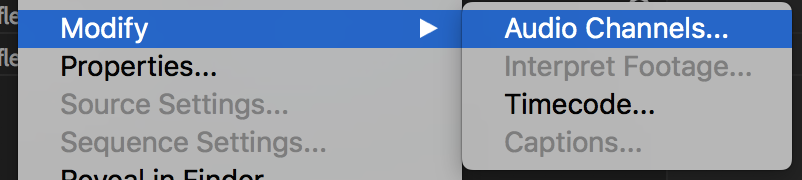
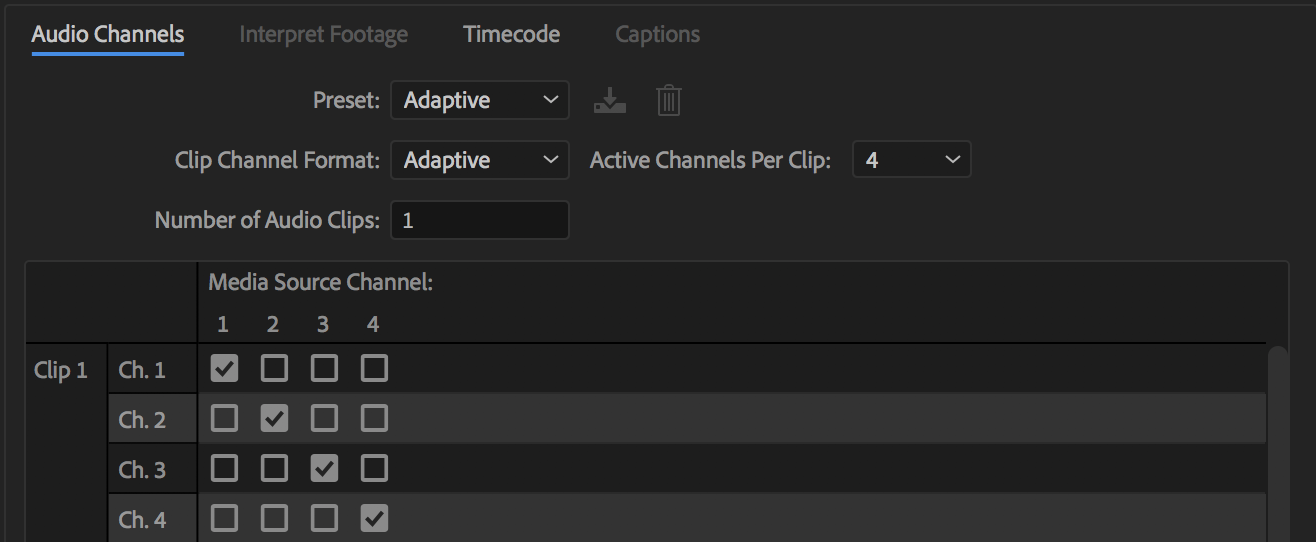
With the .amb audio track selected open the contextual menu > Modify > Audio ChannelsIn the Audio Channels tab change the Preset > AdaptiveWhen the audio clip is added to the timeline it will now appear as 4 audio channels on 1 Audio Track
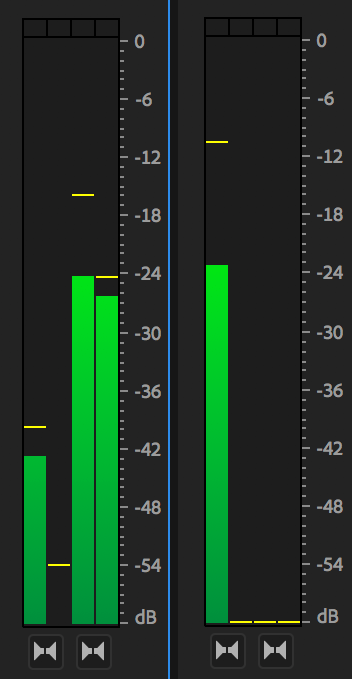
When played back there levels will show audio in all 4 channels not just the left





















 mattprentice