A few months ago I came across an article reviewing a book about the architect Peter Zumthor. In it there is a mention of an idea that “landscapes are historical documents.” The idea caught my interest so I saved the link but went back to what I was working on at the time.
As I mentioned in my post about Bauhaus, although I have never studied architecture formally a number of ideas from the field have had strong influences on my other work.
Once I began to explore the idea further I realised this was a concept explored across history, archeology, anthropology, the list goes on. I was reminded of just how small my knowledge is compared to the entirety of human learning and discussion. Here is a concept close to many ideas that I have been interested in for many years that I have never encountered.
Didn’t you study geology?
This seems even more profoundly strange when put in context that I studied Geology for a number of years and learnt to read landscapes, rocks, and strata as a document of geological time, and physical processes and activity. Detailed analysis of the types, deformations and positions of rocks in a place can give us an understanding of the story of a place as it has moved across the earth, been crushed, submerged, baked, uplifted, and scoured; each layer telling a detail.
Humans consistently modify their environments—both directly and indirectly. However, the linkage between human activity and anthropogenic landscapes intensifies in urban situations. The artificial landscapes and dense concentrations of human populations encountered in urban environments create a centripetal pull for resources that results in continual and distant landscape changes, thus inextricably linking urbanism and anthropogenic landscapes. Examining past and present patterns of urban settlement and environmental impact provides context for this symbiotic relationship. Archaeological data, methodology, and technology offer insight into the similarities and variations in urban anthropogenic landscapes across time and space, suggesting that ancient practices can be compared with contemporary ones and that ancient models may have applicability for future-focused urban planning.
Urbanism and Anthropogenic Landscapes
Arlen F. Chase and Diane Z. Chase
Annual Review of Anthropology 2016 45:1, 361-376
The above abstract is just an example of the way that landscape as document is used. By studying landscapes the changing story of how those spaces are used, and has been used is readable.

I realised during the writing of this post than none of this was completely new to me, I just hadn’t fully cemented the connections. I had encountered these ideas before when discussing landscape art with a close friend.
James Winnett has worked on a number of public art projects and installations that have responded to and been an extension of the story of the place.
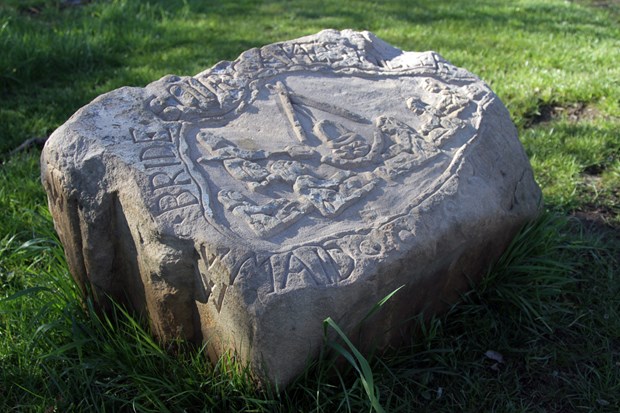
As part of the project 15 large carved sculptural works were produced drawing on an extensive programme of research and community engagement which examined the complex social, industrial and natural history of the site.
James Winnett – The Cunningar Stones

A jet of white water is forced skyward from a gravity-fed fountain placed downstream of a dramatic highland waterfall. Powered entirely by the immense natural energy of water, the intervention was developed to explore a number of related themes from debates on sustainability and energy use to questions of landscape identity and representation.
James Winnett – The Rise and Fall of the Grey Mare’s Tail
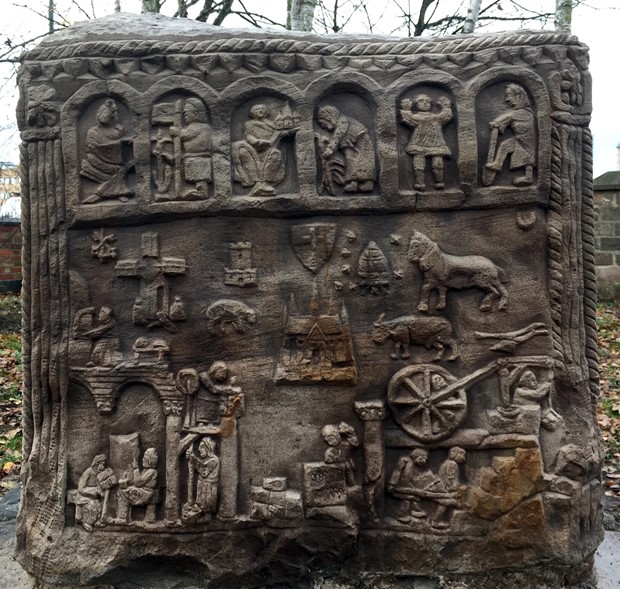
The stone appears as a medieval artefact, the four faces functioning as chapters in the story of the site in which it stands. A series of arches above each panel depict the agricultural labours of the four seasons, interspersed with key figures who shaped the events unfolding below.
James Winnett – The Lenton Priory Stone
Winnett’s work in each of these cases is not only a representation of the story of the place but becomes part of the story of the place. As public art it designed to be a physical destination and a locus for conversation.
Each stone was recovered from the ground after being dumped there during the demolition of the Gorbals in the 1960s. Developed to reference Scottish folk carving while retaining the aesthetic of an architectural ruin, the stones act as landmarks within the landscape encouraging exploration and generating interest in the identity of the park. Each stone retains the architectural details and other marks from its history with my own carvings intervening in these layers. Many of the carvings reference the rich flora and fauna of the park.
James Winnett – The Cunningar Stones
As Winnett discusses he is interested in the way that places and objects hold their story and that his intervention becomes just one moment in that ongoing story. Similar to Duchamp’s ready mades, Winnett seems to suggest to me that there is nothing specifically superior about the contribution o the artist to the history of the object, only that they want to draw an audiences attention to the story of the object. By recontextualising an existing object as art, whether by moving it into a gallery, or by adding to its story the artist reminds us that narratives that surround our seemingly ordinary objects.
Another way to think about Poetic
This reminds me of John Akomfrah’s ideas of film preserving a moment in time. It has been interesting to contrast the Netflix natural world series Our Planet (2019. Chapman et al.) with Vertigo Sea (2015, Akonfrah). Other than the multiscreen nature of Akomfrah’s work that are similarities between the works; beautiful photography of the natural world, discussion of our human impact on the world we live in. I really enjoyed Our Planet (especially the more opinionated environmentalist angle on the narration), but with these same pieces Akomfrah is able to create something else, not just a documentary about the natural world, but a cinematic poem.
he has continued to mine the audiovisual archive of the 20th century, recontextualizing these images not only by selecting and juxtaposing them but also through the addition of eloquent and allusive text. In Memory Room 451 (1997), Akomfrah speaks of memories become dreams and vice versa. In similar fashion, his films use found footage to create cinematic poetry and then use this poetry to tell history afresh.
https://library.harvard.edu/film/films/2014janmar/akomfrah.html
This doesn’t give me a clear approach for a poetic piece but draws me towards the importance of the interventions, what and when to manipulate.
 mattprentice
A very interesting read Matt. Your comments on the nature of landscape as a document or artefact, evidencing both the geological and human bring to mind the words of Neal Ascherson writing in Stone Voices: The Search for Scotland, ‘Scottish earth is in most places … a skin over bone, and like any taut face it never loses a line once acquired.’
LikeLike
Thanks James, I will check out Neal Ascherson
LikeLike