Turner Prize and Vertigo Sea
Vertov and his contemporaries wanted to explore the power of the camera’s mechanical eye to challenge existing ideas. I couldn’t help being reminded of this as I watch Vertigo Sea. What would would Eisenstein have thought about the interplay of three images and a rich multilayered soundscape? Fact, fiction, historical, contemporary, colour, text, word, music, sound.

I felt the richness and vibrancy of Vertigo Sea created an experience as immersive as any Hollywood Action film but used this experience to challenge rather than dictating to an audience. So many questions are asked; political, cultural, environmental, all bound up with the framing device of the beautiful but violet sea.
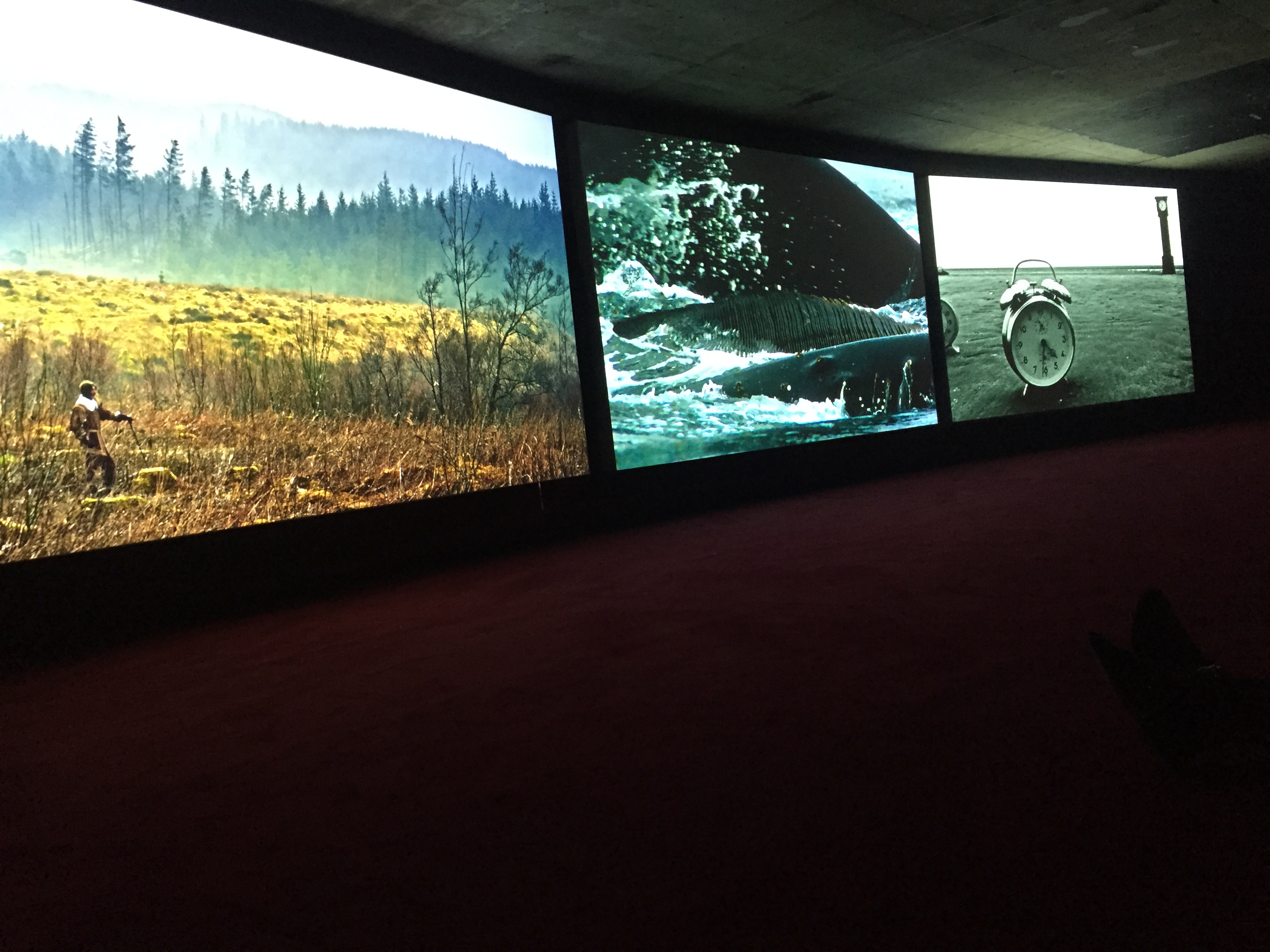
Whilst looking for a clip of Akomfrah’s work to illustrate my point I discovered this film of him talking about his creative process where he describes montage in his films, making reference to a dialectic between the images joined by a cut (or three screens) creating a new meaning.
For me Vertigo Sea pushes against but also acknowledges the the legacy of cinematic filmmaking techniques. Rather than outright rejection of the work of other filmmakers Akomfrah instead utilises and extends the techniques to tell a tapestry of stories that cinema is unsuitable for.
The way that images and theme repeat and evolve for me give Vertigo Sea parallels with the ideas of minimalism. Images want to tell us stories, even TH:EC:LO:CK found it difficult to break away from this, we seem to be driven to create linear narratives. For me, Akomfrah challenges this by repeating imagery and forcing us to be active viewers, ours eyes scanning across multiple screens, we pickup and drop the treads in different ways until the stands leave us with a net rather than a line.
 mattprentice