Concrete reflections
IMG_9309

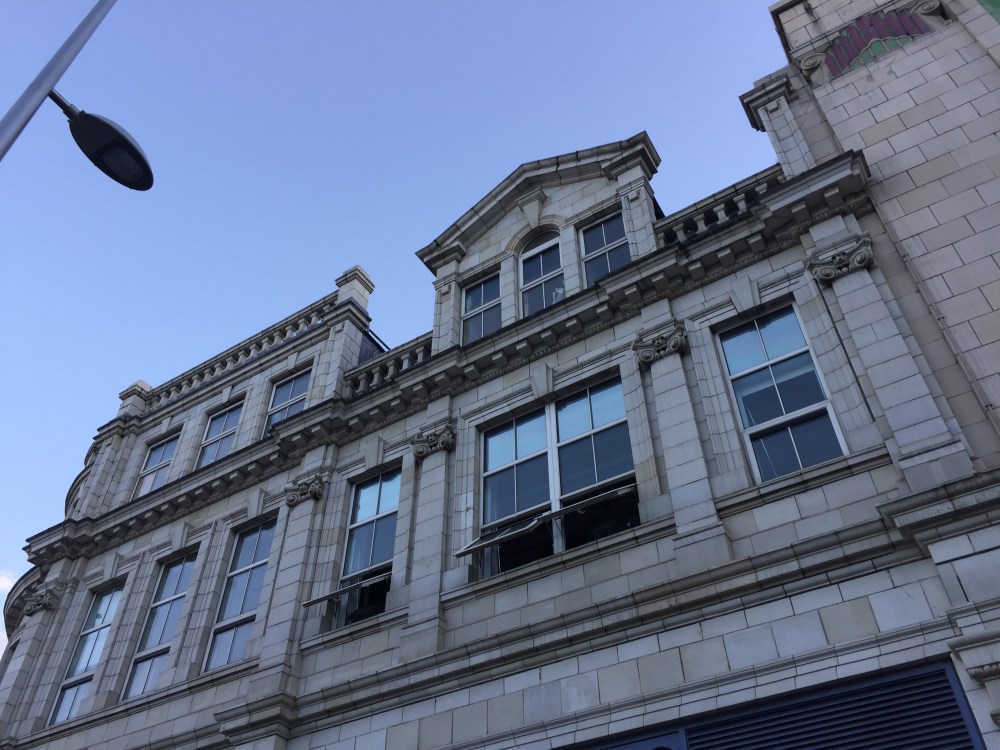
Thursday 1st November the group’s concrete soundscapes were played from the Ellen Terry Building in Coventry onto Jordan Well. The crisp November evening collaborated with us to draw in small groups of listeners who were intrigued, baffled or interested in the sounds, even those passers by who did not stop and listen paused in their journey to establish where the odd noises were coming from. I noticed that while most people who did stop only started for 2-3 minutes (about the length of one piece) a number of others stayed for 30-40 minutes even though they did not know anyone studying on the programme. I was asked by one of these individuals if it was a live performance and how the sounds were made. Wandering around the area I was able to hear the echos of the pieces drifting several streets away.

IMG_9312

One passer by asked me if it was “Art”, when I asked them what they thought they commented that they didn’t understand it, I thought that this was interesting; what was there to understand? For those of us who can hear, we hear sounds all day everyday, most of the time these sounds are expected so we don’t listen. By placing unexpected sounds back into the environment passers by were encouraged to listen.

I was disappointed hearing my own piece in this environment, it had lost much of the presence and layering that I had been trying to develop during the production and mixing. I had mixed it in a controlled environment and all of my testing had been in enclosed spaces. I had used a similar process to sound for film, but this was an unconventional environment to exhibit the work. Following my conventional instincts, what has worked before, led me down the wrong path. The process to create work should reflect that work and not be uncritically tied to prior experience.

Concrete conclusions

This represents the conclusion of my concrete sound project that began to develop watching TH:EC:LO:CK. I was interested in exploring the busy, outdoor, urban space of the performance area for the soundscape and encouraging listeners to consider not just how they were spending their day but also the passing of time, as I had done whilst experiencing TH:EC:LO:CK.

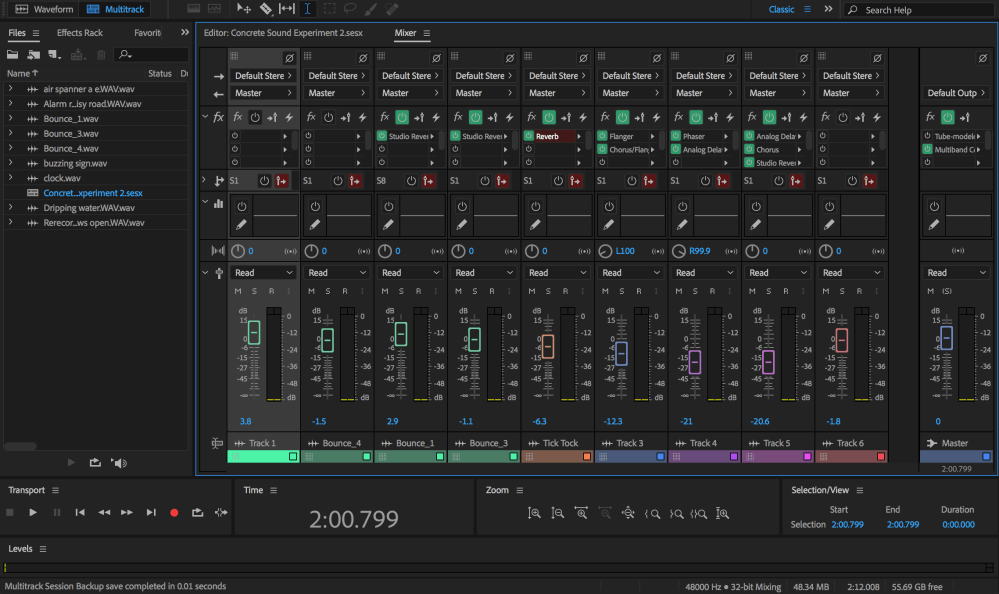
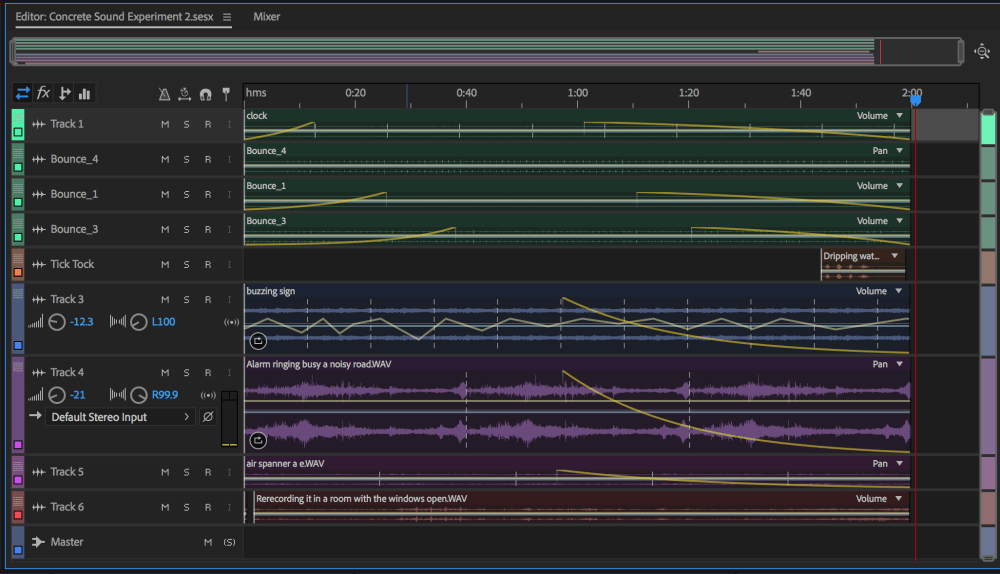
Developments since the third experiment have been smaller feedback from a number of listeners indicated that they they were drawing to in clock rhythm and commented that the layering was unsettling. In this version I have pushed some of the panning techniques I was using before to further open up the spaces between individual sounds, trying to give them a distinct place in space. I spent some time trying to get as much separation as possible between each of the the clocks that are in the piece to try and surround the listener.

Concrete Tim Mixer

Adobe Audition mixer screen shot showing track levels, pans and effects.

I also experimented with the compression settings used on the final mix down to try and retain more of the dynamic range in the soundscape. I have been concerned throughout this development with the need to complement and compete with the environmental sounds of a busy urban street. Previously this had encouraged me to be fairly aggressive with compression during the mix down to make sure there were solid levels throughout the soundscape. Having experimented with play back in a range of sizes of spaces and with sizes of speakers I found that I could take a lighter approach to the compression and achieve a fuller sound that still had enough presence to be heard.

It will be interesting to hear the final piece in its intended site after this development process.

Concrete feedback

I had the chance to share Concrete Sound Experiment 2 this week. I have not shown work to peers for criticism in some time, the feedback that there needs to be more progression was useful. In comparison other work showed the power of more space, stripping back the sounds letting then have room to be heard individually.

I am going to rewatch the Walter Murch crowd sequence video as I still want to produce a very dense soundscape but need more dynamics to help reveal that density rather than it sounding muddy..

A number of commenters noted that the rhythm of the clocks was lost so I need to clarify this as I feel this is the main element I want to achieve with the piece, drawing attention to the passing of time.

Concrete Sound Experiment 3


I have been working to add more dynamic range to the soundscape whilst taking into account that it will be competing and mixing with sounds of the street outside Ellen Terry building when it is presented. I had some really useful feedback regarding this and was referred to the song exploder podcast , specifically the Jon Hopkins episode. Hopkins commented that he likes to work destructively, feeding earlier versions of the track into a series of effects to produce new complex sounds that become part of the track.

I tried to embrace this concept when working on this version of the track in two areas.

Firstly I extracted sections of Concrete Sound Experiment 1 that had been worldized and further layered them, the reverb and delay effects seemed to produce useful results.

Secondly I further explored waveform editing, I had initially been put off this due to the destructive nature of the edits. I have always enjoyed the idea of nonlinear editing as non-destructive as I felt free to experiment and try things without fear of breaking anything. Having listened to Hopkins I tried to approach the waveform edit like painting, pushing and layering effects and changes to until I found something that worked or needed to start again.


Concrete Sound Experiment 2

I have attempted the worldizing technique describe by Walter Murch and also developed some more layers. The laptop that I am using was struggling with the numbers of layers in the previous project so I used the worldizing as an opportunity to mix that project into one track. I played the project back on some reference monitors in a classroom full of hard surfaces and then recorded this. There was also a storm taking place outside at the time and the windows had been left open, so in addition to the echo from the room there are also some interesting rattling sounds that were added by the blinds in the room.

More layers - Screen Shot

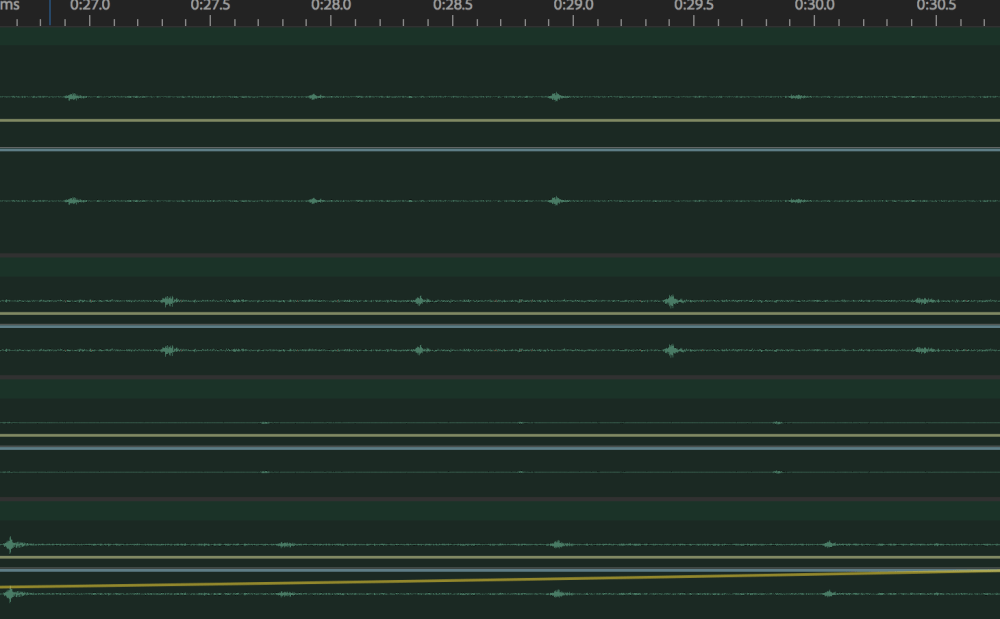
Having workshopped some responses to the initial experiment I have extended the clock sounds through the piece. I thought that I would draw inspiration from the recent trip to Tate modern and how this focused attention on the passing of time. I repeated the phasing experiment from the first experiment but with additional layered versions which I think has increased the looping effect this creates.

Phasing Clock - Screen Shot

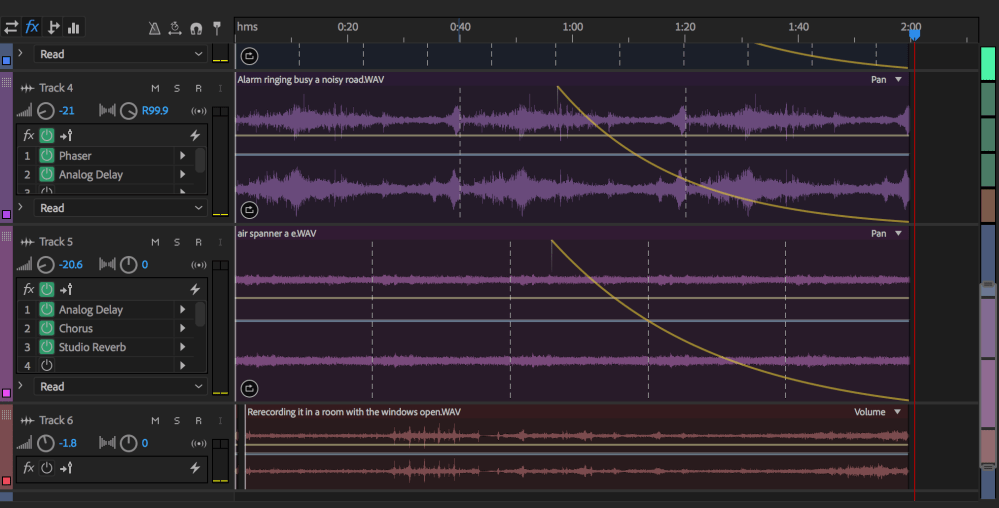
I had recorded some interesting buzzing and alarm sounds that I wanted to make use of to add so additional depth to the soundscape. I distorted and exaggerated these to try and help them sound less real. I found that compounding a number of effects on top of each other help to create this. This was inspired in part by Eraserhead and the way that the sounds of the hums and buzzes of machines in the environment were exaggerated to produce the very unsettling sonic landscape of the film.

Effects layering  - Screen Shot.png

The buzzing and ringing sounds become unpleasant after repeated listens whilst mixing, hopefully some of this will carry through to listeners when they hear the piece. I ended up pushing the ringing/buzzing very low down in the mix as it was dominating.

Mix  - Screen Shot.png

This piece will not have long to engage a listener, in part due to its length, and in part due to the transitory nature of the audience. I am hoping that the unsettling sounds will link to that of the recognisable clock to get listeners to pause and think about time.


Concrete sound experiment 1


Hands on workshop with Adobe Audition this afternoon, distorting and mixing the audio recordings that I have been collecting over the last few weeks.

I was focusing on trying to achieve something that sounded like the phasing found in analog tape delay.

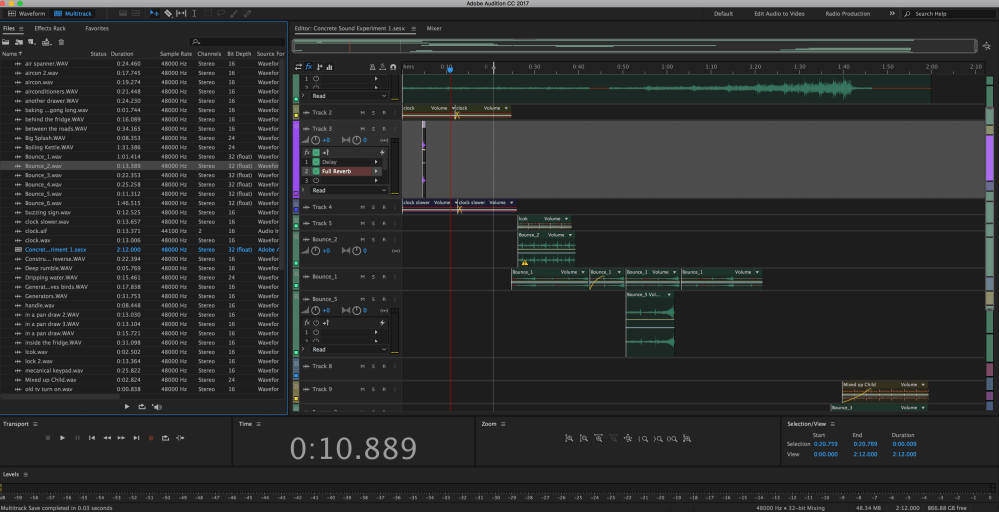
Concrete 1 time lineThere are a few sections where this seems to have worked. Only hearing it on headphones and small speakers means I need to review the current mix again before I know what it really sounds like. So far the section towards the middle where the sound builds then cuts seems to be the most interesting.
Concrete 1 mix

I am hoping to play the track back in a big space and record it back again to see how the room interacts with the sound.

Concrete

The concrete sound project is giving me an opportunity to engage practically with a theme and genre that I have appreciated for a number of years. Prior to my undergraduate degree I was interested in the work of Brian Eno, BBC radiophonic workshop (though Doctor Who), and the synthetic soundtracks of films like A Clockwork Orange (Kubrick, 1971). More recently Philip Glass was a gateway into the world of Minimalism. The hypnotic quality of Steve Reich’s work using looped and repeated phrases, forcing you to listen to the individual sounds until they become new and surprising is a process that I am hoping to use as a starting point.

IMG_9202

As the soundscapes are to be played out into the street where they will mix organically with the other sounds in the environment I feel that a structure rhythmic approach is likely to produce a more surprising outcome for those who encounter it.

Glass Repeat