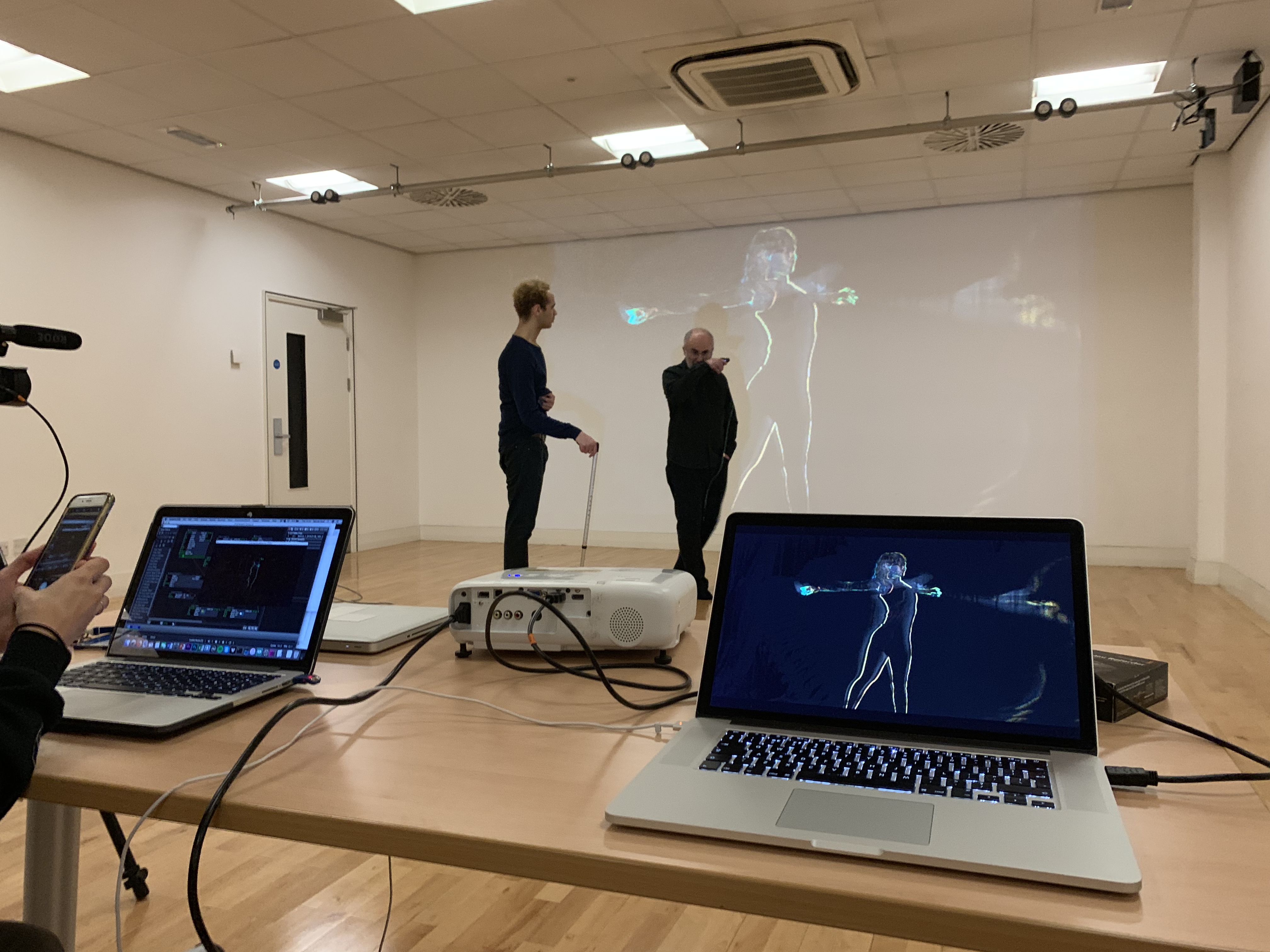
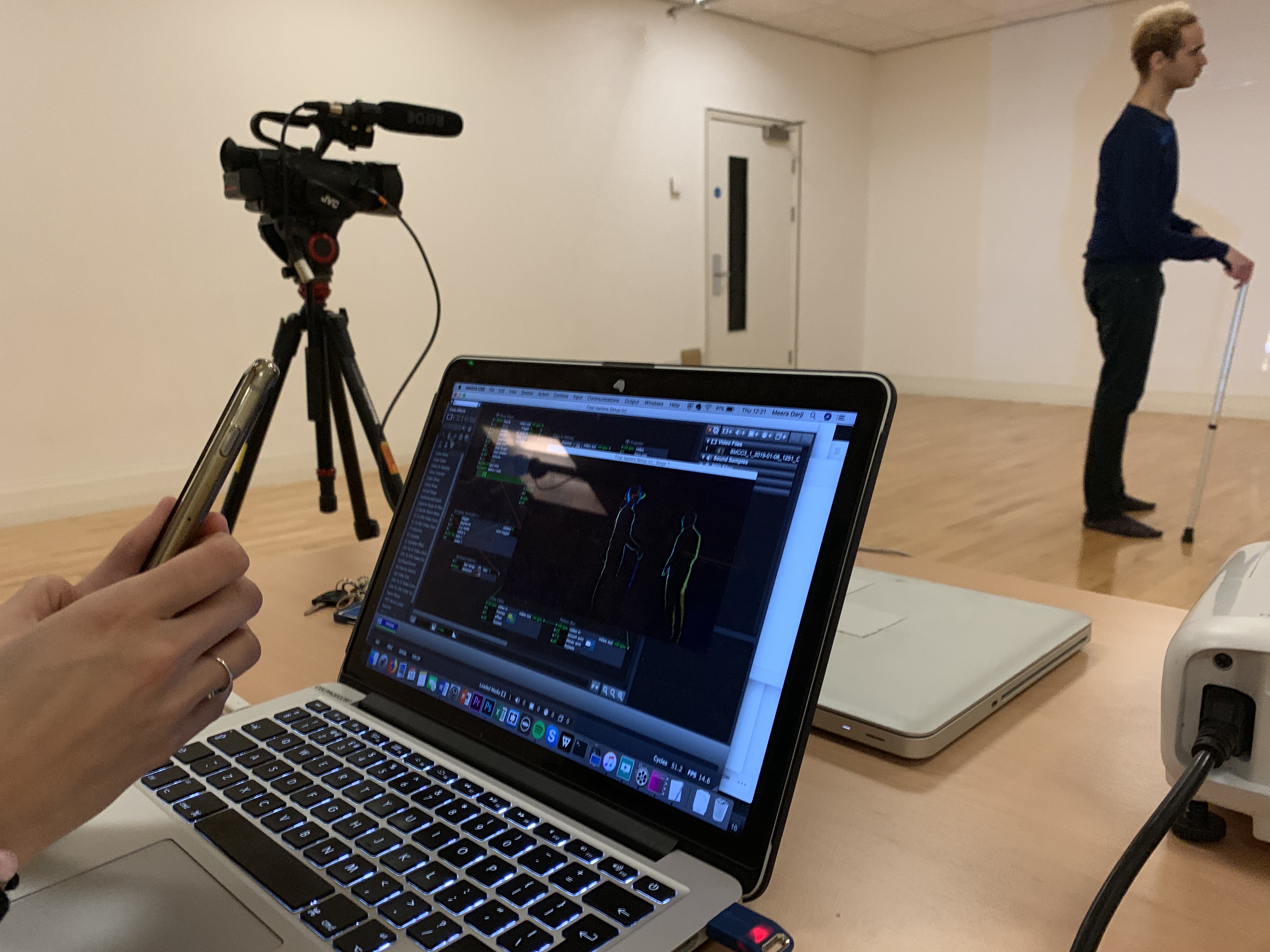
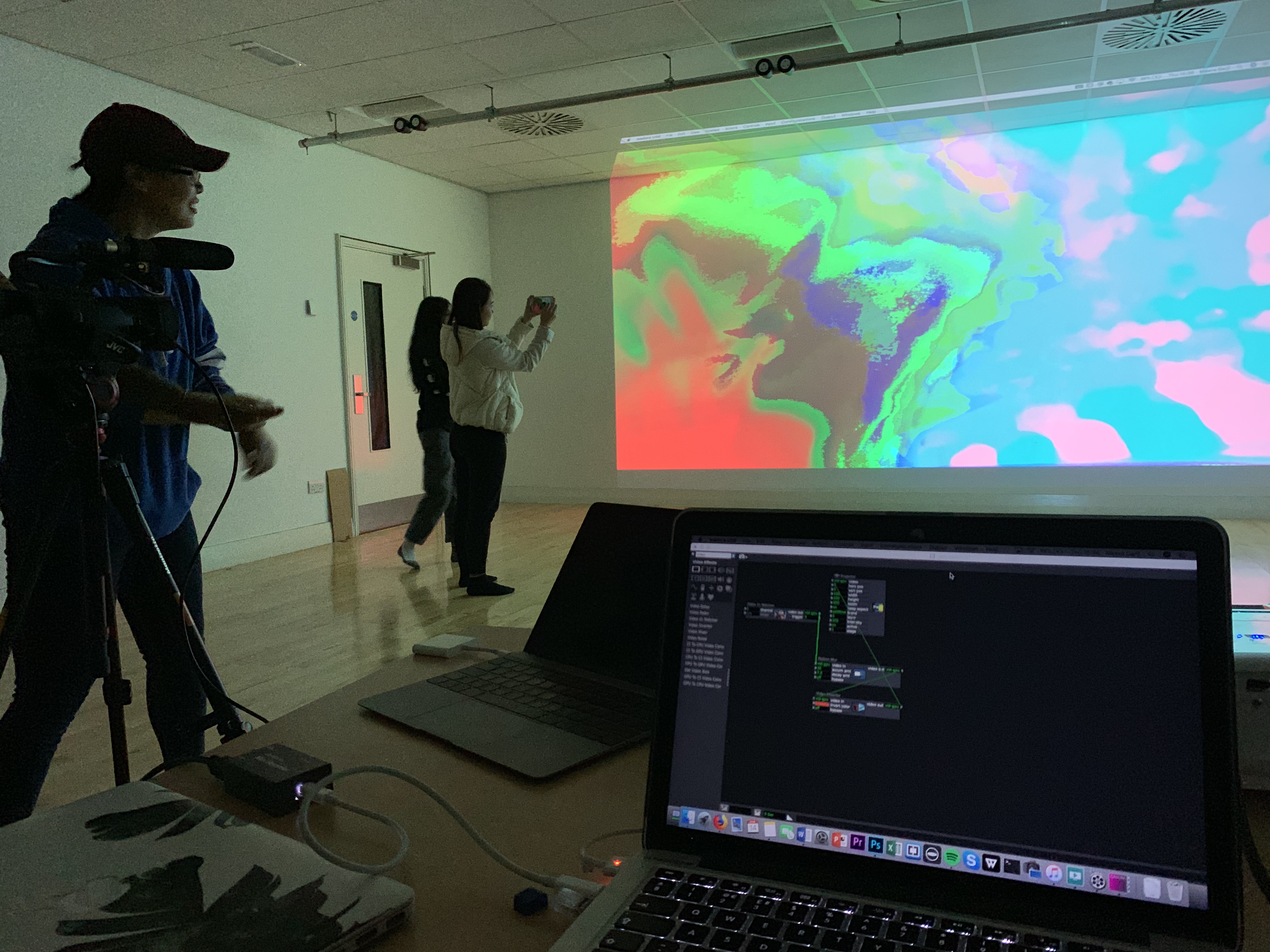
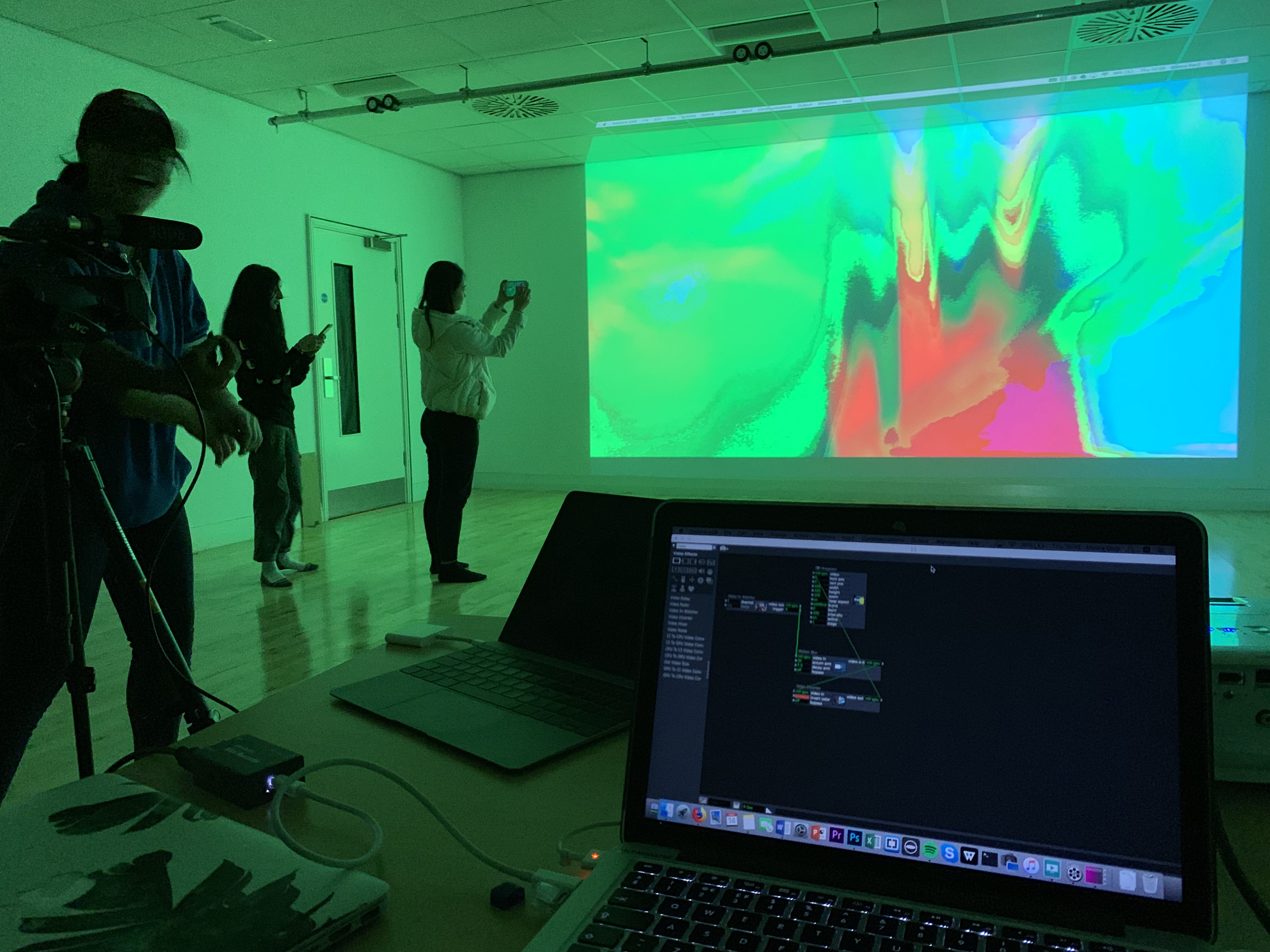
Spent the day in the dance studio experimenting with Isadora and various interactions with Live input.
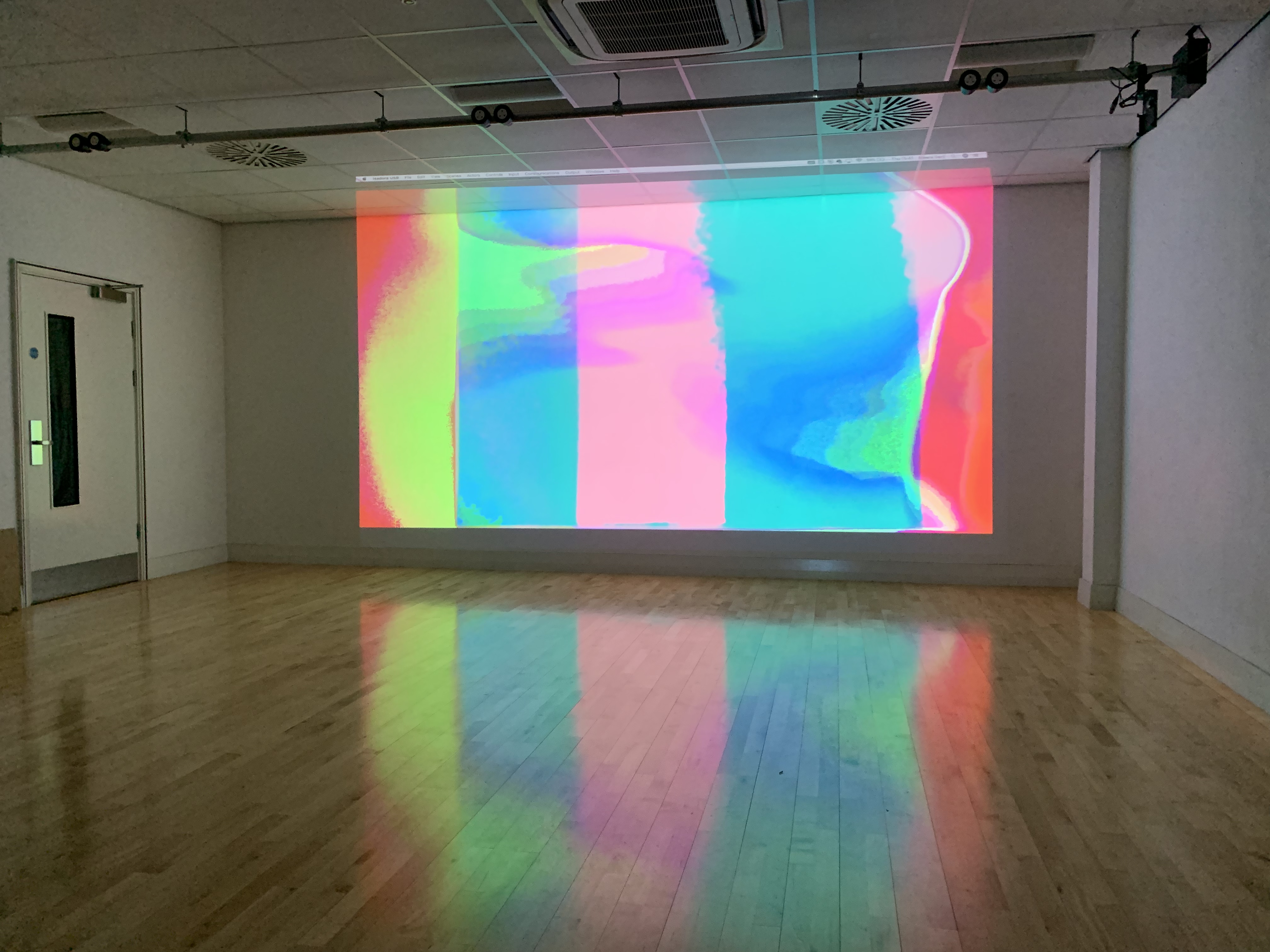
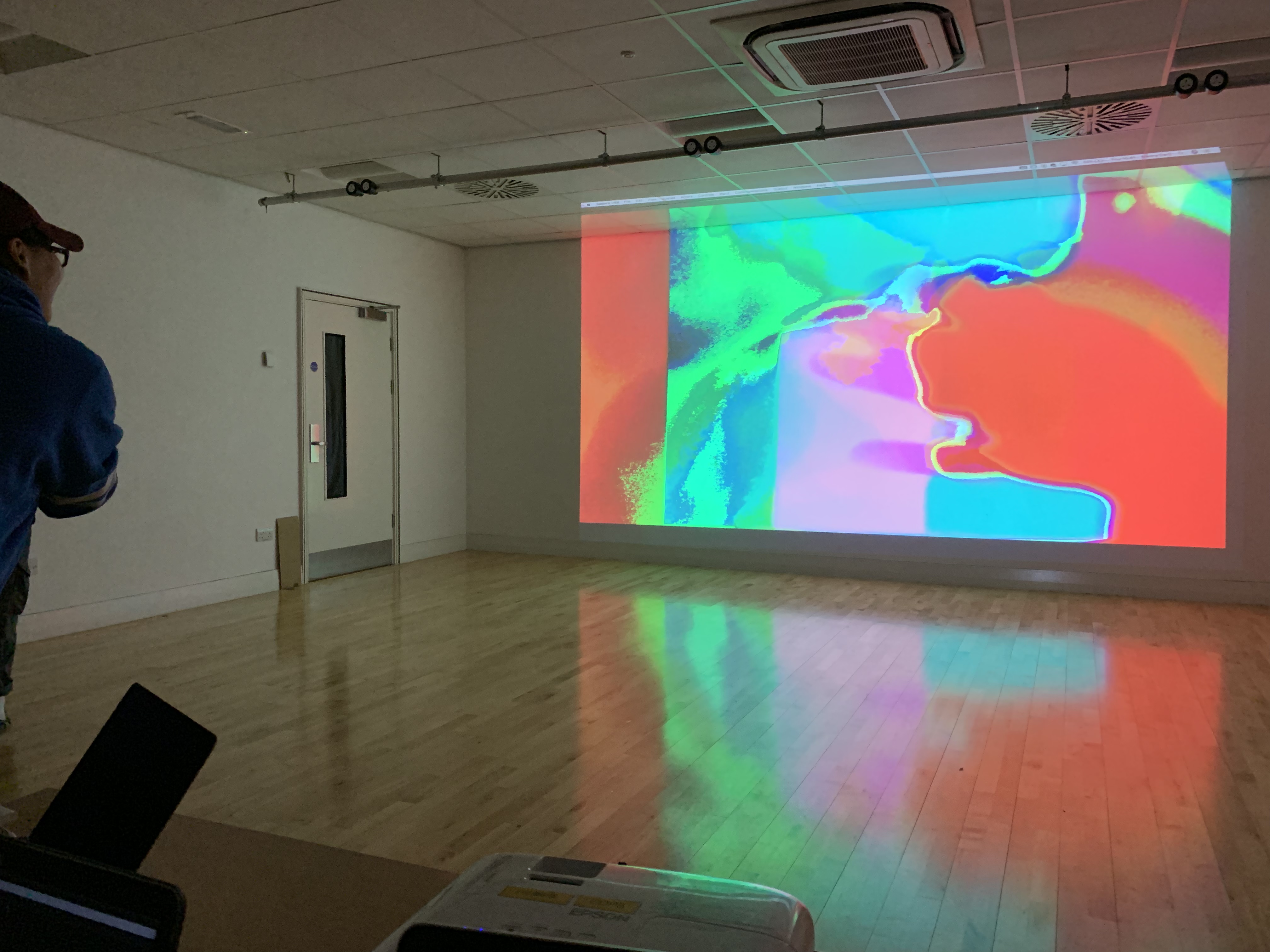
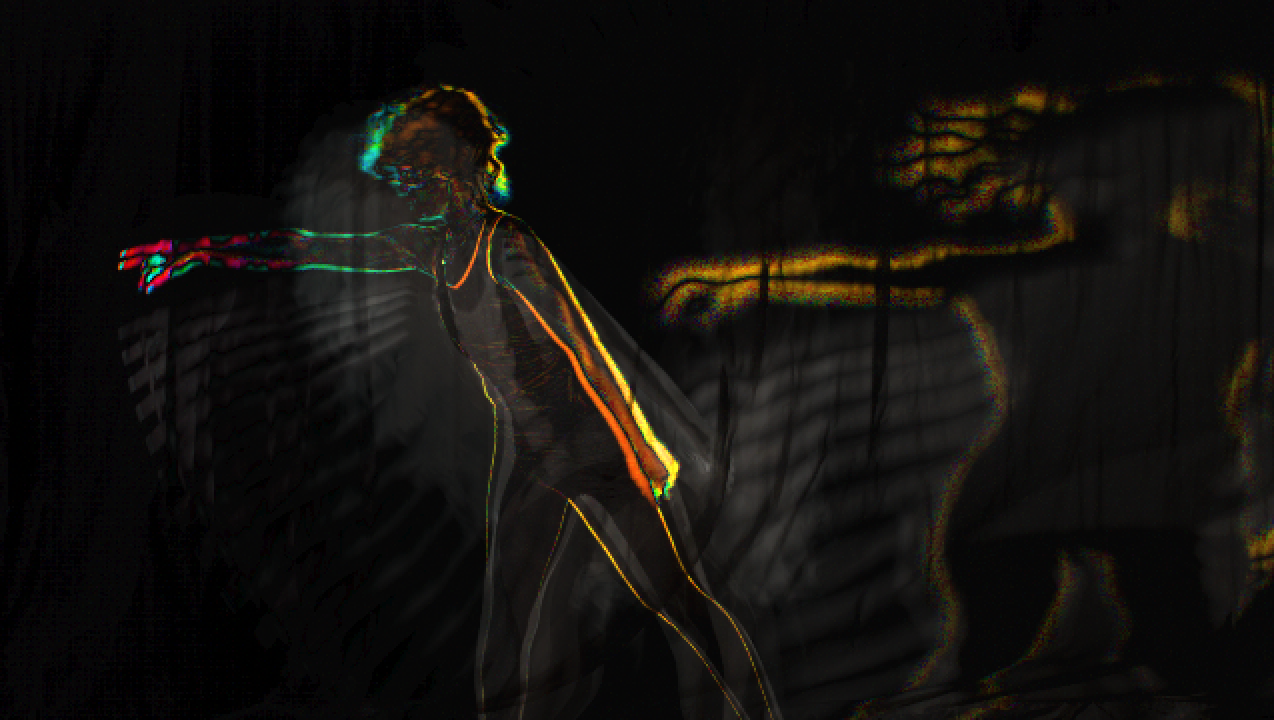
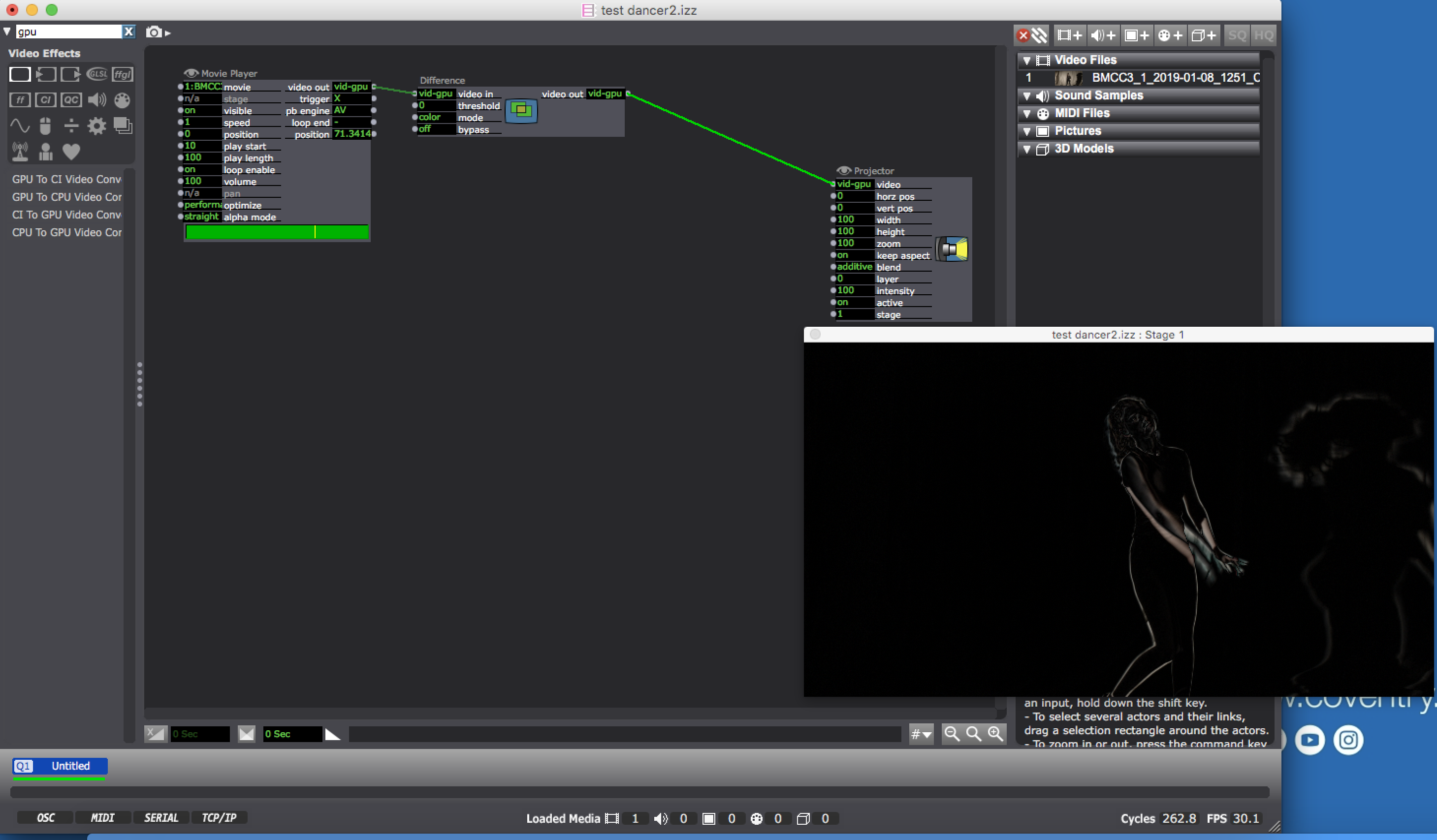
There were some interesting effects projecting the prepared video, capturing this and running it through an Isadora stage. Hit a few bugs (crashed) when trying to record the output of the Isadora stage which results in these photographs being the only evidence. The Difference effect was really successful in identifying and exaggerating the movements.
After lunch there was time to try projecting the Isadora output including the live capture, this created a really interesting feedback loop. Again capturing the output from Isadora kept causing it to crash but this time I managed to get some video.
Other than the issues with capturing these experiments started to show the power of Isadora in a live performance setting. It was really interesting being able to adjust parameters on the fly and watching the results.
I had completely forgotten that the archive was there having not visited it since the initial digitisation. I spent some time reading some of the features and (quickly) shared it with some of the students that I am working with.
I was running a seminar about discussing why we make the work that we make I used my currently in development motion project as a discussion point.
Several individuals in the session shared their reading that I was making work about representation and power structures. This had not been my intension, I was looking to move away from a narrative reading of the work but there were a number of reading that saw the evolution of the repetition as exploring breaking out of a box or becoming free, there were specific references to gender politics.
Was this because the readers were themselves interested in this issue?
Was it because identity is a topic that is frequently discussed in my classes?
Was it because the figure in the image is recognisably female and the voice is male?
Was it because in my previous work struggled with this question?
As I discussed during the Kino project, as much as I want to make work that explores the picture plane through abstraction there is a pull of gravity that pulls my work back towards a issues of voice, representation, and identity.
What we had in common often got lost in bitter political battles when ‘the personal’ became confused with ‘the political’. The question of what was a feminist issue and who should speak those issues was hotly debated at feminist meetings and on the pages of the magazine. Who was the ‘we’ of the Women’s Movement? Who was included and who was excluded? Who held power?
What struct me reading the reflection on Spare Rib was the scale of the complexity of trying to unpick power structures. The Brexit movement is seem by some as a challenge to a structure of power, it is a person fight to nationalise decisions that impact local issues. The unintended consequence is that an arcane set of laws designed to project the economic interest of creators will deny researchers and other creators a valuable artefact.
This political and personal complexity is reminiscent of the visual complexity Pollock’s work. The sanctuary of abstraction is so inviting, but reality just creeps in.
I was searching for an anchor for the experimentation that I was undertaking in Isadora and came across a journal discussing the choreography of Anne Teresa De Keersmaeker and Steve Reich’s composition principals. Structure as Process: Anne Teresa de Keersmaeker’s Fase (1982) and Steve Reich’s Music
First of all, Reich is concerned with clarity of structure, which he feels can only be achieved by creating compositions in which structure (“process”) and musical content are identical. He has no use for hidden constructive devices that serve to obscure musical process. Secondly, musical processes, once set into motion, have a life of their own, and need no further meddling from the composer to progress; they are impersonal and objective procedures. Thirdly, improvisation can play no part in a musical process; on the contrary, one must subvert one’s own feelings and allow inexorable forward thrust of the process to take charge. Lastly, no matter how objective the process, unexpected events will still occur: these are the resulting patterns.
Steve Reich, “Music as Gradual Process, Part II,” in K. Robert Schwarz, Perspectives of New Music, vol. 20, no. 1/2 (Autumn 1981–Summer 1982), 226. in (Bräuninger, R. (2014) ‘Structure as Process: Anne Teresa de Keersmaeker’s Fase (1982) and Steve Reich’s Music’, Dance Chronicle, 37(1), pp. 47–62. doi: 10.1080/01472526.2014.877273.)
In this passage I found a strong correlation with the process that I was approaching with my work.
I wanted to focus the view on the movement, the shapes of the body in motion – isolating it from a narrative or specific emotion
I wanted to set up the initial conditions and parameters and let these play out over the piece – it will evolve over the duration
Like an scientific experiment the rules of the test should not be manipulated once started – post processing invalidates the results
The result will be the patterns that emerge – the interplay between sound, image and rules
By reducing the set of musical parameters, Reich narrowly focuses the listener’s attention, creating a meditative sense of contemplation, in spite of the mechanistic quality of the sound reflecting the cultural setting in which Reich lives.
(Bräuninger, R. (2014)
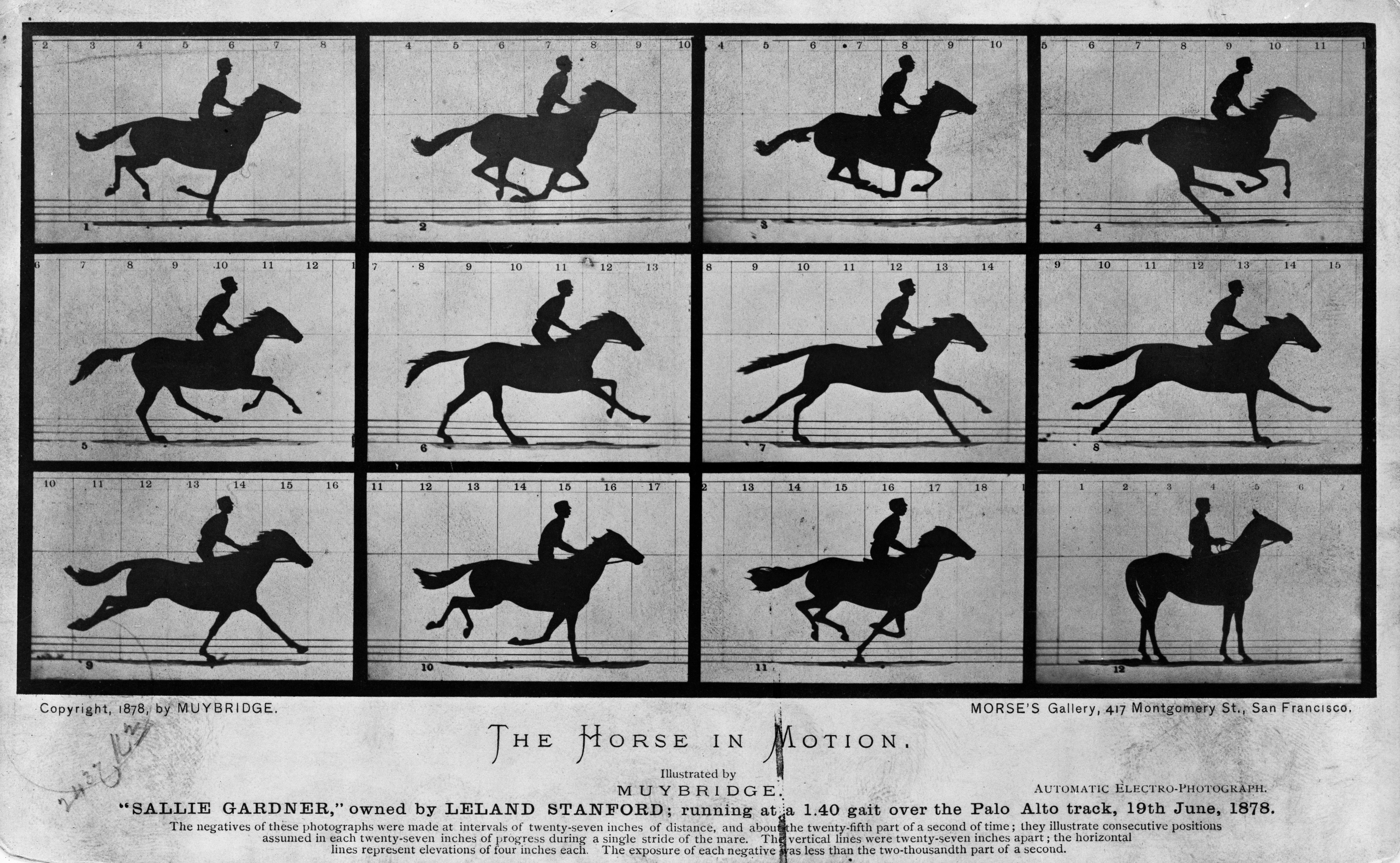
I would argue that our contemporary cultural setting, interconnected, digital, saturated with data and surveilling eyes, demands an even more mechanistic quality. When we consider the use of digital video rather than analogue music or performance an individual frame is already an individual unit. We can see this in Muybridge’s photographs of motion, continuous motion is atomised and then recombined to give an approximation of motion.
The Horse in Motion, Muybridge (1878)
In filming a continuous sequence of dance it is frozen and shatter, information is lost but replaying the individual images in sequence we can recreate and restore an approximation of the original motion. Muybridge’s photographic sequences revealed details about the movement of animals that were unknown before, they made visible a new information.
De Keersmaeker was not aiming to find a visual equivalent to this detail in Reich’s music; instead, she sought to give her choreography its own distinct organization, influenced by Reich’s structured process but not a mere translation of it.
(Bräuninger, R. (2014)
I see a similar relationship between the way I am looking at using repetition of a sequence of frames of dance and Reich’s approach. I want to find a process for presenting the series of frames that makes up a distinct movement, I want to decoupled the shapes of a body in motion from the meaning of a body in motion.
When we watch Fase we no longer perceive events passing along a time-line, but are thrown into an endless continuum in which the here and now, the being in the moment, becomes central to our perception.
(Bräuninger, R. (2014)
As we listen to the repetition of the same patterns continuously rearranged, particular combinations of sounds emerge and we experience a sense of change within constant repetition.
(Bräuninger, R. (2014)
With a duration of 2-minutes it is unlikely that a sense of meditation will emerge, instead I am hoping that a suggestion of the repetition continuing after the end of the piece will remain.
Having detoured via After Effects I wanted to go back to Isadora because I wanted to have the option of using the same series of effects and filters on live video later in the project. My initial approach was to replicate the phasing experiment in Isadora.
Many many projectors
The initial version lacked the synchronisation of the After Effects version, although I could have fixed this with some work I felt that this experiment had run its course. I want to look specifically at looping a small section of the dance and exploring how this evolved.
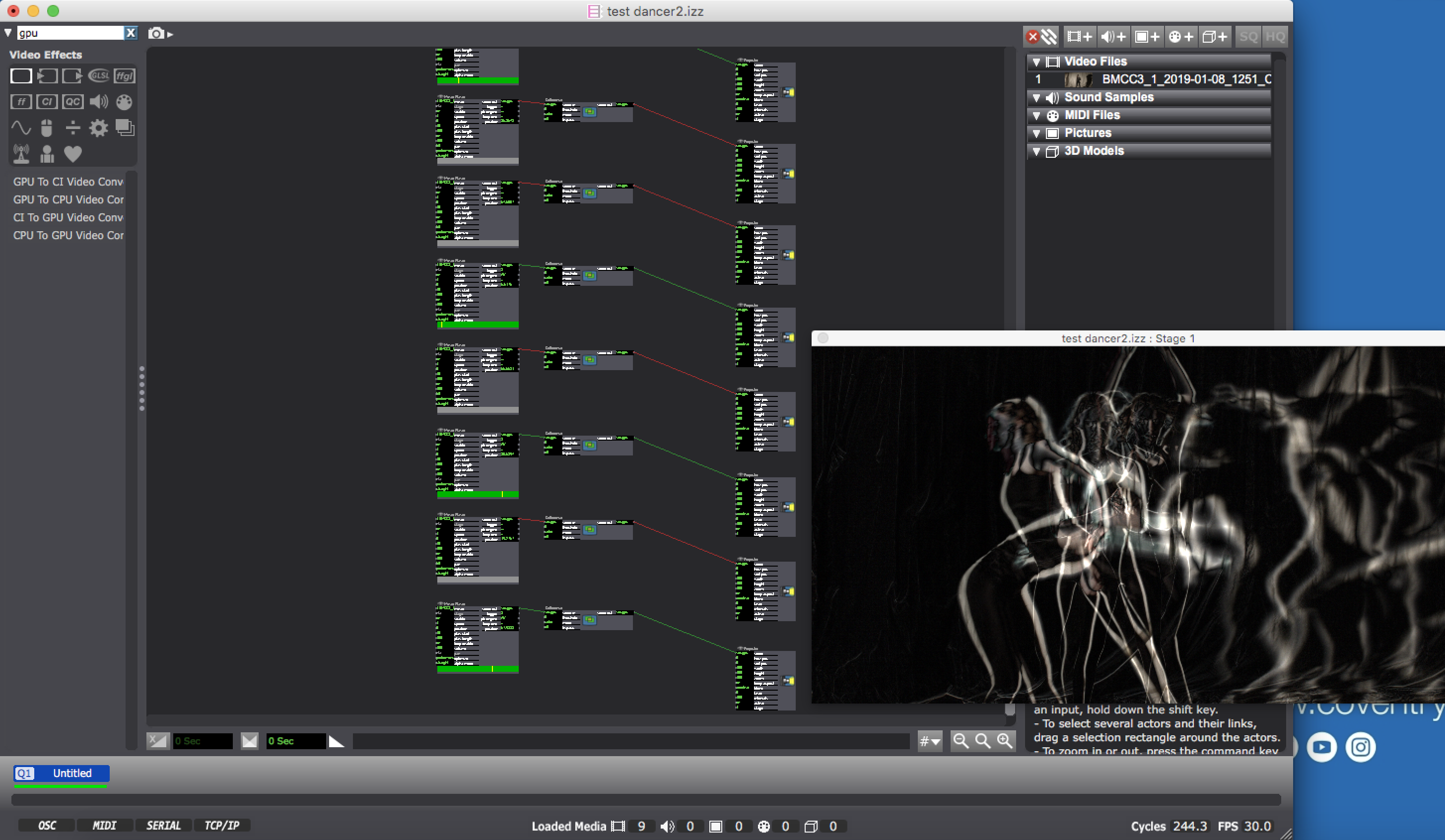
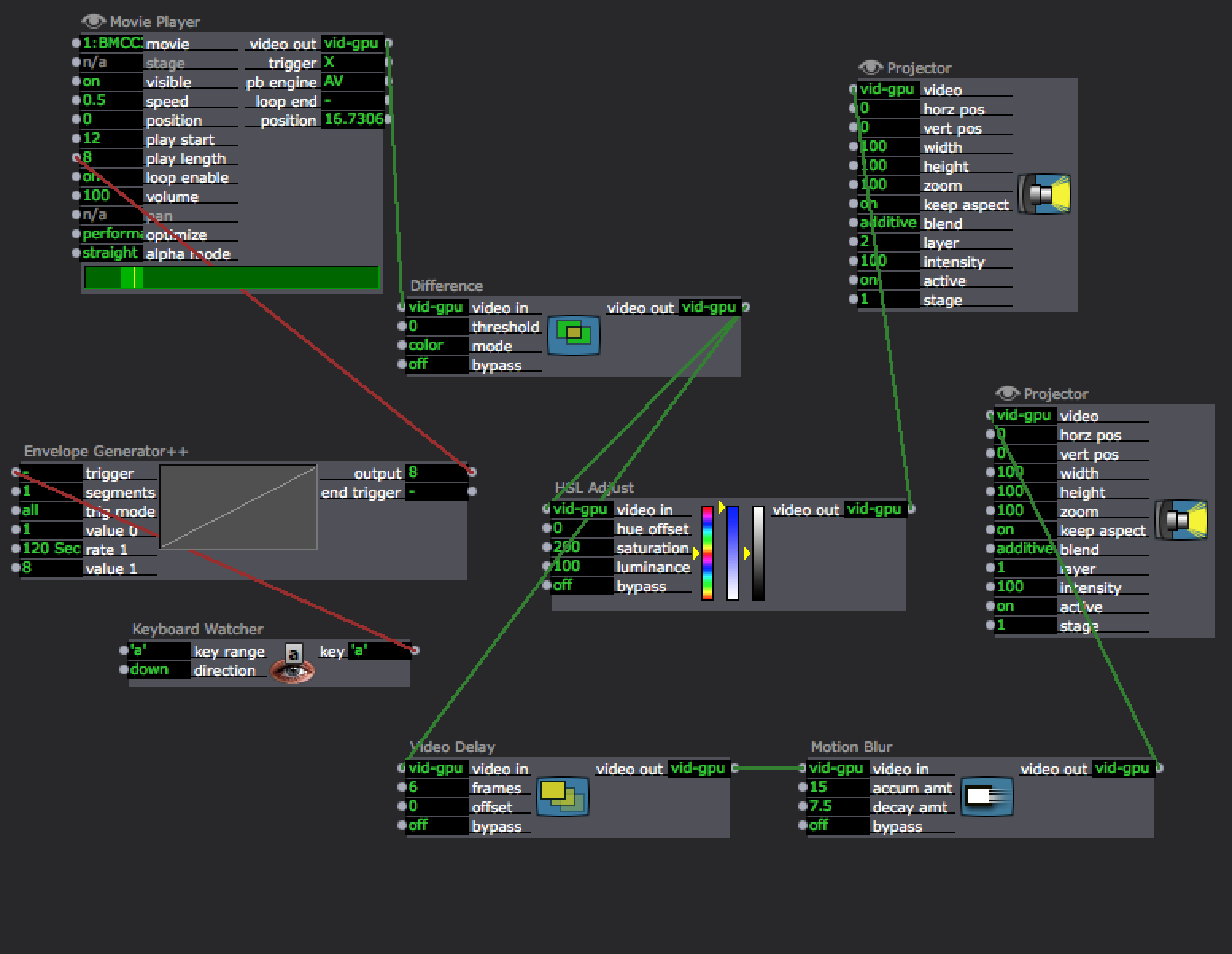
Current state of Isadora project
I adapted one of my early Isadora stages by removing the City Lights effect and adding a Delayed Motion Blur onto another projector.
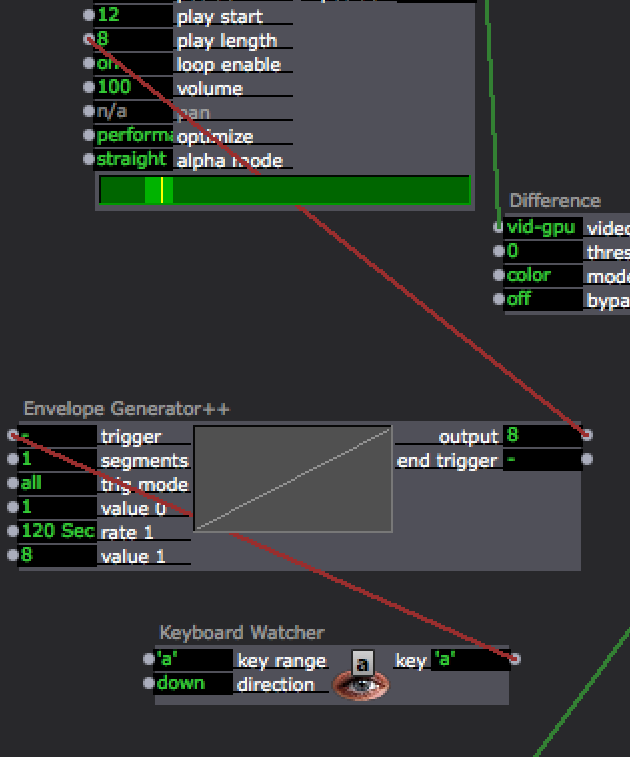
After experimenting with the length of the loop I discovered the Envelop Generator ++. I set the envelop to increment the play length over a duration of 120 seconds. This causes the loop to evolve over the length of the piece.
The length of the loop evolves of the duration the piece.
I really liked the Jackson Pollock point about starting out with a vague direction of where he was heading when he started a project and not being afraid of destroying the work in the process.
“Sometimes I lose the painting but I have no fear of changes, of destroying the image, because a painting has a life of its own I try to let it live.”
Working digitally it can be difficult to let go in this way as it is so easy to command-Z and go back to where you were before you did something, there is no permanence to a process. I find that this can leave using digital effects techniques experimentally hollow as it is too easy to try all of the filters, this abundance of choice makes choosing meaningless.
Having already recorded some (supposedly) test footage with the dancer that I had discussed working with I was able to start exploring Isadora
I found the Difference effect emphasised the movements in a really interesting way, somewhere in the network of modules that I applied (I think it is probably the variable Delay) the frame-rate Isadora was able to output dropped to 5fps. The result of this when recording the stage was the time-lapse/fast motion effect of the above test.
I had two more filming sessions planned with the dancer to work on something more specific, we had discussed some ideas around the work of Bob Fosse I was interested in using some of the ideas of isolating movements rather than doing the whole body. Unfortunately illness got in the way, so I have had to work with what I have got.
The other side effect has been that I had to work with Isadora without a dongle, therefore I couldn’t save projects in progress and could only record 5 seconds of the stage at a time. The result is some of the limitations that are normally absent when working digitally.
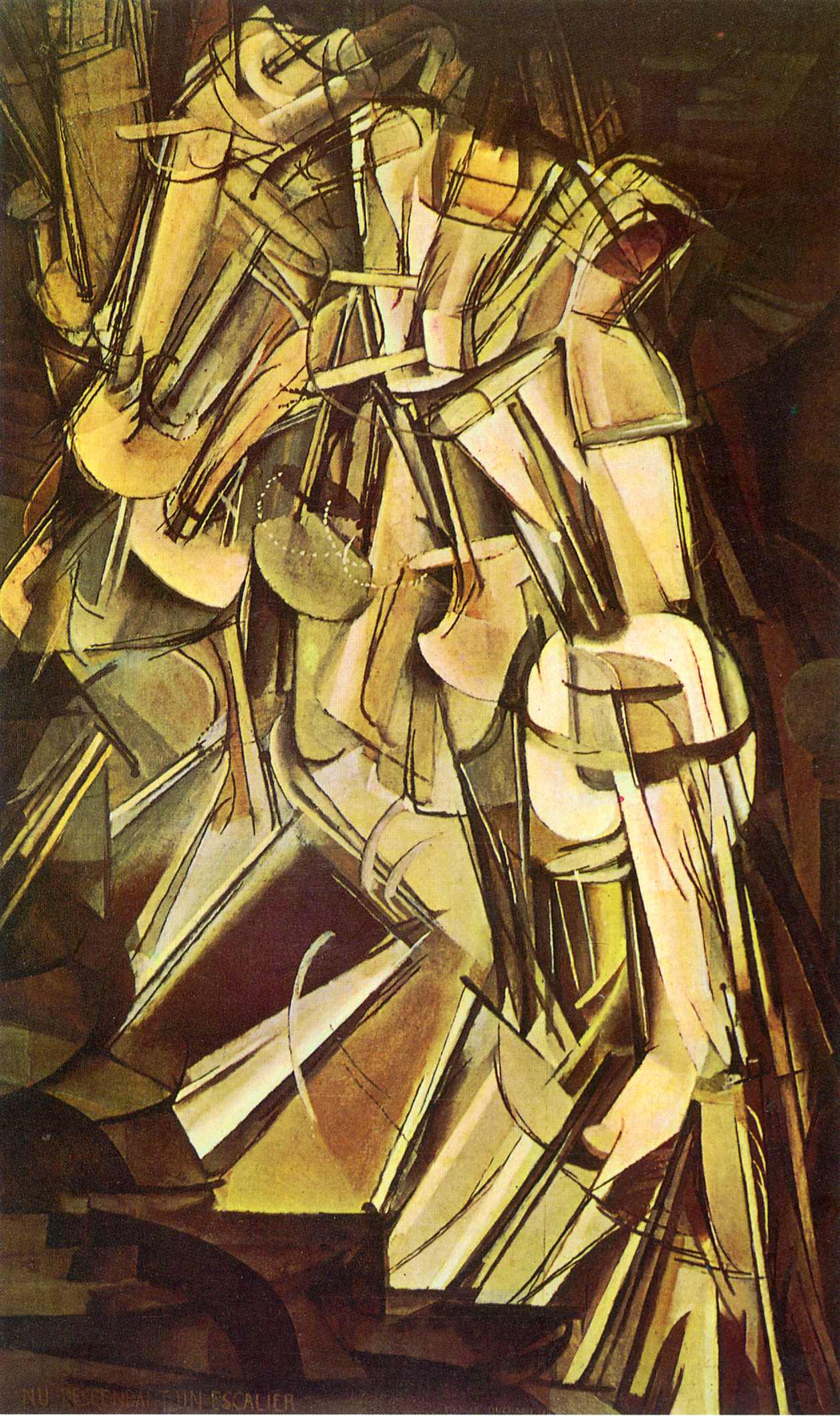
I have long been interested in exploring what a visual representation of phasing from minimalist music might look like so this is the direction that I am setting off in. Duchamp’s Nude Desending a Staircase is an interesting reference point here as well for me it has that same hypnotic, rhythmic, and evolving quality that It’s Gonna Rain has got.
Steve Reich – It’s Gonna Rain
In one of the workshops for DaDa we were shown a delay effect in Studio Artist that gave an interesting visual reminiscent of Duchamp’s painting.
I recorded a short section of the dancer with the difference effect applied from Isadora then took it into Studio Artist.
Difference in Isadora
Interesting effect produced in Studio Artist but really I wanted to see the movement evolve rather than happen randomly
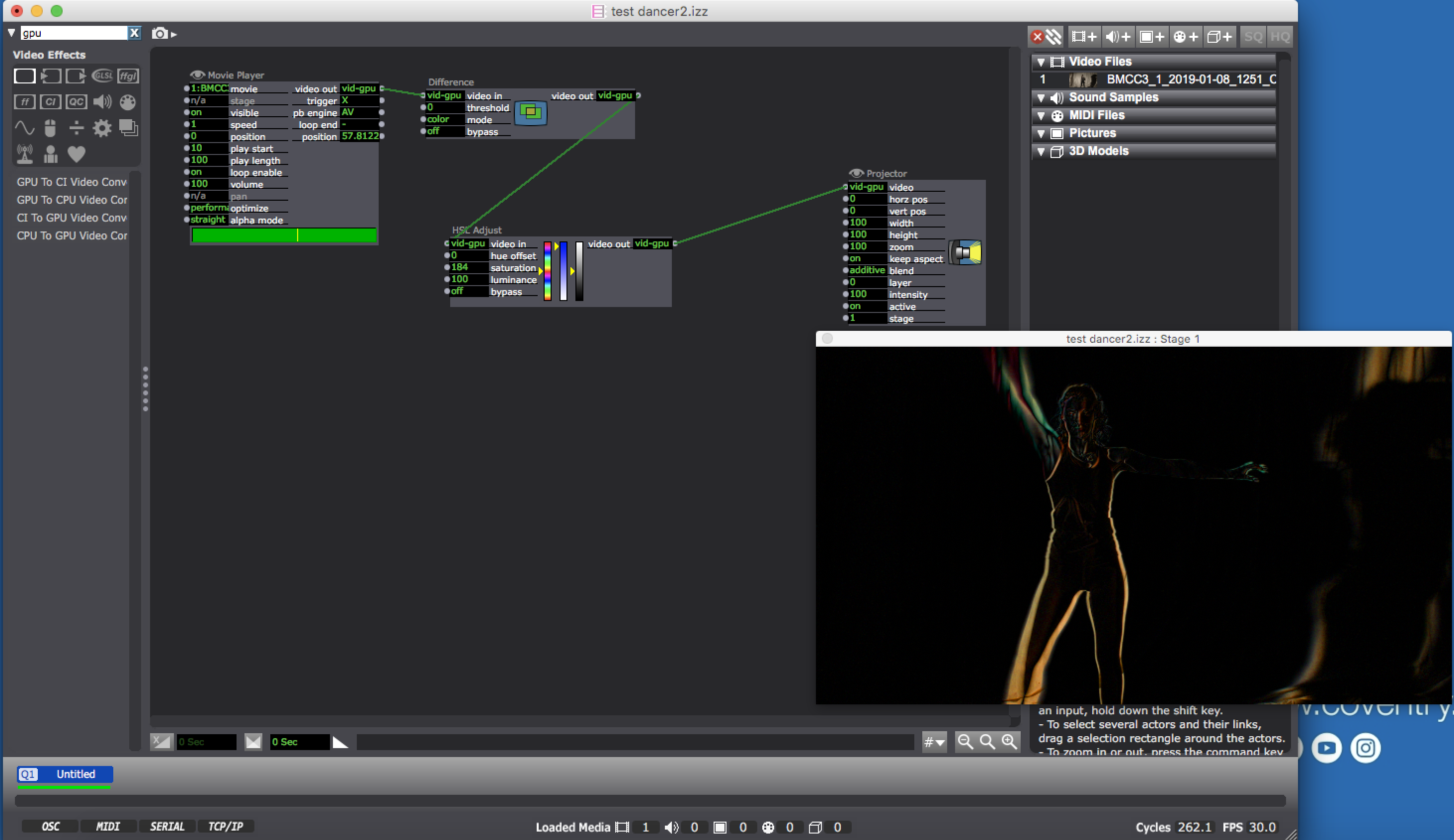
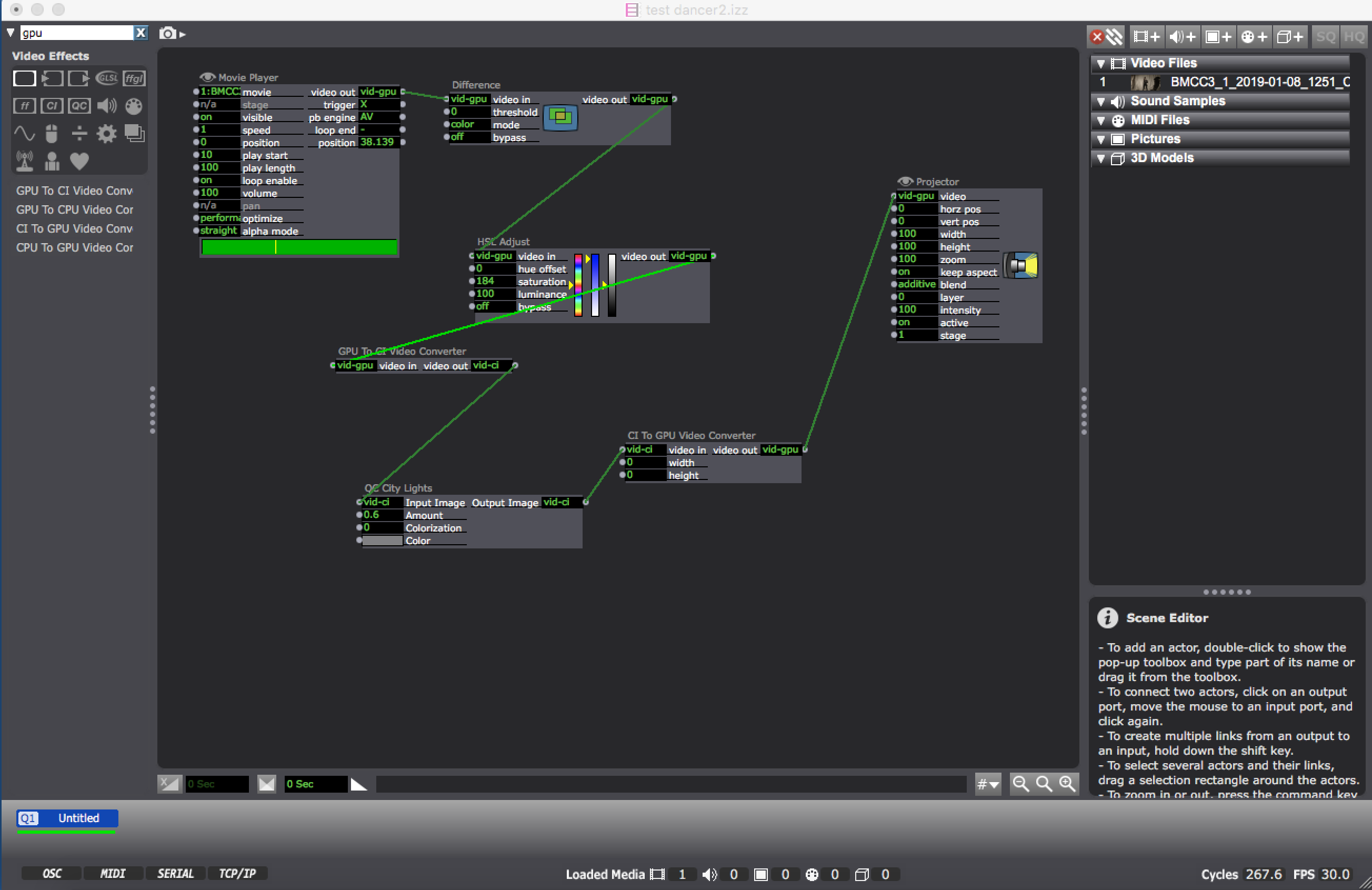
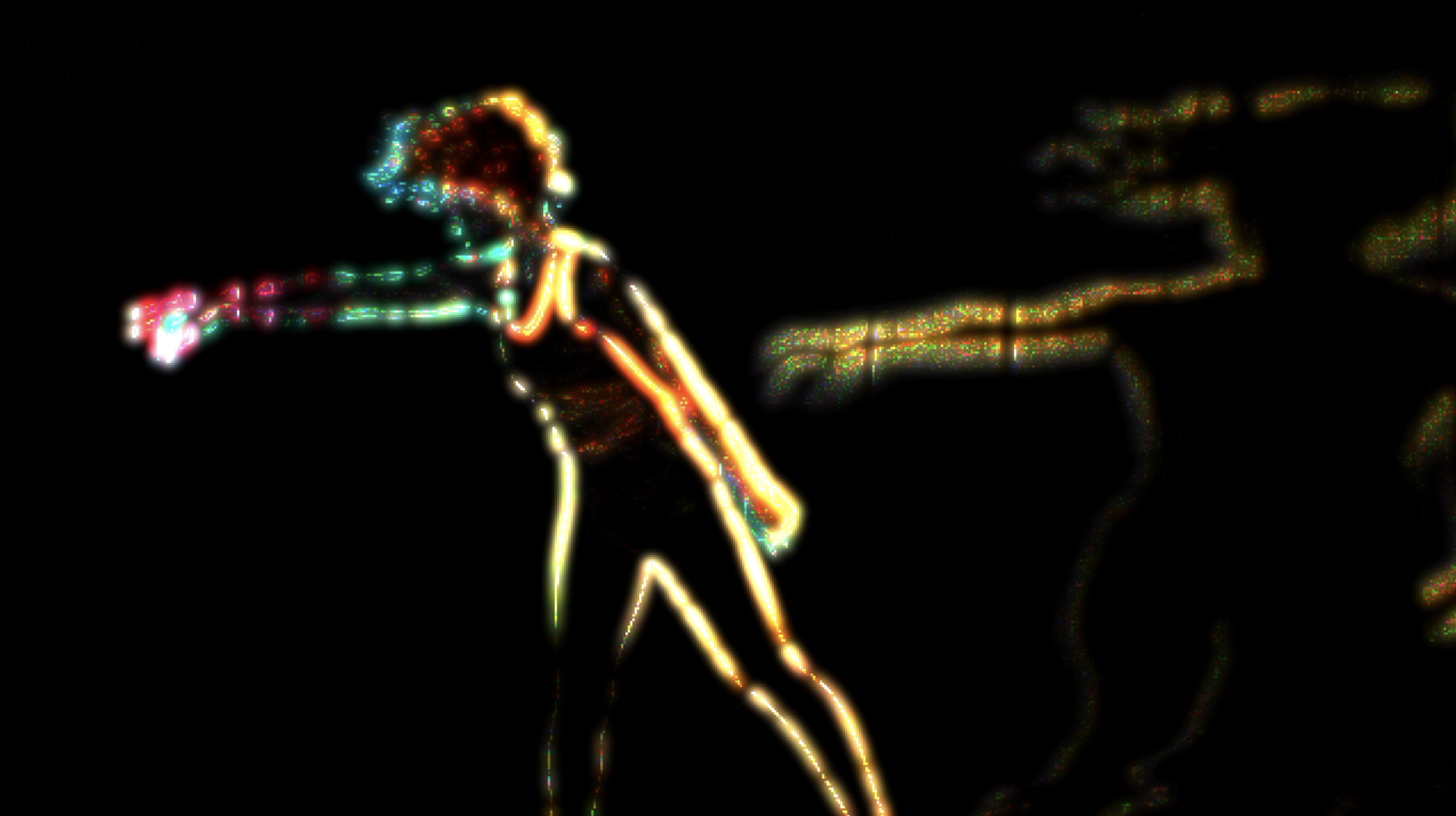
I did several more experiments with the footage with muted tones but wanted to represent the energy of the dance through colour. Going back to Isadora I took the saturation over the top and added the City Lights effect, that produced something that felt light neon lights.
Difference and HSL Adjust used to boost saturationThe QC City Lights actor needed a format conversionDifference, Saturation, City Lights in Isadora
I also recorded a series of short clips and pieced them together to produce a longer section of the dance, I then layered 252 times in After Effects with a series of delays and various lengths of dance loop.
255 layers of Dancer
Interesting effect but it lost something in the chaos of the middle. I went back to the idea of phasing.
The shorter length of loop in this version helps to show the repetition and time delay.
For the most recent experiment I did some maths on the length of the clips and the time stretching that would be applied to the second layer. By using a ration 8/9 I was able to make sure that the two versions came in and out of phase at multiple points during the 2 minutes. Again this was achieved in After Effects.
This week Kino came to a close. I have really enjoyed this project, the experimental context allowed me to pursue theoretical ideas as a tangible practical outcome. Most of the audiences I have shown the film to have not ended up anywhere near the concepts that I wanted to address, but the process has been constructive.
Blogging the process for this project has been less structured than I would have looked as I wanted to explore so many ideas I ended up with a lot of long draft posts that I wanted to refine before publishing. For the movement project I really want to try and find a way of shortening each of the posts to give me a better chance of refining it in one sitting. I think this will really help me to manage the evolution of my ideas to structure how my first principals have become the realised artefact.
There are probably too many ideas in a three minute film, but how can we be sure of an audiences reading of a film when their eyes are scanning between two screens, there are so many variables. I think that the images and sounds have become loaded with so many concepts that in developing the project further I would consider ways to give the audience some sort of foothold to begin the climb.
Amongst the blank faces though I received one comment that made me feel like I was starting to approach something that I was concerned with. One of my peers commented that the long duration of the same image made him start watching the space between the screens. Something that I had wanted to achieve from my first ideas.
As I have mentioned previously I find the exploration of space vastly inspirational. I believe in publicly funding science, and education. I wanted to include this imagery into Kino. A bit of research starting with NASA’s Voyager missions led me to a series of images and animations created from the Cassini mission.
What would the Kinoks have thought of sending a machine to Jupiter to look at what was there in multiple wave lengths? A very mechanical eye.
I was hoping to avoid creating a narrative in the work that I was producing, I wanted to find a way to draw from the natural beauty of the images without adding a documentary narrative.
In my earliest explorations for Kino I had been looking at projecting images back into the environment, I had run into trouble with this due to the low refresh rate of the battery powered projector that I was using. After a brief detour looking at how I could find similar patterns to the planetary images in everyday objects (this did not fill me with wonder), I settled on projecting the images onto other surfaces so that they became reworked, but using a more powerful projector. I did a few tests with some cardboard models as the projection surface as I was thinking of looking at the link between pure blue sky exploration and the materials that enter our lives, but ultimately I settled on my own eyes as the canvas.
I really wanted to use the real Cassini images rather than similar images that I had generated because it is the visceral reality of a machine of our creation being up there that I find so engaging. I wanted to try and get some sense for myself of the randomness and luck involved in these missions with them being flown so remotely so once I had selected the clips that I like I used a random number generator to take small sections of the animations and put these onto a timeline. This randomness would be interesting to explore further in a future project. Below are the animations that were used for the source of the projection.
Kino has come at an interesting confluence for me, the anniversary of Bauhaus has lead to a number of retrospective articles and given me the opportunity to reflect on how our thoughts are shaped by experiences.
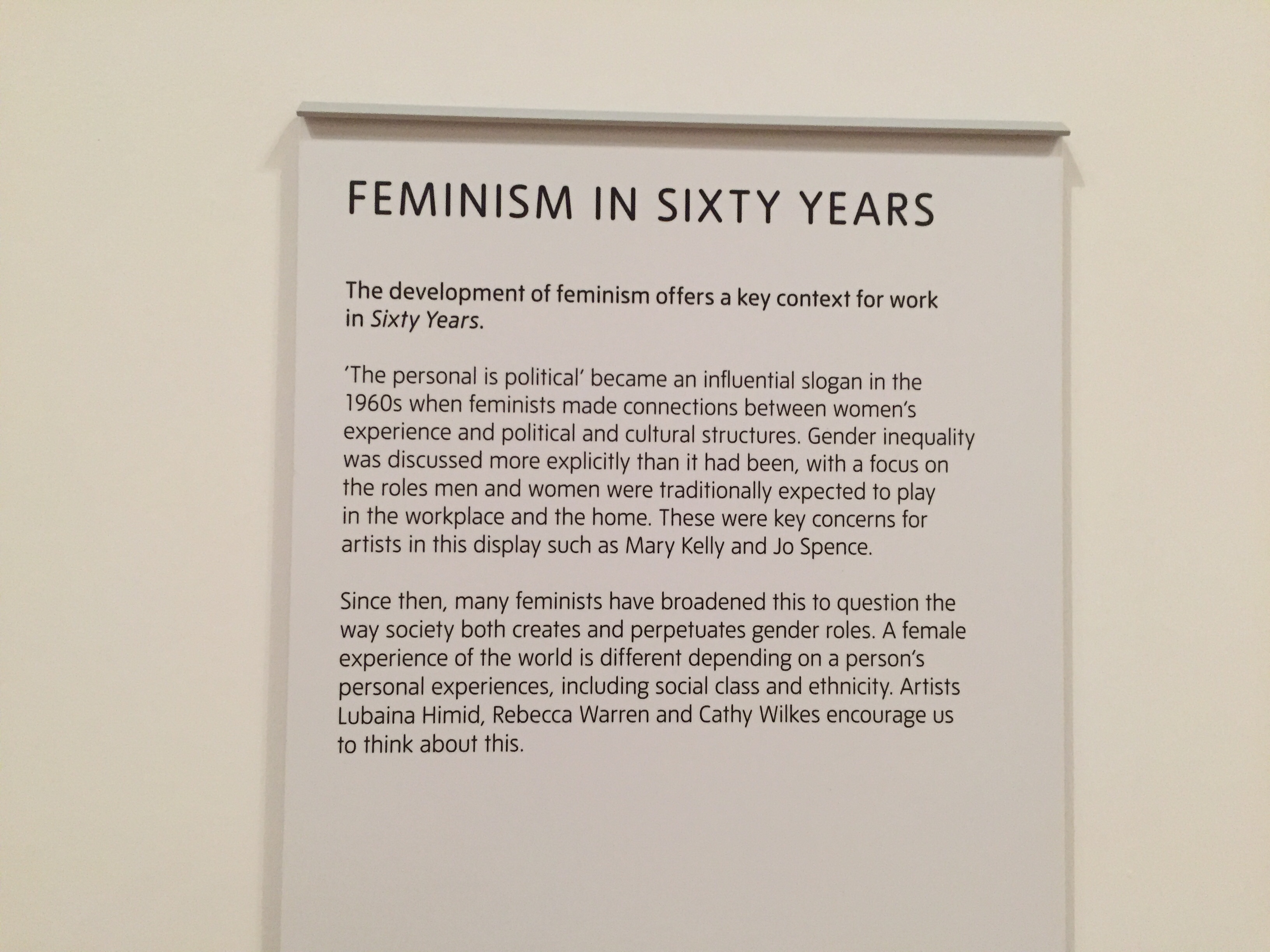
I had a lecturer during my undergraduate degree who was exploring ideas of Feminism through discussion of cleanliness. A single idea struck me profoundly during that lecture, it was the first time I encountered ‘The personal is political’ as a concept. It began an exploration of power, and social norms and values, this has developed for me into a broader rejection of elitism in the arts. I wrote my undergraduate dissertation on the cultural value of mainstream cinema, and the links between consumerism and identity. I came across a phrase in a translation of Michael Foucault, “Nodes on a network”, I have been referring to that idea for so long now that I can’t remember the original source. I can see the mustard yellow of the hardcover book, I can see the desk in the now demolished brutalist Birmingham Central Library.
Birmingham Central Library – Sadly departedBirmingham Central Library – Before the burger chain
Forward
The demise and loss of this modernist oasis first to fast food chains and then to wrecking ball for me has a deeper significance. The John Madin designed Central library was a grand vision of a cultural centre integrated into the heart of the city, it even had a bus garage for the basement. Cost implication never realised the original dream and it slowly fell into poor repair and had poorly planned additions stuck on to make better commercial use of the space. In 2016 it came face to face with Birmingham’s Motto – Forwards.
Library of Birmingham – look at me, look at me. Please!
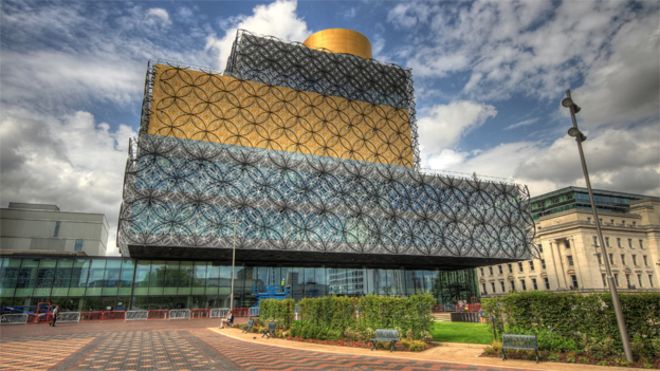
The functions of the library have been replaced by the Library of Birmingham. But where the Central library was an upturned concrete pyramid in the centre of the city the Library of Birmingham sits apologetically off to the side of a square that has slowly lost its footfall as the centre of the city moves over, pulled by new shopping areas. The cladding of the library is reminiscent of Birmingham’s most famous building, the aluminium disk adorned Selfridges building. To me the library is pleading to still be seen as relevant.
Optimimism
When I first discovered the Bauhaus at art school I was drawn to what I saw as an optimistic philosophy. Science, technology, and design can evaluate us, that art is important to society. There are plenty of examples of where the Utopian dream of Modernism didn’t/doesn’t work, the central library is a good example, it was never finished, it was inflexible, it didn’t take into account changing use cases. But in the clean lines, lack of wasteful detail, and simple forms I see a very human honesty; this is the thing that I have made. To me there is hope in a lot of modern art; that new ideas, new technology will improve the world.
Spacerace
Another optimistic anniversary
December 24 2018 was the 50th anniversary of the Earthrise image captured from Apollo 8. Much has been written about how this image has inspired the environmental movement, but for me it is more important as a record of human optimism; there was an idea to go to the moon, plans were made, we went. That is a hugely over simplified and naive statement but I believe that it gets at the optimism that was necessary to dream that it was possible.
Fear of Technology
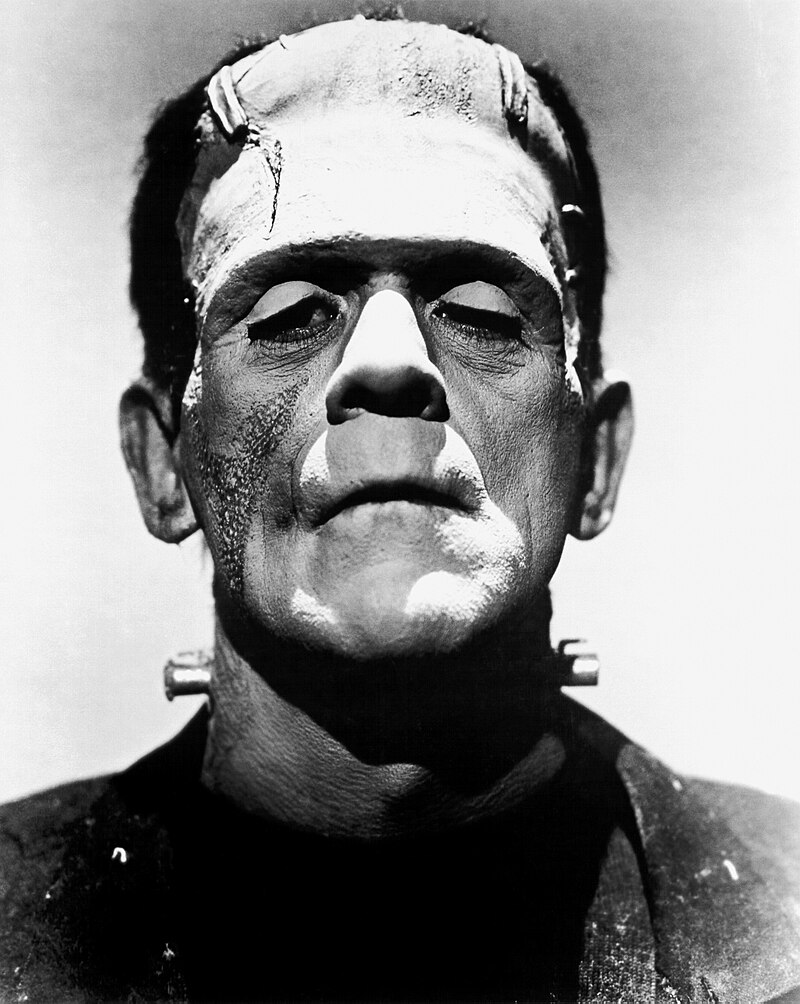
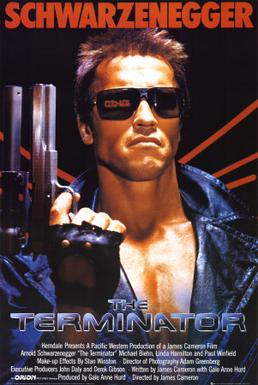
Whatever the causes this optimism in technological progress has in places been replaced by fear. I think that there is a lot of evidence (blame?) for the this in Science Fiction films. The Scientist always goes too far, they create a monster, it kills us all.
Science’s monster – Frankstein’s MonsterArtificial Intelligence will kill us all
The future of our species is in question like never before, which has made farsighted optimism an unusual challenge.
A predictable rejoinder, of course, is that in recent decades that same entity also has been implicated in a spectacular series of disasters: Hiroshima, the nuclear arms race, the American war in Vietnam, Chernobyl, Bhopal, the Exxon oil spill, acid rain, global warming, ozone depletion. Each of these was closely tied to the use or the misuse, the unforeseen consequences or the malfunctions, of relatively new and powerful sciencebased technologies. Even if we fully credit the technical achievements of modernity, their seemingly destructive social and ecological consequences (or side effects) have been sufficiently conspicuous to account for much of today’s “technological pessimism.
The high profile failures of technology have driven the narrative of fear which dominates the socially positive benefits such as hygiene and medicine.
Alternative Truth
Postmodern Pessimism
under the regime of largescale business enterprise the ostensible values of sciencebased technology (matter offact rationality, efficiency, productivity, precision, conceptual parsimony) were being sacrificed to those of the minority owners: profitability, the display of conspicuous consumption, leisureclass status, and the building of private fortunes.
Unchecked capitalism has shifted the narrative, the rise of populism in contemporary politics seems to suggest that the fear of technology is part of a general erosion of the concept of empirical truth. The ideas of the scientific process, repeated measurement, observation, logic that developed out of the Age of Reason are challenged by post-modern ideas of plurality. It seems that the very ideas that have been developed over the 20th Century that challenged centralised power have now been co-opted by the institutions of power.
The politics of power are so complex that it is difficult to begin to unpick the relationships in a blog post but for me the revivalism associated with post-modernism, looking backwards rather than forwards is inherently pessimistic. That is not to say that technological progress is always beneficial, or should be free from oversight, but is there still space for big dreams.
Diversifying Utopia
I need to make one final point before closing out this rambling post that relates directly back to my own practice and values.
I think importantly it is the experiences that seem small but come to dominate, exposure to the ideas of Feminism, Richard Dyer, and Stuart Hall (a very short list), I became acutely aware of the privileged position that I was fortunate to occupy in society, and also the lack of diversity in the Bauhaus, and amongst modernist thinkers in general. It forced me to question how inclusive these visions of the future were
In developing my response to Kino I want to address make specific acknowledgment of the privileged position of my point of view. By turning the camera back on my eyes, a literal male gaze obscuring the other ideas that I was address.
My audio for Kino underwent a circular process and ended up right back with my initial idea of using a mathematical sequence to derive a midi sequence which would in turn ‘play’ a software instrument.
Music detour
In between this I had a detour via the work of Laurie Anderson, having discussed my ideas and tests with a number of people I found that the ideas I was exploring were rather opaque (I eventually decided that this was ok). At this point I had a chance encounter with Laurie Anderson’s O Superman again.
The combination of spoken word and synthesised vocals sent me off down a path to produced a generated voiceover. I used a series of rules, based on sampling random sentences from my notebook, to develop a script for a voiceover that I then gave to the voice generator in Adobe Audition.
Once I had heard the first test I felt that I would be moving too far in the direction of having a narrative to the piece so I dropped the experiment at this point.
Return of Recamán’s Synth
At this point I was preparing for the main filming of the project so I spent some time away from the audio, whilst researching as much footage from NASA planetary probes as possible I started to consider the ideas I discussed regarding who made these discoveries, I realised that I would not be able to fit this into the already overloaded visuals of the project and realised this was pushing me back towards an algorithmic soundscape.
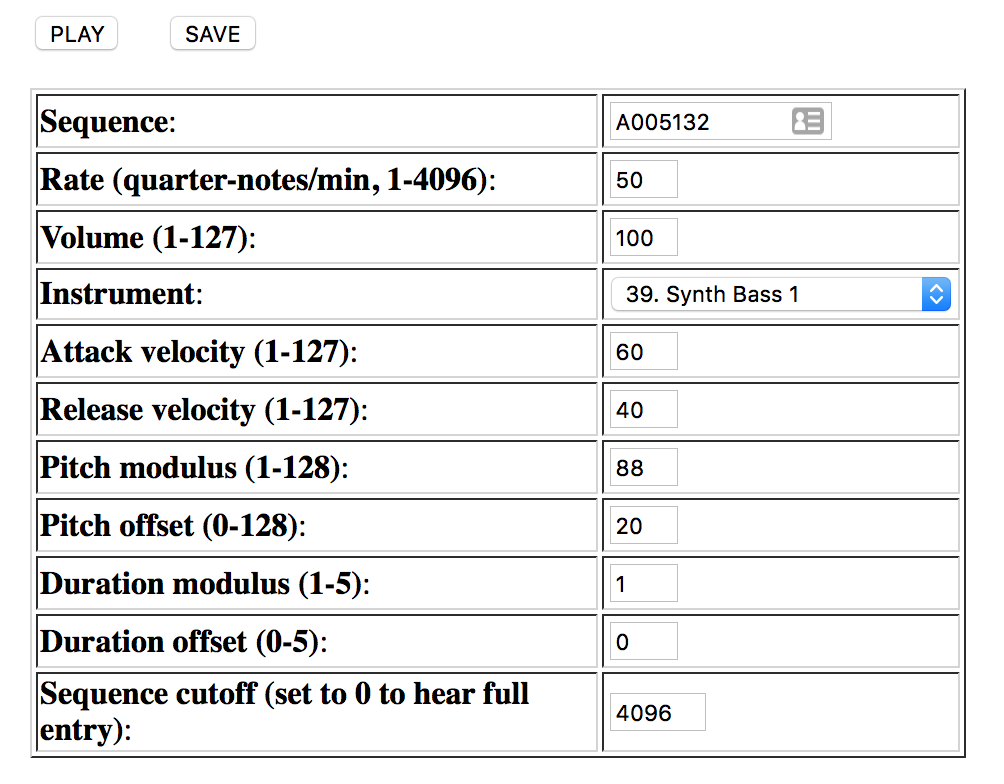
I came across Recamán’s sequence several years ago and became fascinated by the way it was both rigidly structured and unpredictable. There is a really useful feature at The Encyclopaedia of Integer Sequences where you can export a Creative Commons licensed midi file for any of the sequences of numbers. Recamán’s sequence can be found here.
Recamán’s sequence (or Recaman’s sequence): a(0) = 0; for n > 0, a(n) = a(n-1) – n if positive and not already in the sequence, otherwise a(n) = a(n-1) + n.
Recamán’s Sequence visualised as a graph – https://oeis.org/A005132/graphThe settings used to generate the midi sequence
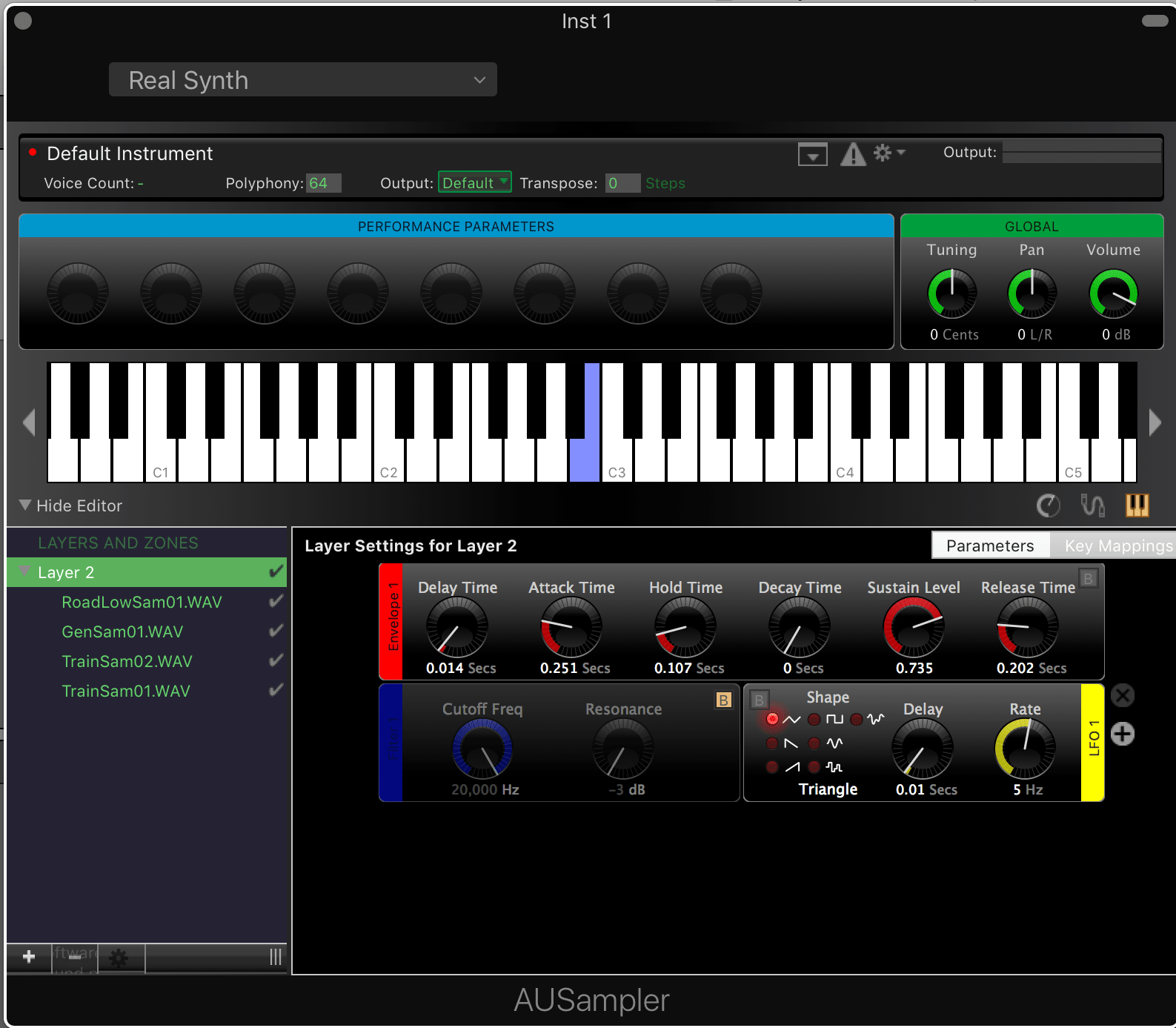
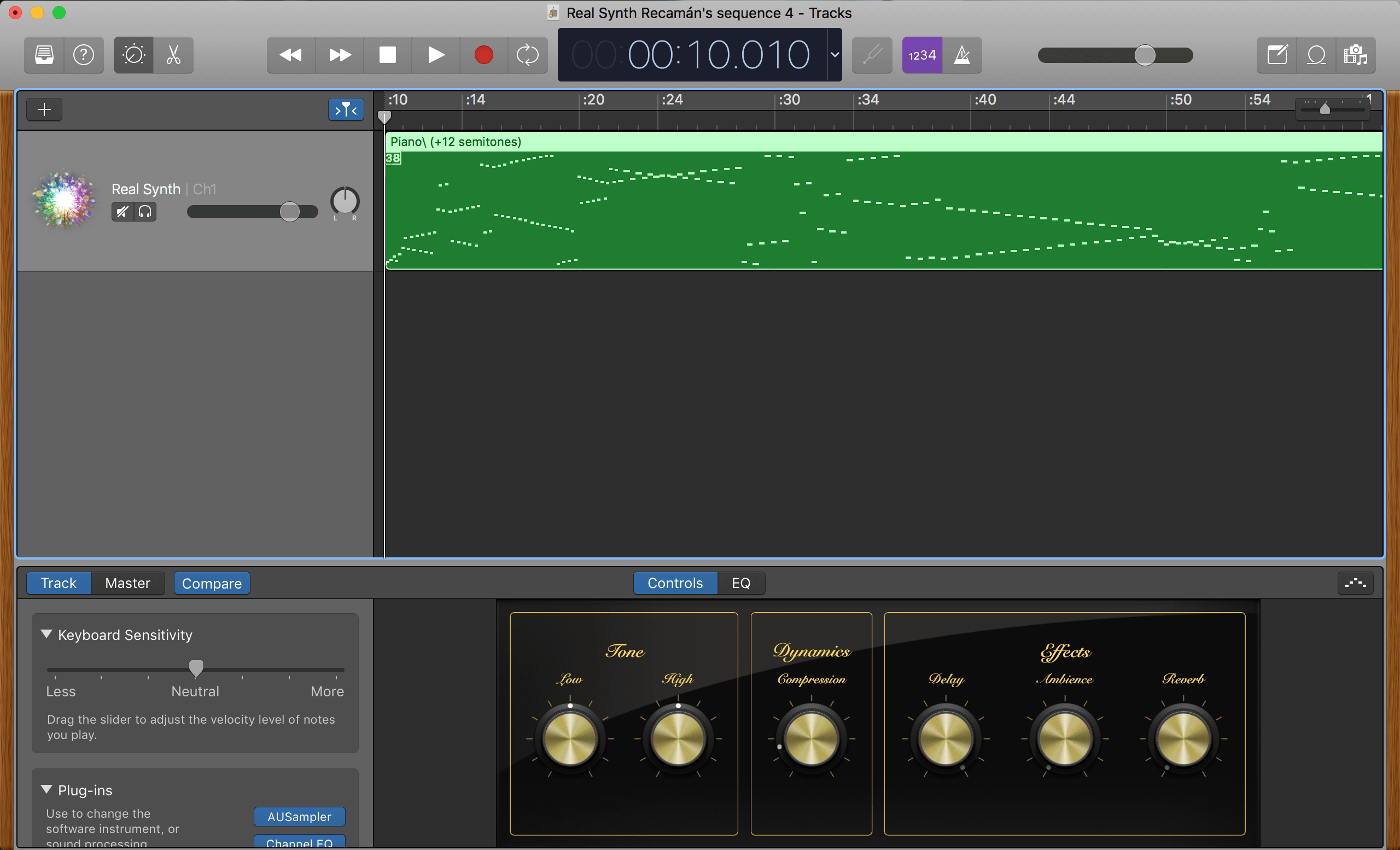
Once I had the midi file I went back to a project that I had been working on to create a software synthesiser using the Musique Concrete technique. In Garageband I created a software instrument using the AU Sampler plugin.
Four short audio samples mapped to the keys of AU Sampler
I specifically used samples that had a range of pitches as well as different audio textures.
AU Sampler Settings
Track settings with added reverb
Mathematically powered synthesis
I am hoping that the structures of soundtrack will reflect the structures of the visuals.
In my last post I was discussing my thoughts on the way scientific progress has allowed us to see further.
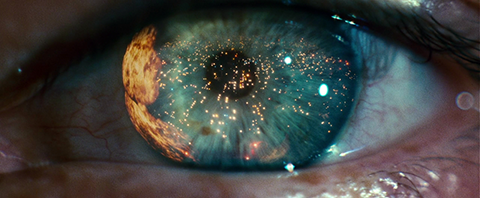
One of the central images of Blade Runner is the eye. In the film artifical life forms, Replicants, are a tool used by humanity but they are banned on earth, they an be identified from humans by their lack of empathic response as given away by their eyes. Personally I think it is very ambiguous if the are genetically engineered, machine or a mixture but I don’t think it matter, in fact I think the plot and narrative of Blade Runner largely make no sense. For me the power of the film is in the poetry of the images and how they are used to suggest themes, the combinations of images and sounds have and internal picture logic that explores what it mean to be human, for me Blade Runner is about humanity.
Eyes being ‘made’ in Blade Runner (1982, Ridley Scott)
In the scene pictured above one of the Replicants looking for more information on how he was made confronts a genetic designer who makes eyes.
I just do eyes, just genetic design, just eyes. You Nexus? I design your eyes.
Blader Runner (1982)
The designer, whilst fearful, is also perversely excited to see his creation living, like Dr. Frankenstein the designer is killed by his creation.
If only you could see what I have seen with your eyes.
Blader Runner (1982)
Along with the eye imagery this line from the lead replicant, Roy, has always stuck with me as being integral to the theme of the film. What makes us human, and how do our experiences play a part in this. It is reiterated in a more famous line from the end of the film.
I’ve see thing you people wouldn’t believe.
Blader Runner (1982)
As I was developing my response to Kino I began to ask myself the same questions about the images that the probes we have sent to other worlds have seen. The voyager missions have now left the influence of our sun, there are people who have dedicated their careers and lives to maintaining, tracking, and analysing the data from the missions. There are countless stories of the thrill of discovery as images or data came through. But can we say that this is our discovery, second hand with voyagers eyes?
As we increasingly use algorithms and machine learning to help sift through massive data sets, and select targets for telescopes are the observations that are made still ours to claim?
Referring back at discussions about Duchamp and intellectual provocations for work I am inclining back towards using a mathematical sequence to generate the soundscape for the Kino project.
I spent this morning capturing a more refined version of my idea for Kino, I recruited two crew members (thanks Callum and Alex) to help with the setup and filming as I wanted to be in the piece myself.
The filming only took six minutes after setting up and testing for over two hours. I was really hoping to achieve the effect that I was looking as close to down the lens of the cameras as possible which proved difficult as the shadow from the projection kept falling in shot. By raising the projector to a steep angle it moved the shadow down almost completely out of the frame but it is still slightly noticeable in the lower corners,I need to live with how it looks for a few days. Production is always compromised, I feel at the moment that I have made the right ones. I think the final direction that I appear to be looking works better than directly into the lens as it does not appear that I am looking at the viewer, this hadn’t occurred to me until I was editing this test together so I am happy that my original idea wouldn’t quite work. I am also please with how still we managed to get the shot without resorting to strapping my head down as I did not want it to appear that I was being forced to watch, but rather choosing to look through curiosity.
I am preparing a detailed post about the images that are being projected onto my face and how they were chosen and arranged.
The audio is reused from the concrete sound project but reversed, I am still working on the audio and wanted something to stand in.
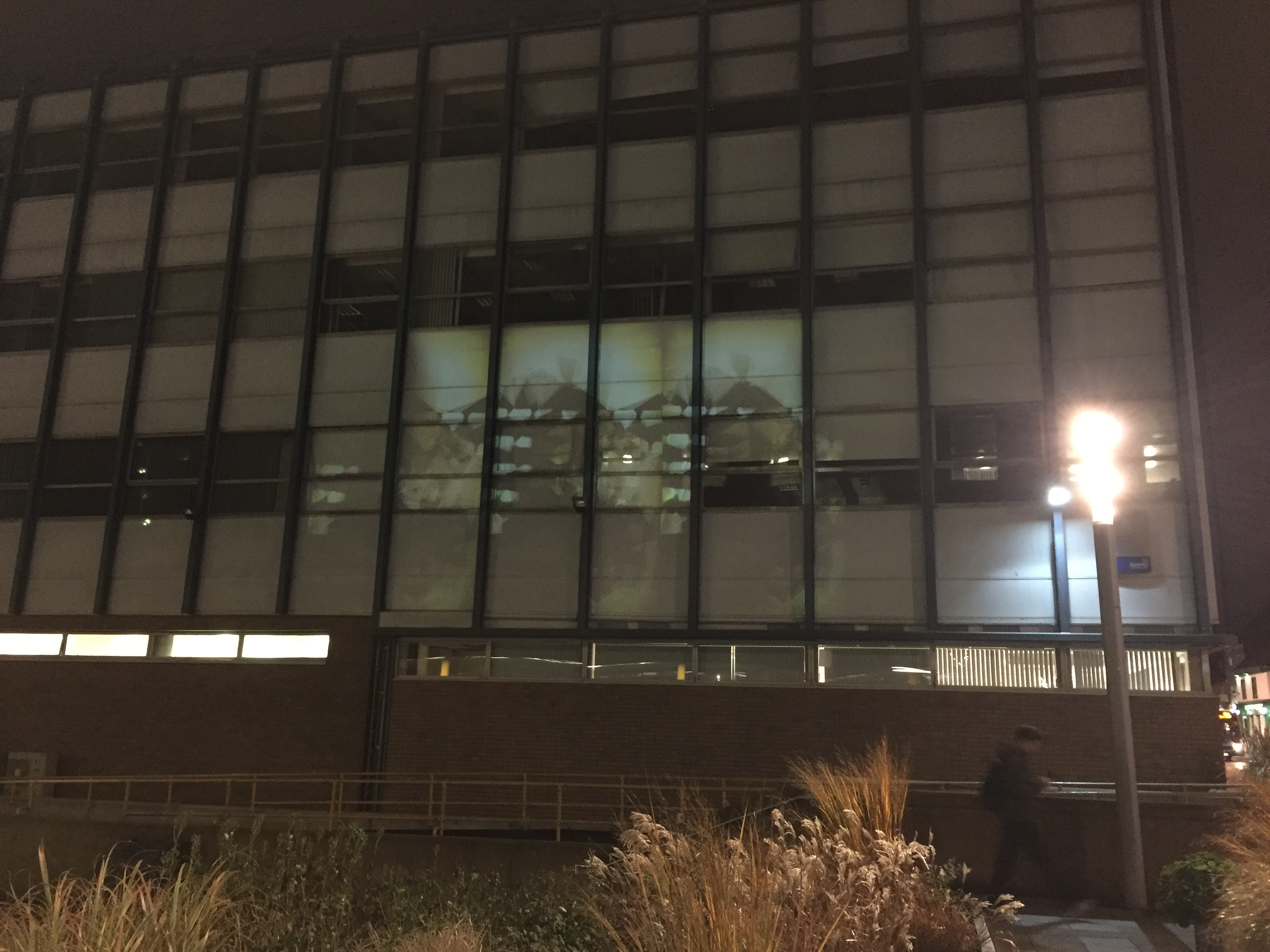
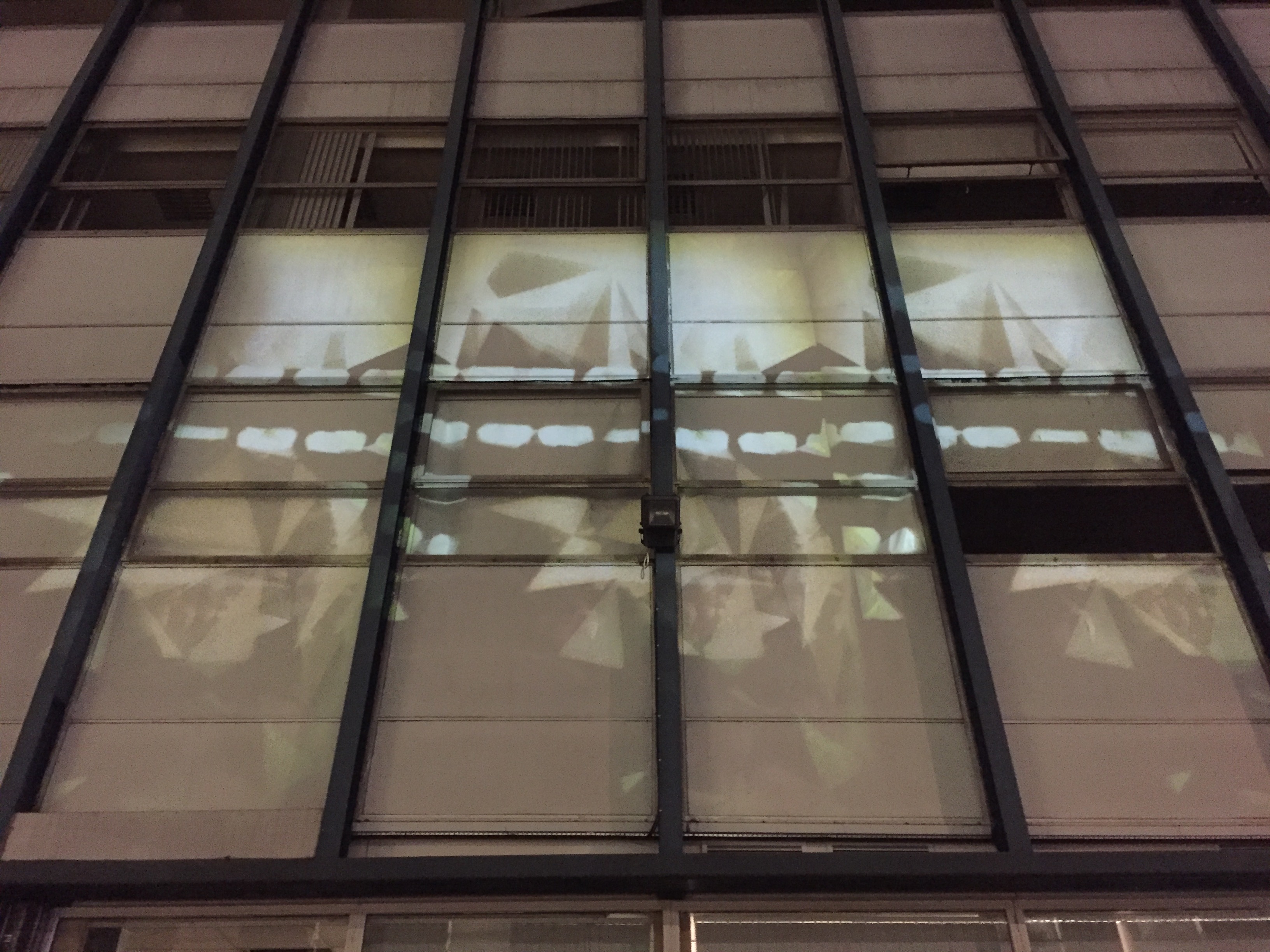
On the same evening that Zero was exhibited in the Tank DaDa was projected onto the wall opposite. I was pleased that the work I had put into making the image readable when projected onto the wall was successful, there were clear sections of light and dark that described the movements of the hands.
The treatment of the video produced a new piece of work that responded to the location that it was going to be exhibited. Producing this piece alongside Zero was an interesting counterpoint as it felt to me like a different path to explore the same question; What can moving image media be? With Zero I felt that the process of theory and practice integrated to develop the piece of work. I never felt like I managed this same integration with DaDa, I feel like I was asking too many different questions for a piece of just thirty seconds.
Light and Dark, Colour and Shape, but what is it all for?
I think the missing step for me here was not asking myself about the question of choice of tools; What is the strength of Studio Artist? In not exploring this critically I was left feeling a detachment from the tool, I think this was mostly mitigated in the final piece because of the number of revisions that I did. Trial and error eventually led me to a product that worked but the process of exploration was not satisfying. I think that this will be an important consideration for Kino as the fairly open area of exploration could lead to a lack of direction and difficulty gaining momentum to the process.
After showing DaDa triple and watching some of my peers work I decided that there were too many competing elements in that version so I decided to focus on repeating one of the processes across the three panels. I also made a final adjustment to the colour and contrast to hopefully help with the clarity when projected.
After the complete disaster of the first Kino test I went back a few steps, I have been exploring the idea the science can physically change the way we see the world, smaller, further, into different spectrums. I am interesting in exploring how this ‘seeing’ reflects back on the watcher. I have projected a series of astronomical images onto the face and focused on how this changes the eyes.
I want to find a way to lock off the head so that the only movement is the eye and projection, I am also going to film both eyes simultaneously.
The sound is a continued exploration of Recamán’s sequence played through a software sampler that is using small sections of everyday sounds as the notes. I think this is far too jarring at present but there is something in not that I want to pursue. I really like the way that it is very procedural, it is hard for me to tell what will happen before I have run it through.
Thursday 6th December Zero screening, final thoughts.
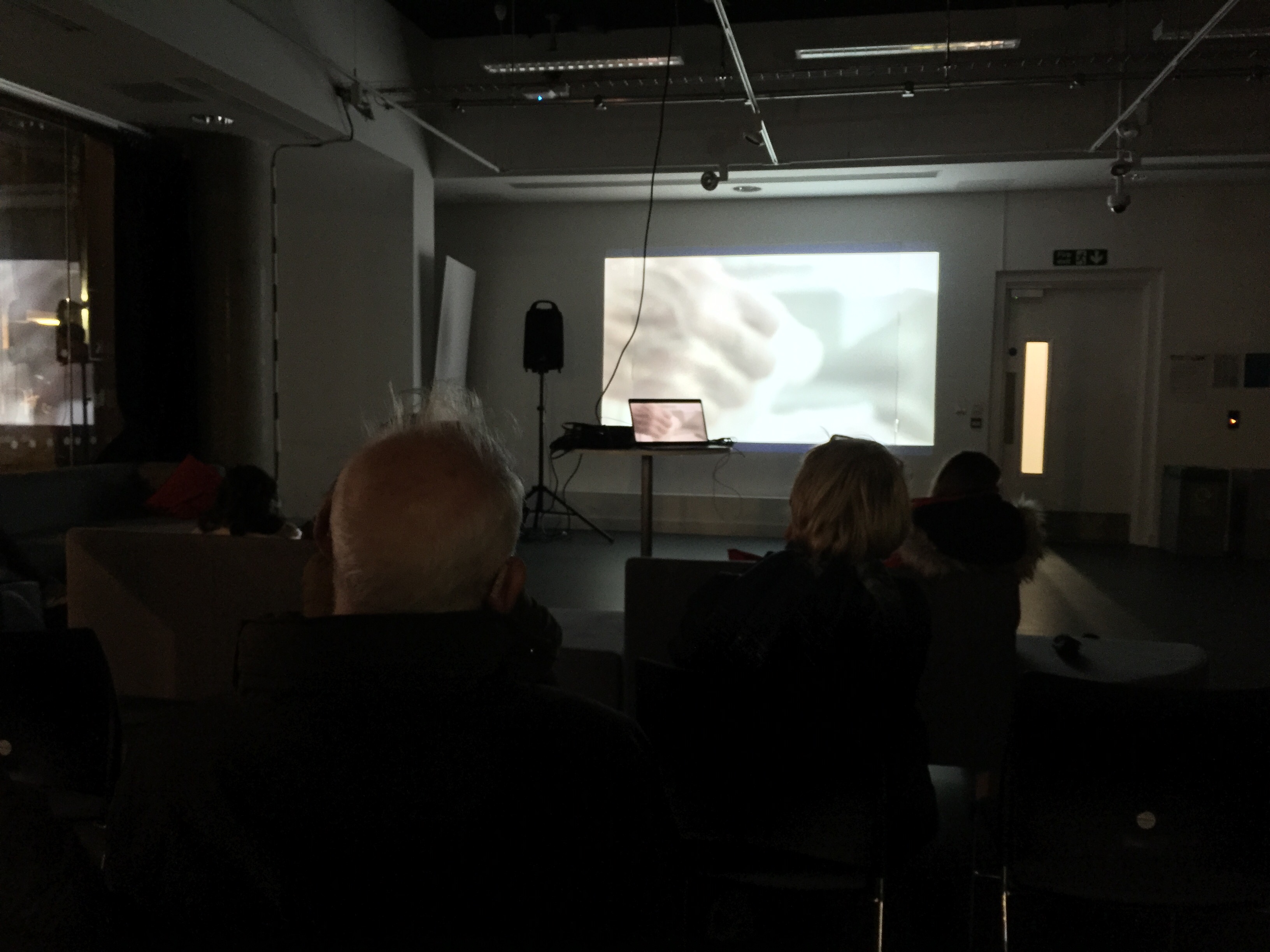
Situated in the midst of the rest of the Zero projects I was happy that the reflective pacing of the film worked as I had intended. I had some nice feedback from some viewers that the film made them think of their Grandparents. More importantly for me I felt that I had done the subject justice within the time requirements.
I was also able to enjoy the experience of having the subject of the film attend the showing.
This project has pushed me to reconsider what a film is, the form is not fixed, the rules are set not because they are inherent but because we have become comfortable with them. Challenging the rules of presentation doesn’t result that the content of the film also has to be challenging. For me the most successful of the zero projects were those that forgot about trying to tell us a story and allowed us to spend time with someone. I was reminded of the sensory filmmaking techniques that we discussed earlier in those films that allowed us a window onto a different world. The only similarity that I noticed between these films was that the camera and edit reflected the subject. The intensity of a kickboxer’s training was echoed in the fast repetition on the hits and saturated colours, while a cat was nursed back to health in neutral colour palette and thoughtful pacing. In both cases the emotion of the moments dictated the rhythm of the cuts.
Following on from the previous series of experiments I went back to the original rushes and processed these further before taking them into Studio Artist. I was looking to focus the viewer specifically on the hands and also the repetitive nature of typing. I decided to crop, repeat, and loop one of the sections. I also further exaggerated the contrast in the footage to give it the best chance of being visible in the exterior environment, this is something that I was very conscious of after the experience of the Concrete project.
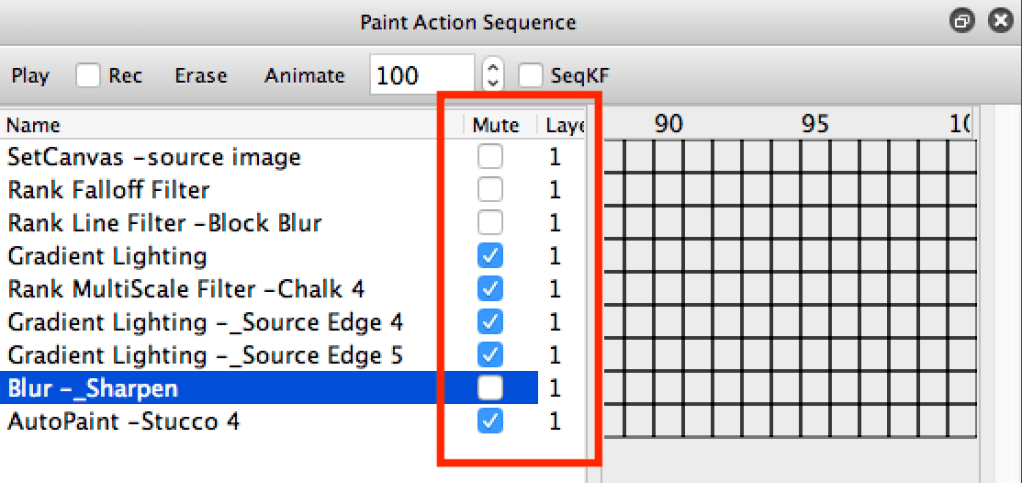
Muted Action steps are skipped to remove that adjusted to the look of the image
Adjusting the Studio Artist presets by turning off specific steps during the processing I was able to manipulate the output to give me a look that worked to give me a look that was tailored to what I was trying to achieve. I settled on these three looks as I felt that they all integrated the different aspects of the image, creating a surface where it was difficult to separate human and machine but the movement of the hand was still identifiable.
I then combined the three panels in Premiere, I think this helps focus a viewer of the repetitiveness of typing.
Lots more experiments with Studio Artist to find a process that works with the footage, the intent, and the delivery environment.
Working with the second version of the raw footage, the rectangular treatment is interesting and references the building that is being projected onto. The camera angle doesn’t really emphasise the hands.
The previous two are good examples of several of the processes that I tried where the end result looked like an effect applied to video. Although the hands and movement are still clear the process doesn’t add anything other than a superficial look.
This is a good example of where a process overwhelms the original imagery. The intense flickering in this version becomes the focus rather than the hands, the original footage could have been anything.
I have previously worked on some theatre and outdoor projection projects and have seen that image contrast is important in getting a projection that has impact when projected onto a surface that already has texture and colour. Subtle textures and patterns were often lost as well.
I could have taken this into consideration when lighting the footage that I shot as the basis for this project as the raw footage is fairly flat. I tried to try and rectify this by pre-processing the footage before taking it into Studio Artist.
Towards something that works
I think the process here has started to enhance the original footage and started to explore the relationship of the hands to the machine, the merging of the hands and the keys into the same surface treatment starts to explore the interaction between humanity and technology that I was interested in. I think the line work around the letters currently draws too much attention.
Over the past few weeks I have experimented with a number of edits of zero and have had some really thought provoking feedback. It has reminded me that film-making is a privilege and that the same film can have an infinite plurality on meanings and uses for its audiences no mater the intentions of the film-maker.
The spectrum of responses has been as wide as the experimentation in the edits that I have explored. I am sure that I could push further with this and find other films within the footage. Specifically I am going to explore a longer cut for my family that is a record of the time, a memory bank capturing this experience that my family has shared. I am also going to explore a the potential of a three screen piece to allow the interwoven themes to work in parallel.
The common thread that I have picked up between all of the conversations around the film has been how abstract should it be, specifically with regard to the amount of out of focus footage that is included in the piece, and how much clearly the intentionality of this is signposted.
The fish washing cut was something of a personal experiment that I had not initially intended to screen. At the time of that cut I was moving back towards a more conventional cut that attempted more explicitly show the relationships. Based on a screening of the the long cut I was also trying to explain the inclusion of the out of focus footage.
After a few days away from the edit I was interested to see and see responses to fish washing. It clearly had the most polarising response but even those viewers who disliked it (intensely in one case) they had things to say about it and were articulating some of the themes that I wanted to explore, even whilst saying they didn’t understand it. Comments such as “I had to listen harder because I couldn’t see” and “I liked the sound of the water running” made me think of films using sensory film-making techniques.
This response is encouraging me to use this edit as my final submission, I am going to revisit the audio as I have yet to pay this much attention. I think that in the context of a screening in a gallery amongst other Zero Films this version of the film feels honest to the approach that I wanted to take in making this project.












 mattprentice