The live capture and collaboration last week resulted in an exciting day of experimentation that resulted in a project that joyfully threw away the careful development of my own movement piece. This gave me some interesting development point for future exploratory projects. Below are some of the results of combining my final movement piece with other creators Isadora stages, my stage with their movement piece, and my stage with a live pilates class.
Aaron’s Isadora stage processing my video
My Isadora stage processing Katherine’s video
Live pilates through my Isadora stage
Is was really interested in the way that the way that the result of this was a visual representation of the clash of ideas and ideologies of the artists working on the projects, often what results is much richer and more complex than I could produce on my own. To me this reflects the importance of having a plurality and diversity of voices in social discourse, the result can be more subtle, vibrant, and inclusive. To celebrate the results of this collaboration I create an edit that brings together these experiments with a modified version of the track that I created to accompany my movement piece.
As I noted at the start of this project the original footage that I captured for this project was only intended to be a test but became an important part of the experimental process the I adopted for this project. The dancer had originally performed without any music so thew only sound that I had was that picked up by the cameras internal mic.
Listening to the sounds repeated whilst working in Isadora I became interested in incorporating these accidental sounds the way that I had the images and created a number of loops from the sounds of the dancers breathing and joints, and our communication before and after the dance.
Short loop created from the dancer’s breathing and joints clicking
What the mic capture after the camera roles
I used a series of phasing and layering techniques that I have experimented with over the course of the year to develop a layered soundscape that mirrored the looping evolving aspect of the visuals.
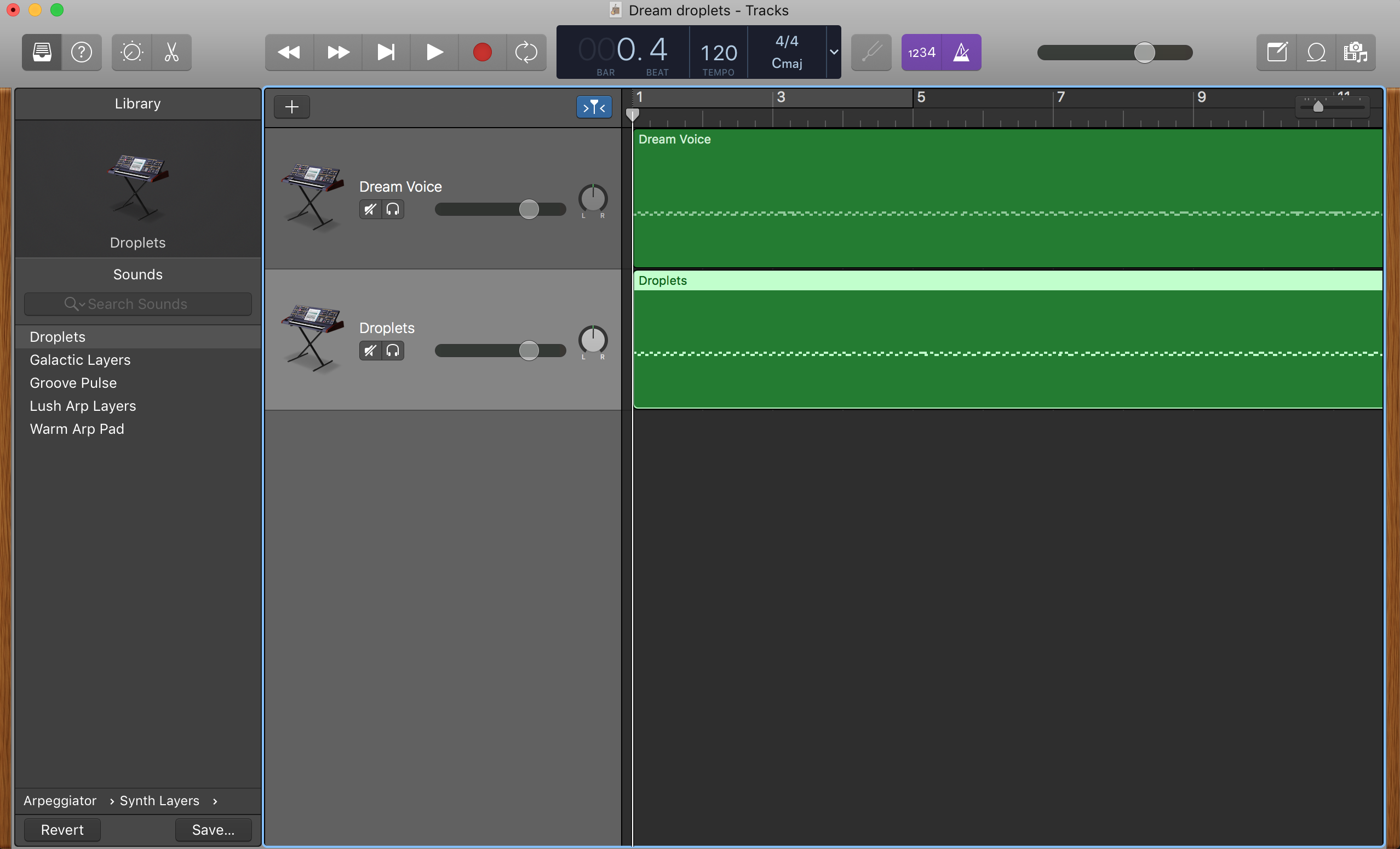
After screening the the piece to a number of groups I became aware that the I wanted to add some kind of musical elements to add texture and also introduce a more harmonious, positive aspect. I had been listening to Jon Hopkins and picked up a the texture of quickly repeating notes in a number of tracks that seemed to blend into a single sound. I created a simple approximation of this using two stock synth sounds in Garageband and repeating the same notes as quickly as I could. I wanted to do do this manually rather than looping the note because I wanted the texture of the sound to contrast with the digital looping of the images and other sounds.
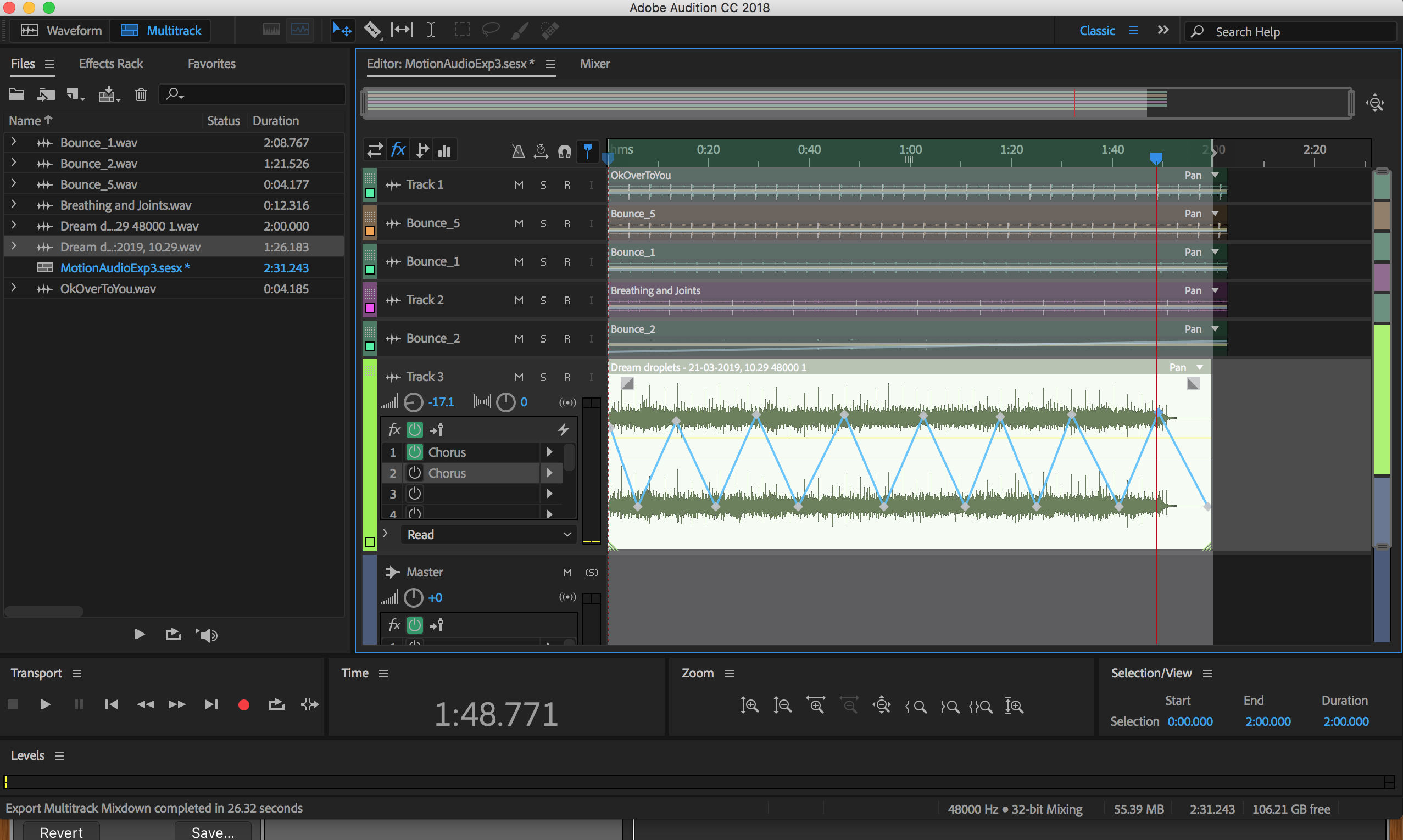
I layered this back over the existing vocal and distorted breathing loops to create the version of the track that was used during Isadora Live capture sessions.
Track3 is the synth sounds with additional layers Chorus applied, this is panned back and forth across the soundstage to create spaceThe synth sounds are mixed low in the mix so that they don’t overwhelm the other aspects.
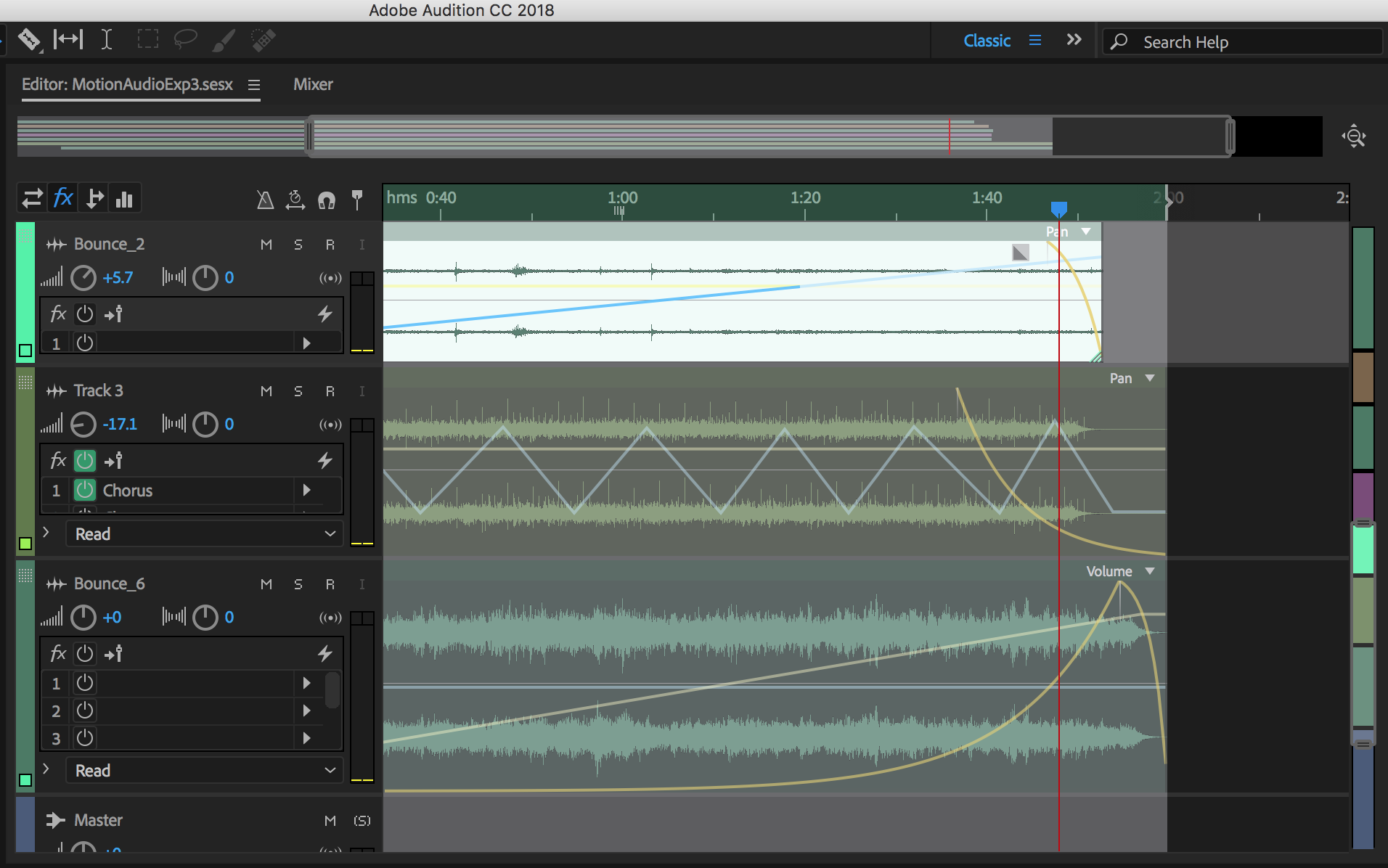
During those sessions I felt that the track ended too abruptly to work as a piece that would be used on its own with the visuals so I added a swell to the end of the track that could be used with an edit of the footage captured during the Live sessions.
Track Bounce_6 creates a swell in the synth track that helps to create a sense of resolution at the end of the 2 minutes
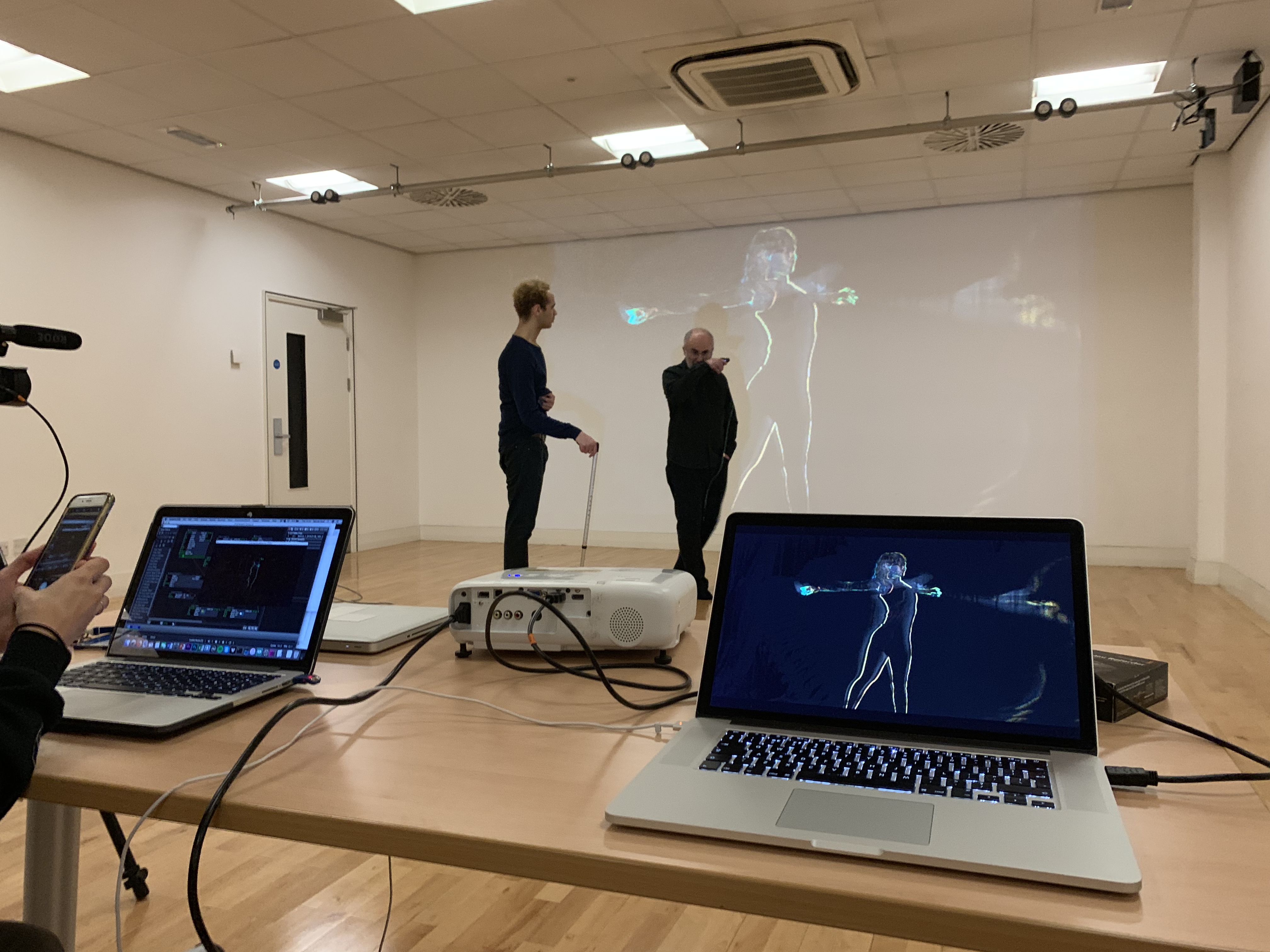
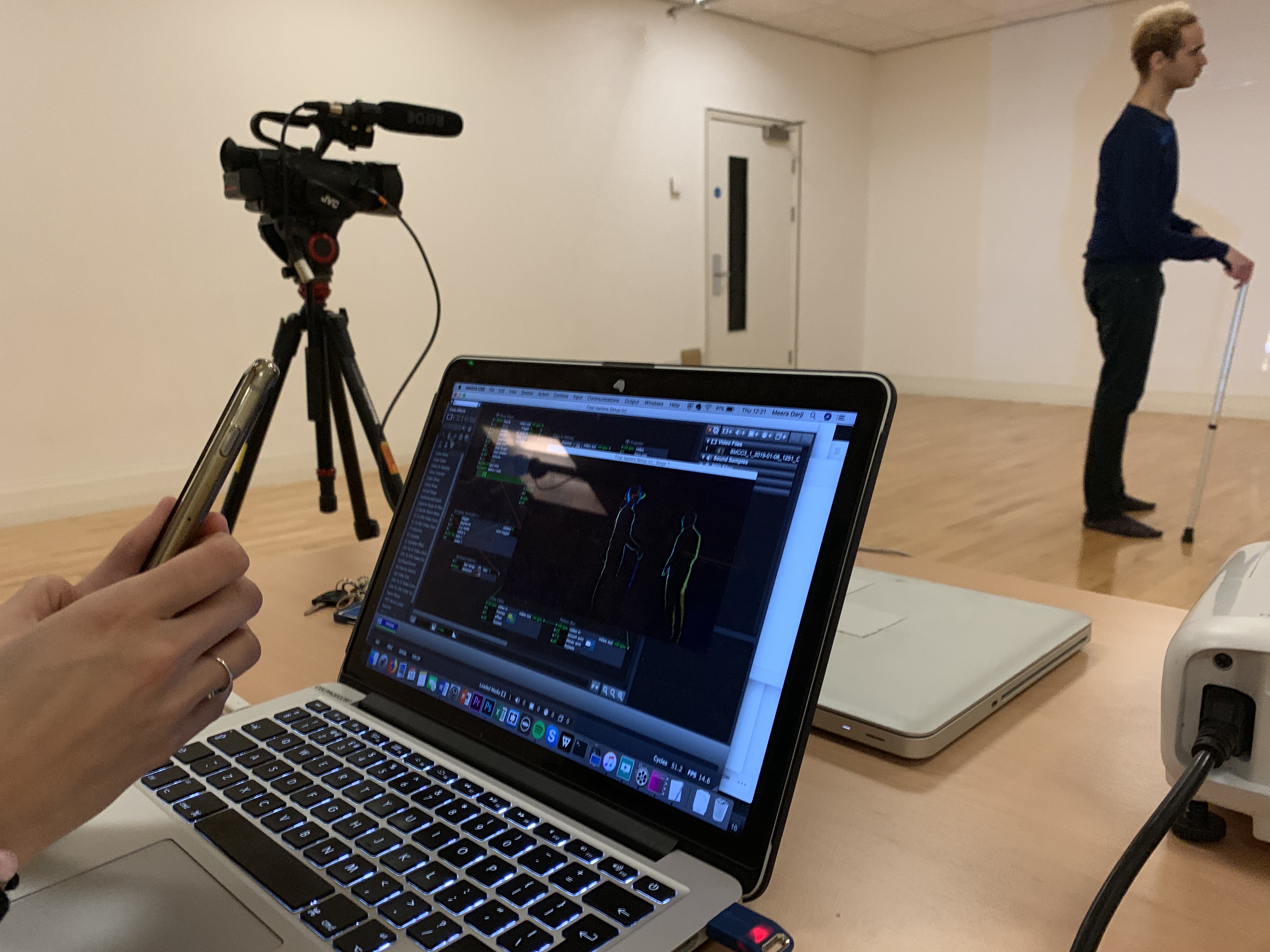
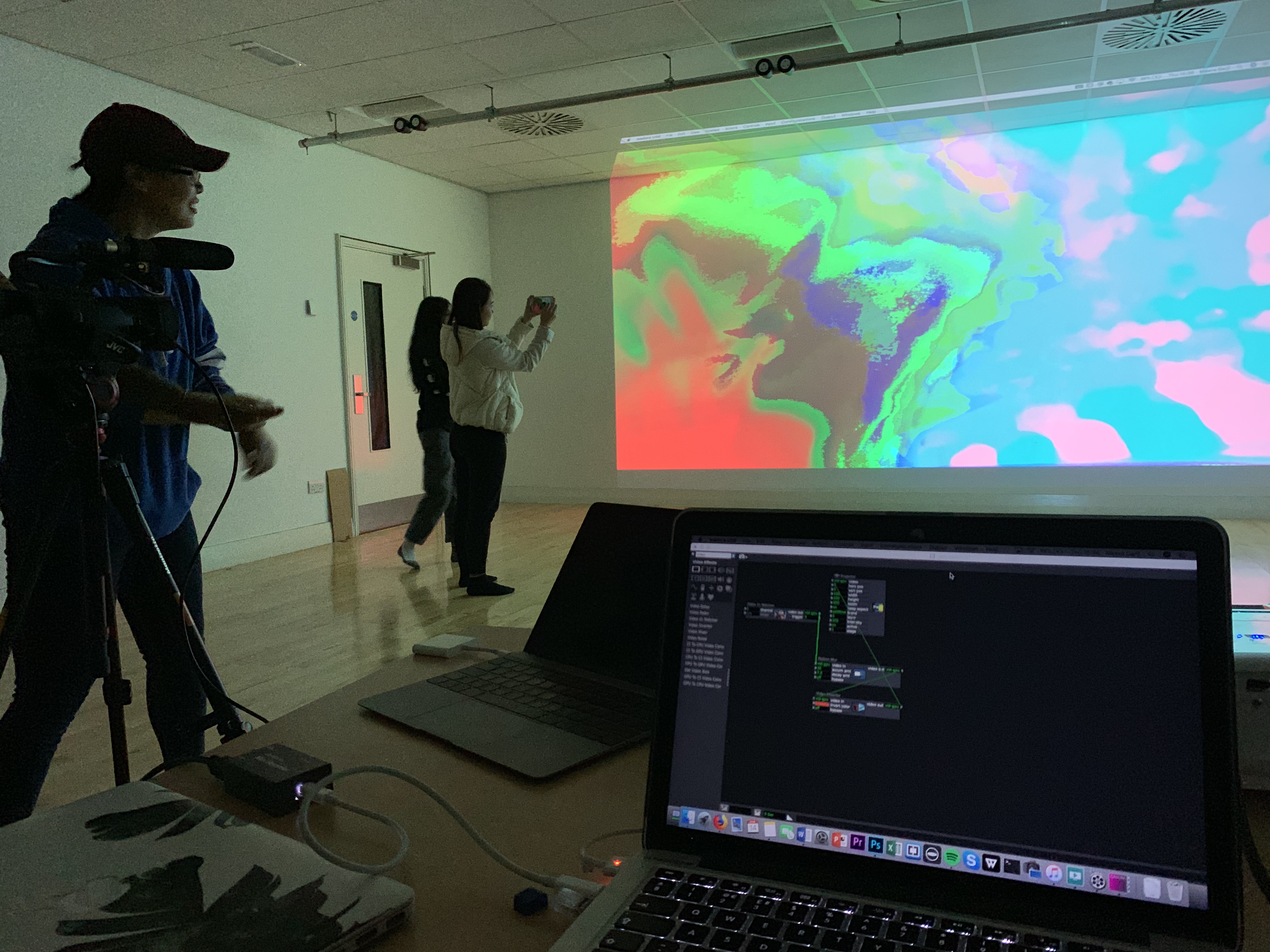
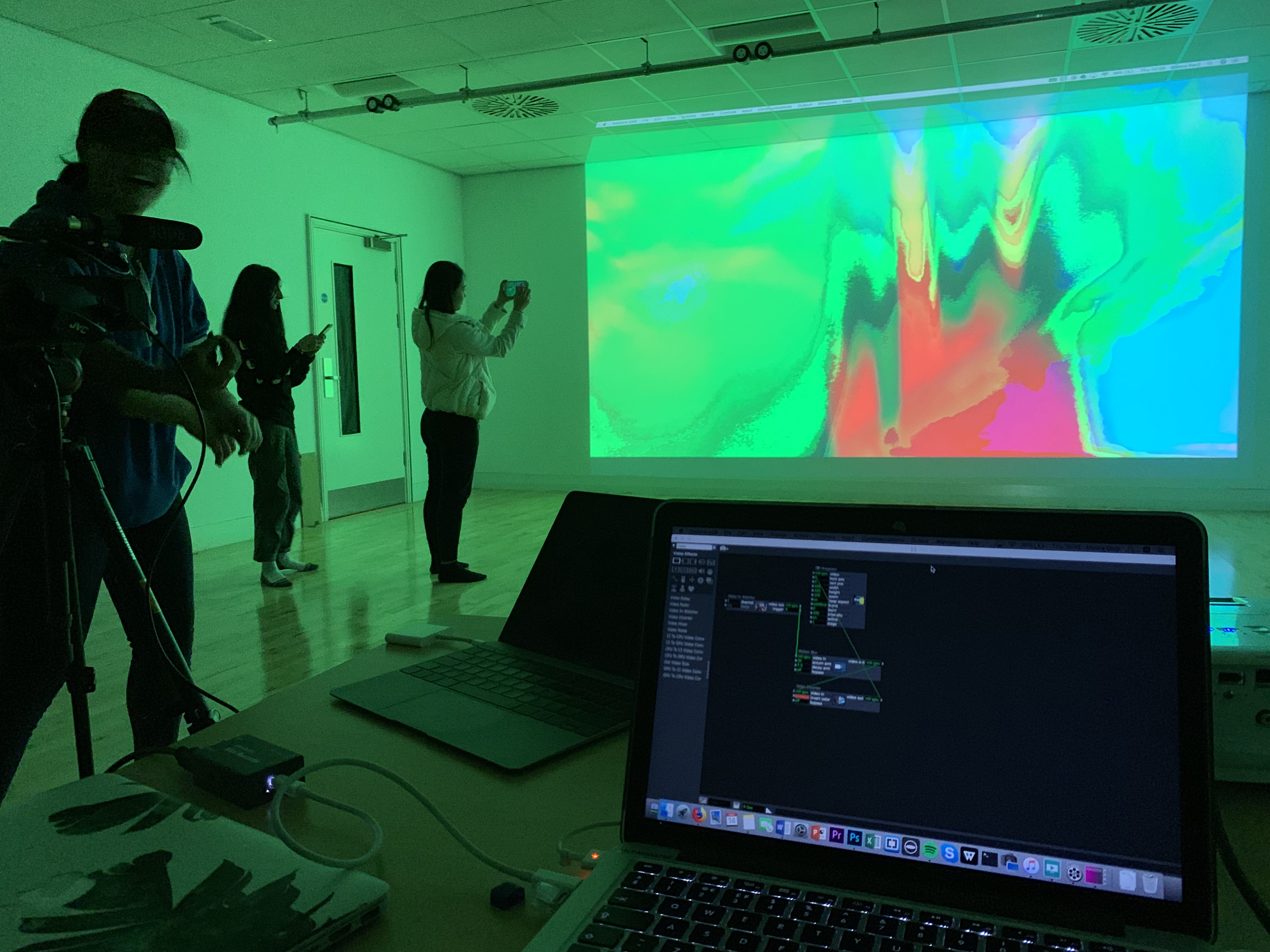
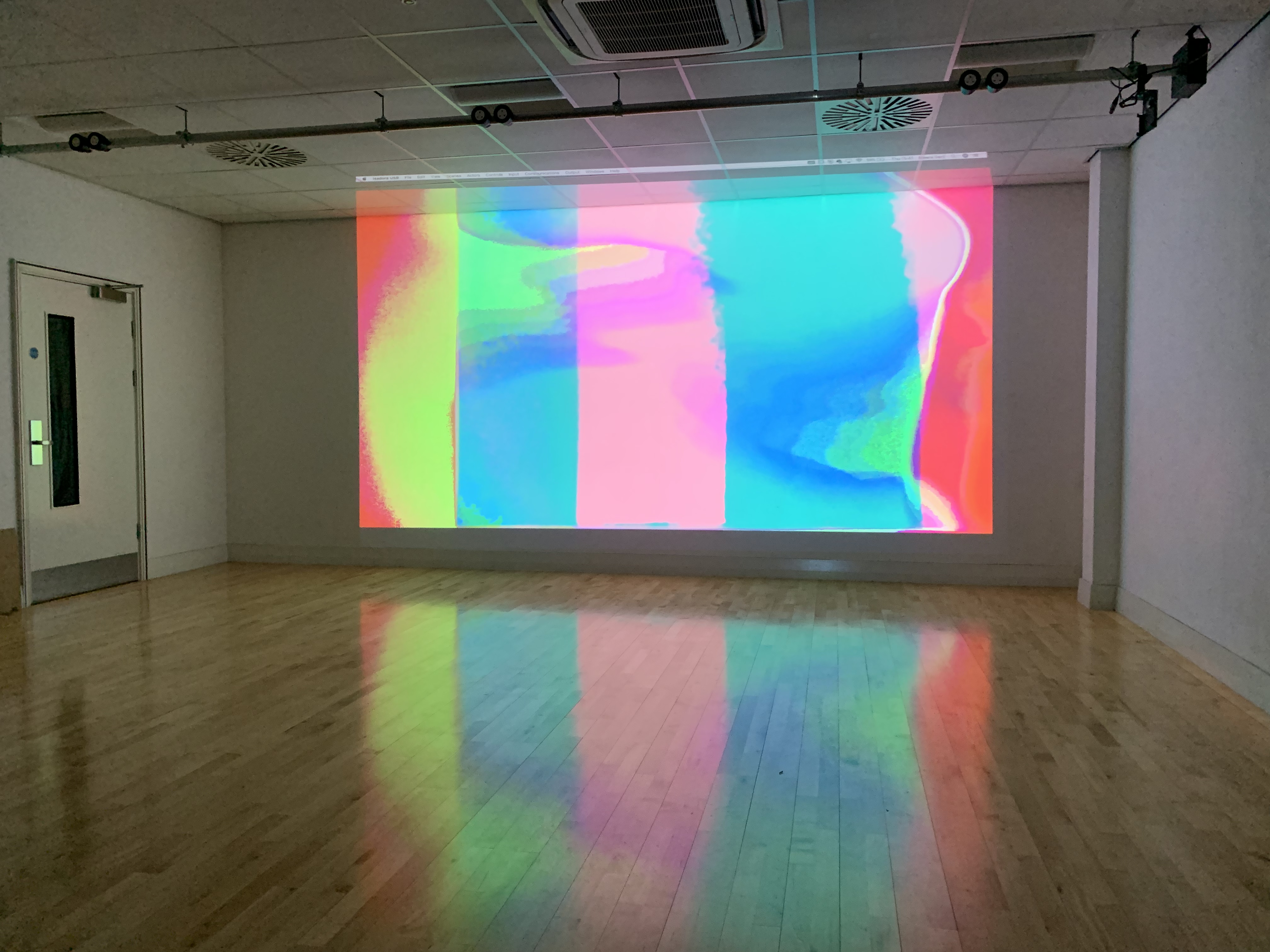
Spent the day in the dance studio experimenting with Isadora and various interactions with Live input.
There were some interesting effects projecting the prepared video, capturing this and running it through an Isadora stage. Hit a few bugs (crashed) when trying to record the output of the Isadora stage which results in these photographs being the only evidence. The Difference effect was really successful in identifying and exaggerating the movements.
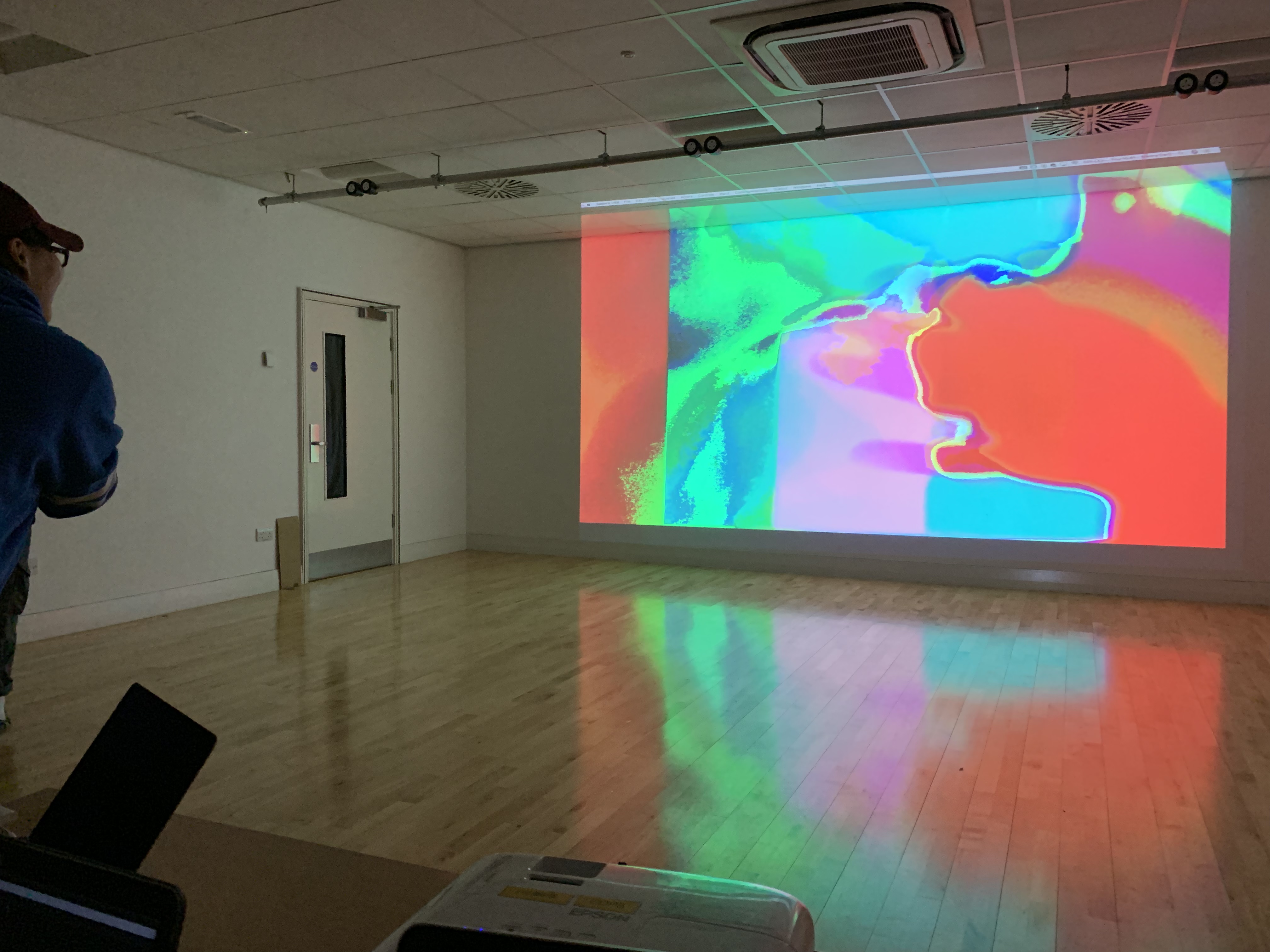
After lunch there was time to try projecting the Isadora output including the live capture, this created a really interesting feedback loop. Again capturing the output from Isadora kept causing it to crash but this time I managed to get some video.
Other than the issues with capturing these experiments started to show the power of Isadora in a live performance setting. It was really interesting being able to adjust parameters on the fly and watching the results.
I had completely forgotten that the archive was there having not visited it since the initial digitisation. I spent some time reading some of the features and (quickly) shared it with some of the students that I am working with.
I was running a seminar about discussing why we make the work that we make I used my currently in development motion project as a discussion point.
Several individuals in the session shared their reading that I was making work about representation and power structures. This had not been my intension, I was looking to move away from a narrative reading of the work but there were a number of reading that saw the evolution of the repetition as exploring breaking out of a box or becoming free, there were specific references to gender politics.
Was this because the readers were themselves interested in this issue?
Was it because identity is a topic that is frequently discussed in my classes?
Was it because the figure in the image is recognisably female and the voice is male?
Was it because in my previous work struggled with this question?
As I discussed during the Kino project, as much as I want to make work that explores the picture plane through abstraction there is a pull of gravity that pulls my work back towards a issues of voice, representation, and identity.
What we had in common often got lost in bitter political battles when ‘the personal’ became confused with ‘the political’. The question of what was a feminist issue and who should speak those issues was hotly debated at feminist meetings and on the pages of the magazine. Who was the ‘we’ of the Women’s Movement? Who was included and who was excluded? Who held power?
What struct me reading the reflection on Spare Rib was the scale of the complexity of trying to unpick power structures. The Brexit movement is seem by some as a challenge to a structure of power, it is a person fight to nationalise decisions that impact local issues. The unintended consequence is that an arcane set of laws designed to project the economic interest of creators will deny researchers and other creators a valuable artefact.
This political and personal complexity is reminiscent of the visual complexity Pollock’s work. The sanctuary of abstraction is so inviting, but reality just creeps in.
I was searching for an anchor for the experimentation that I was undertaking in Isadora and came across a journal discussing the choreography of Anne Teresa De Keersmaeker and Steve Reich’s composition principals. Structure as Process: Anne Teresa de Keersmaeker’s Fase (1982) and Steve Reich’s Music
First of all, Reich is concerned with clarity of structure, which he feels can only be achieved by creating compositions in which structure (“process”) and musical content are identical. He has no use for hidden constructive devices that serve to obscure musical process. Secondly, musical processes, once set into motion, have a life of their own, and need no further meddling from the composer to progress; they are impersonal and objective procedures. Thirdly, improvisation can play no part in a musical process; on the contrary, one must subvert one’s own feelings and allow inexorable forward thrust of the process to take charge. Lastly, no matter how objective the process, unexpected events will still occur: these are the resulting patterns.
Steve Reich, “Music as Gradual Process, Part II,” in K. Robert Schwarz, Perspectives of New Music, vol. 20, no. 1/2 (Autumn 1981–Summer 1982), 226. in (Bräuninger, R. (2014) ‘Structure as Process: Anne Teresa de Keersmaeker’s Fase (1982) and Steve Reich’s Music’, Dance Chronicle, 37(1), pp. 47–62. doi: 10.1080/01472526.2014.877273.)
In this passage I found a strong correlation with the process that I was approaching with my work.
I wanted to focus the view on the movement, the shapes of the body in motion – isolating it from a narrative or specific emotion
I wanted to set up the initial conditions and parameters and let these play out over the piece – it will evolve over the duration
Like an scientific experiment the rules of the test should not be manipulated once started – post processing invalidates the results
The result will be the patterns that emerge – the interplay between sound, image and rules
By reducing the set of musical parameters, Reich narrowly focuses the listener’s attention, creating a meditative sense of contemplation, in spite of the mechanistic quality of the sound reflecting the cultural setting in which Reich lives.
(Bräuninger, R. (2014)
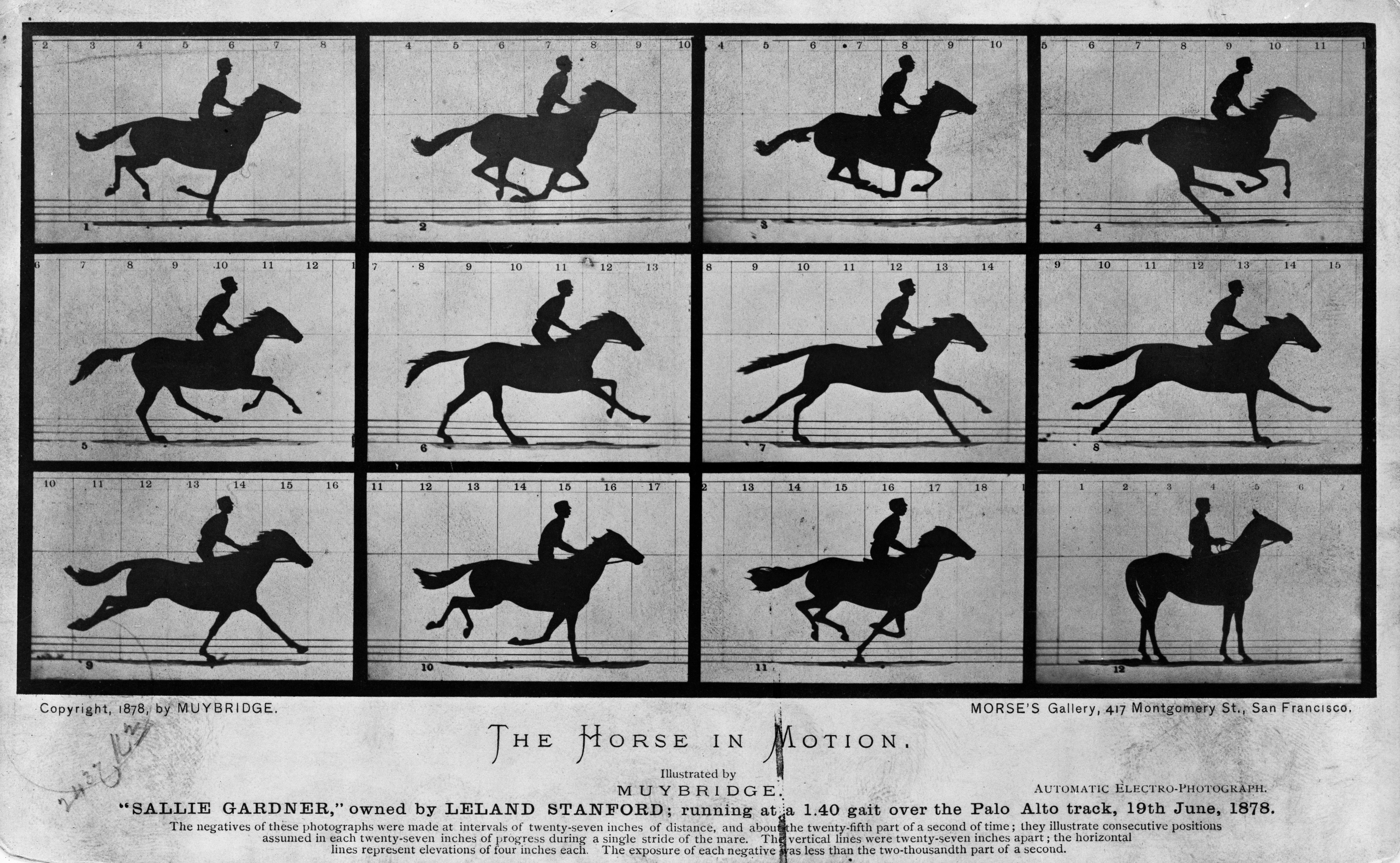
I would argue that our contemporary cultural setting, interconnected, digital, saturated with data and surveilling eyes, demands an even more mechanistic quality. When we consider the use of digital video rather than analogue music or performance an individual frame is already an individual unit. We can see this in Muybridge’s photographs of motion, continuous motion is atomised and then recombined to give an approximation of motion.
The Horse in Motion, Muybridge (1878)
In filming a continuous sequence of dance it is frozen and shatter, information is lost but replaying the individual images in sequence we can recreate and restore an approximation of the original motion. Muybridge’s photographic sequences revealed details about the movement of animals that were unknown before, they made visible a new information.
De Keersmaeker was not aiming to find a visual equivalent to this detail in Reich’s music; instead, she sought to give her choreography its own distinct organization, influenced by Reich’s structured process but not a mere translation of it.
(Bräuninger, R. (2014)
I see a similar relationship between the way I am looking at using repetition of a sequence of frames of dance and Reich’s approach. I want to find a process for presenting the series of frames that makes up a distinct movement, I want to decoupled the shapes of a body in motion from the meaning of a body in motion.
When we watch Fase we no longer perceive events passing along a time-line, but are thrown into an endless continuum in which the here and now, the being in the moment, becomes central to our perception.
(Bräuninger, R. (2014)
As we listen to the repetition of the same patterns continuously rearranged, particular combinations of sounds emerge and we experience a sense of change within constant repetition.
(Bräuninger, R. (2014)
With a duration of 2-minutes it is unlikely that a sense of meditation will emerge, instead I am hoping that a suggestion of the repetition continuing after the end of the piece will remain.
Having detoured via After Effects I wanted to go back to Isadora because I wanted to have the option of using the same series of effects and filters on live video later in the project. My initial approach was to replicate the phasing experiment in Isadora.
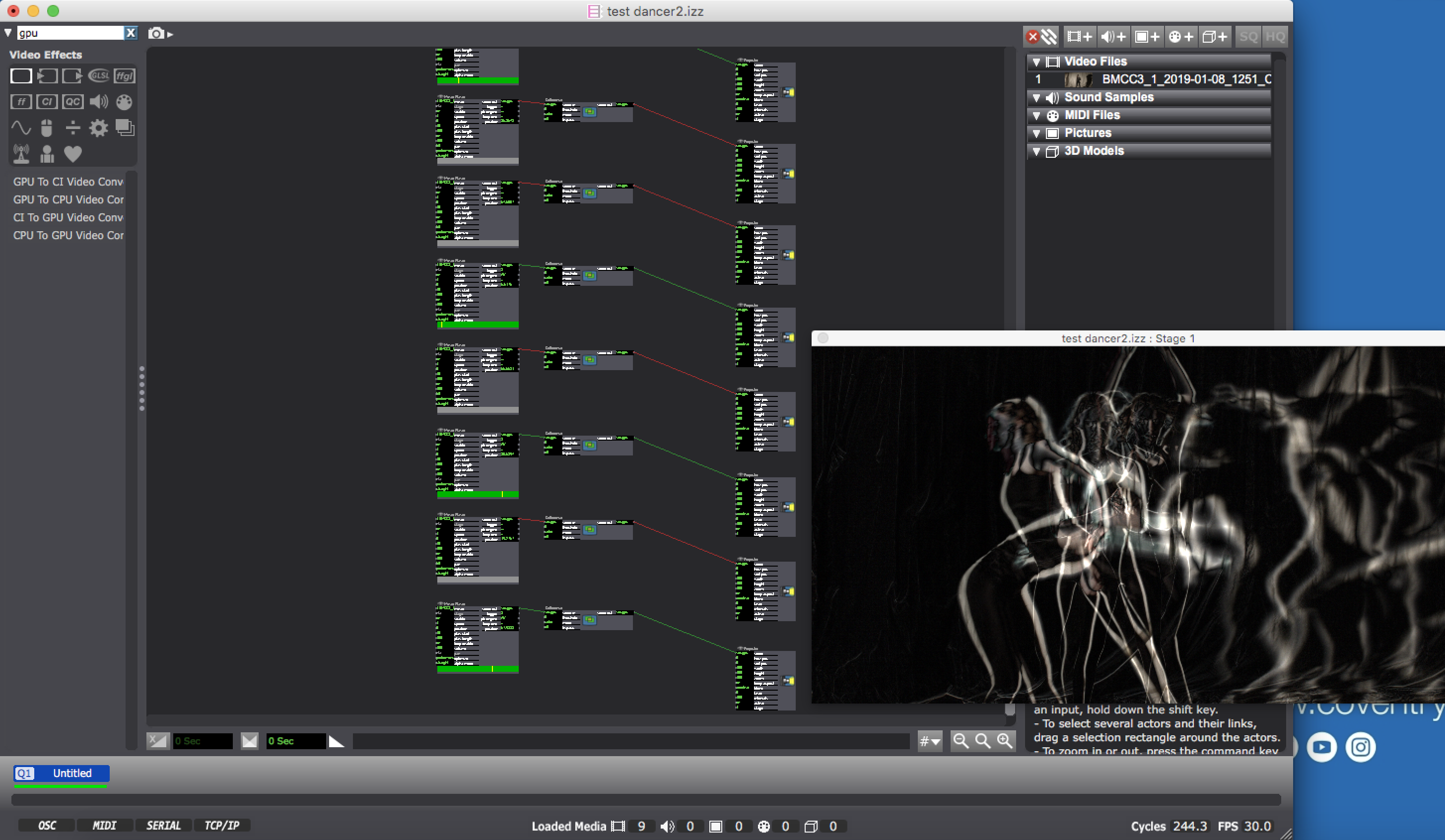
Many many projectors
The initial version lacked the synchronisation of the After Effects version, although I could have fixed this with some work I felt that this experiment had run its course. I want to look specifically at looping a small section of the dance and exploring how this evolved.
Current state of Isadora project
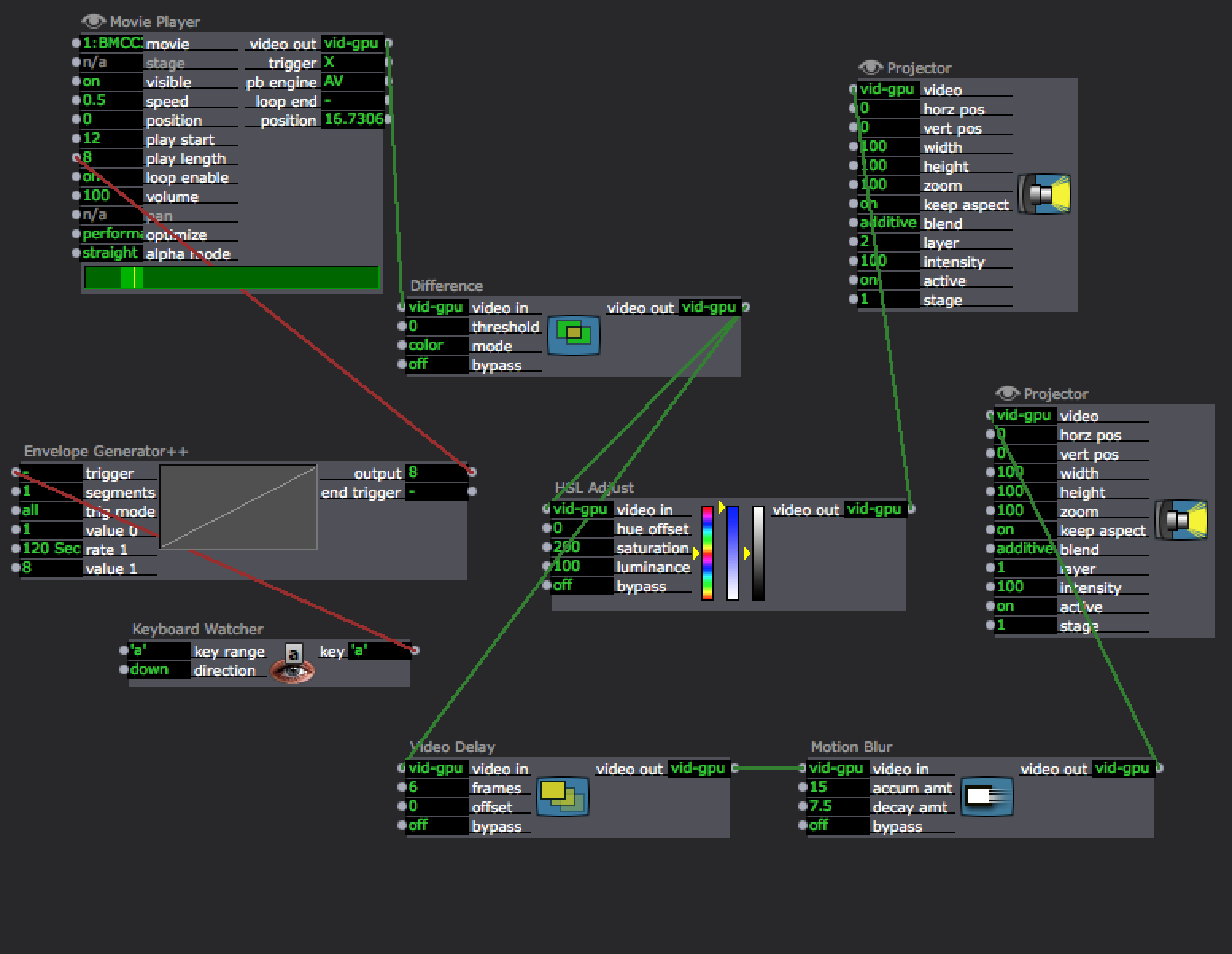
I adapted one of my early Isadora stages by removing the City Lights effect and adding a Delayed Motion Blur onto another projector.
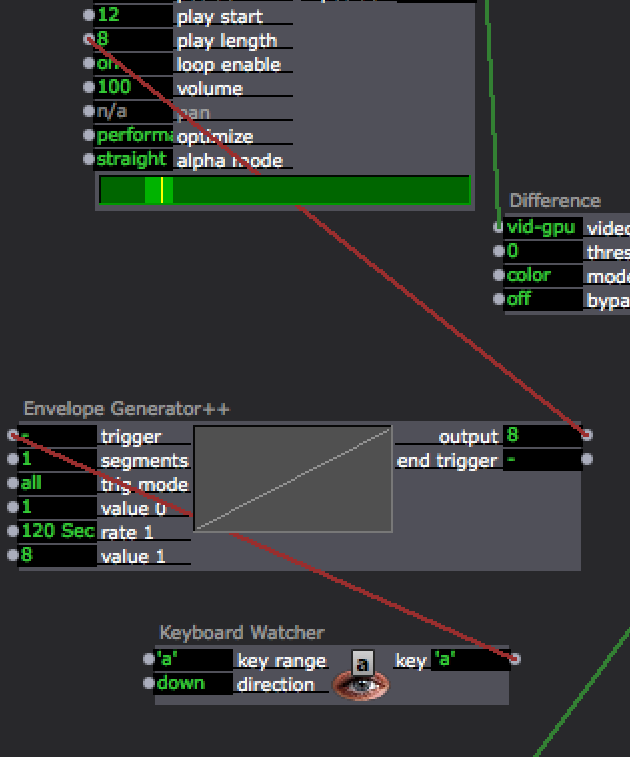
After experimenting with the length of the loop I discovered the Envelop Generator ++. I set the envelop to increment the play length over a duration of 120 seconds. This causes the loop to evolve over the length of the piece.
The length of the loop evolves of the duration the piece.
I really liked the Jackson Pollock point about starting out with a vague direction of where he was heading when he started a project and not being afraid of destroying the work in the process.
“Sometimes I lose the painting but I have no fear of changes, of destroying the image, because a painting has a life of its own I try to let it live.”
Working digitally it can be difficult to let go in this way as it is so easy to command-Z and go back to where you were before you did something, there is no permanence to a process. I find that this can leave using digital effects techniques experimentally hollow as it is too easy to try all of the filters, this abundance of choice makes choosing meaningless.
Having already recorded some (supposedly) test footage with the dancer that I had discussed working with I was able to start exploring Isadora
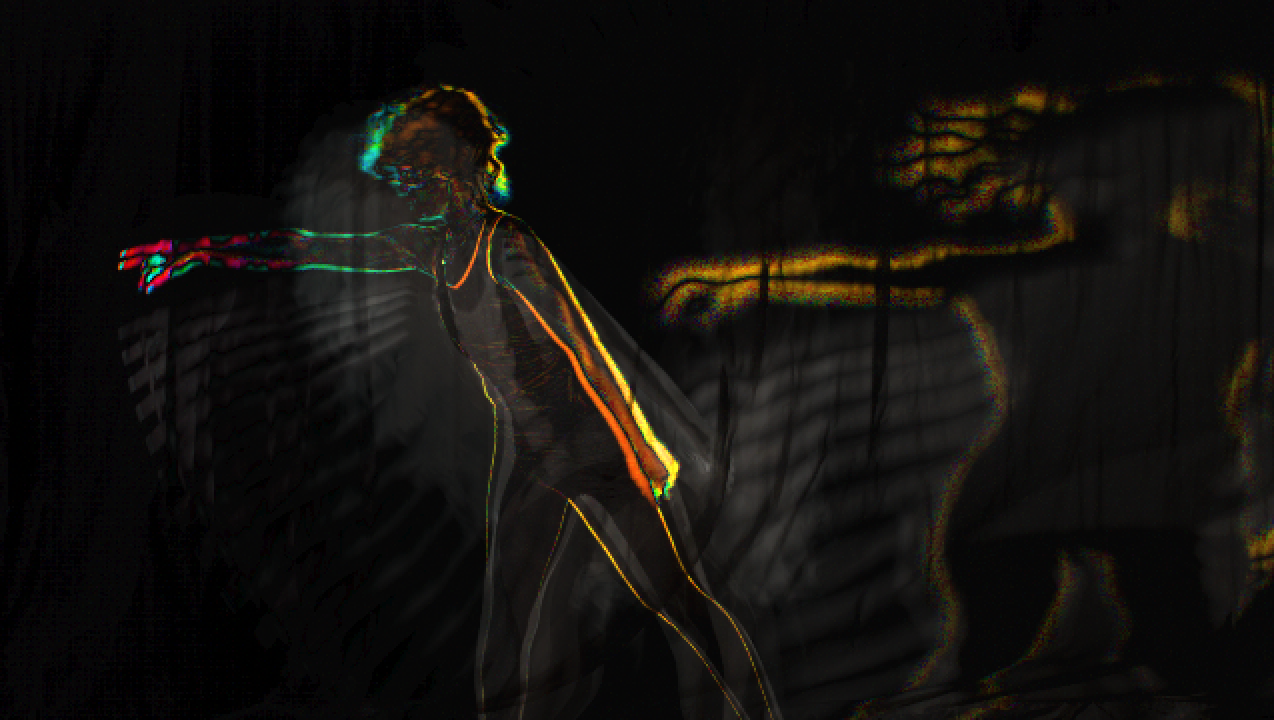
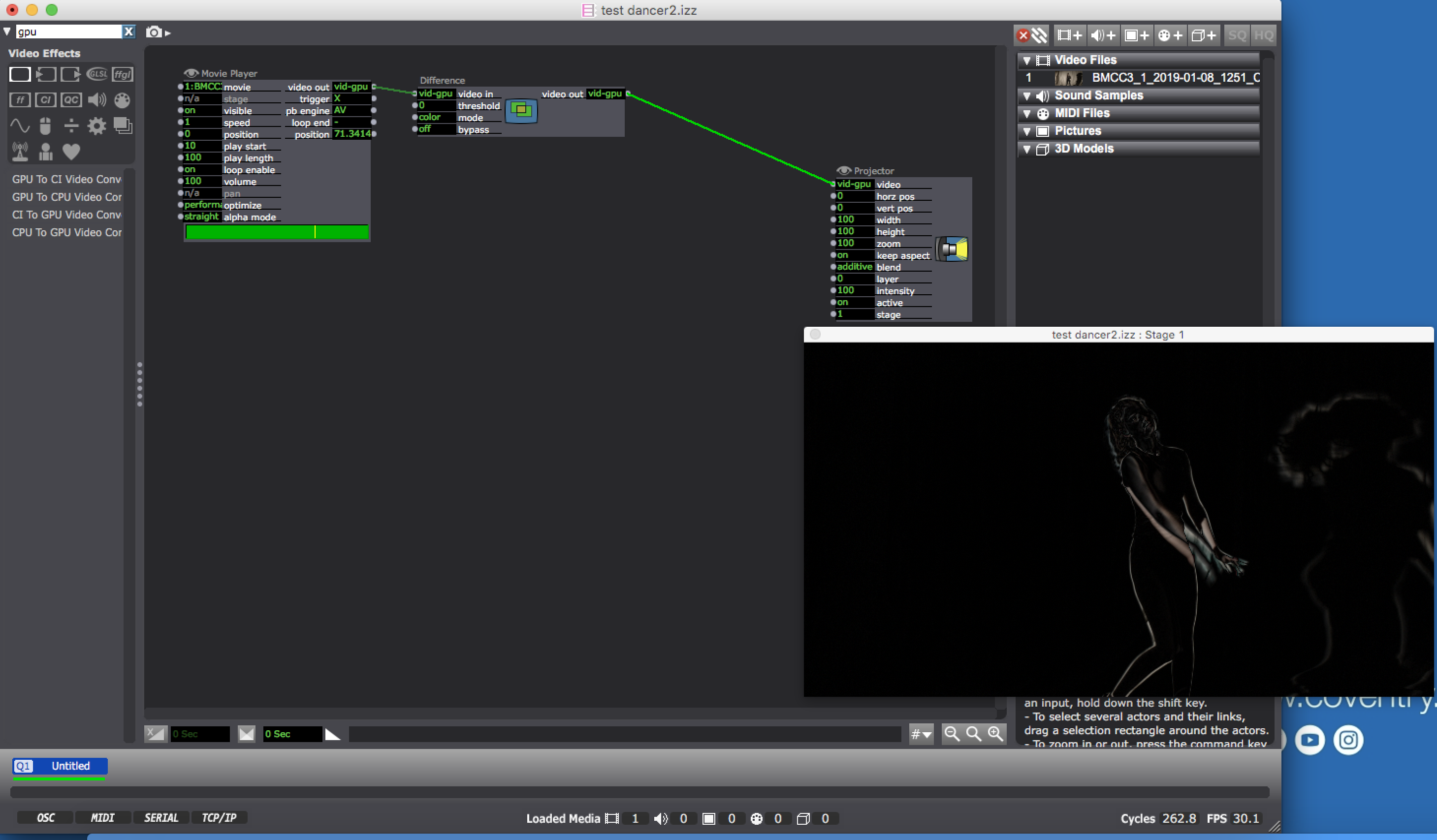
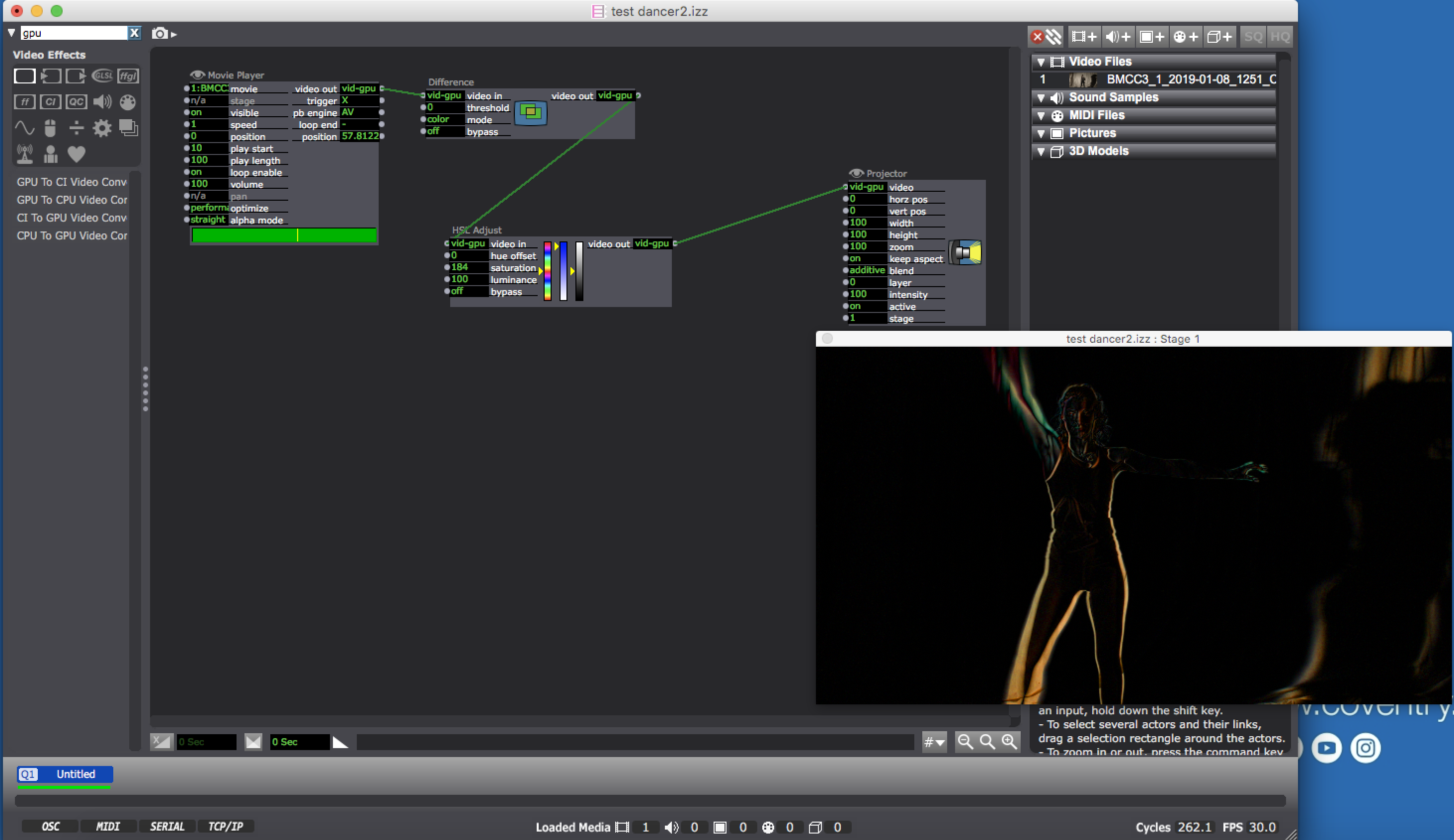
I found the Difference effect emphasised the movements in a really interesting way, somewhere in the network of modules that I applied (I think it is probably the variable Delay) the frame-rate Isadora was able to output dropped to 5fps. The result of this when recording the stage was the time-lapse/fast motion effect of the above test.
I had two more filming sessions planned with the dancer to work on something more specific, we had discussed some ideas around the work of Bob Fosse I was interested in using some of the ideas of isolating movements rather than doing the whole body. Unfortunately illness got in the way, so I have had to work with what I have got.
The other side effect has been that I had to work with Isadora without a dongle, therefore I couldn’t save projects in progress and could only record 5 seconds of the stage at a time. The result is some of the limitations that are normally absent when working digitally.
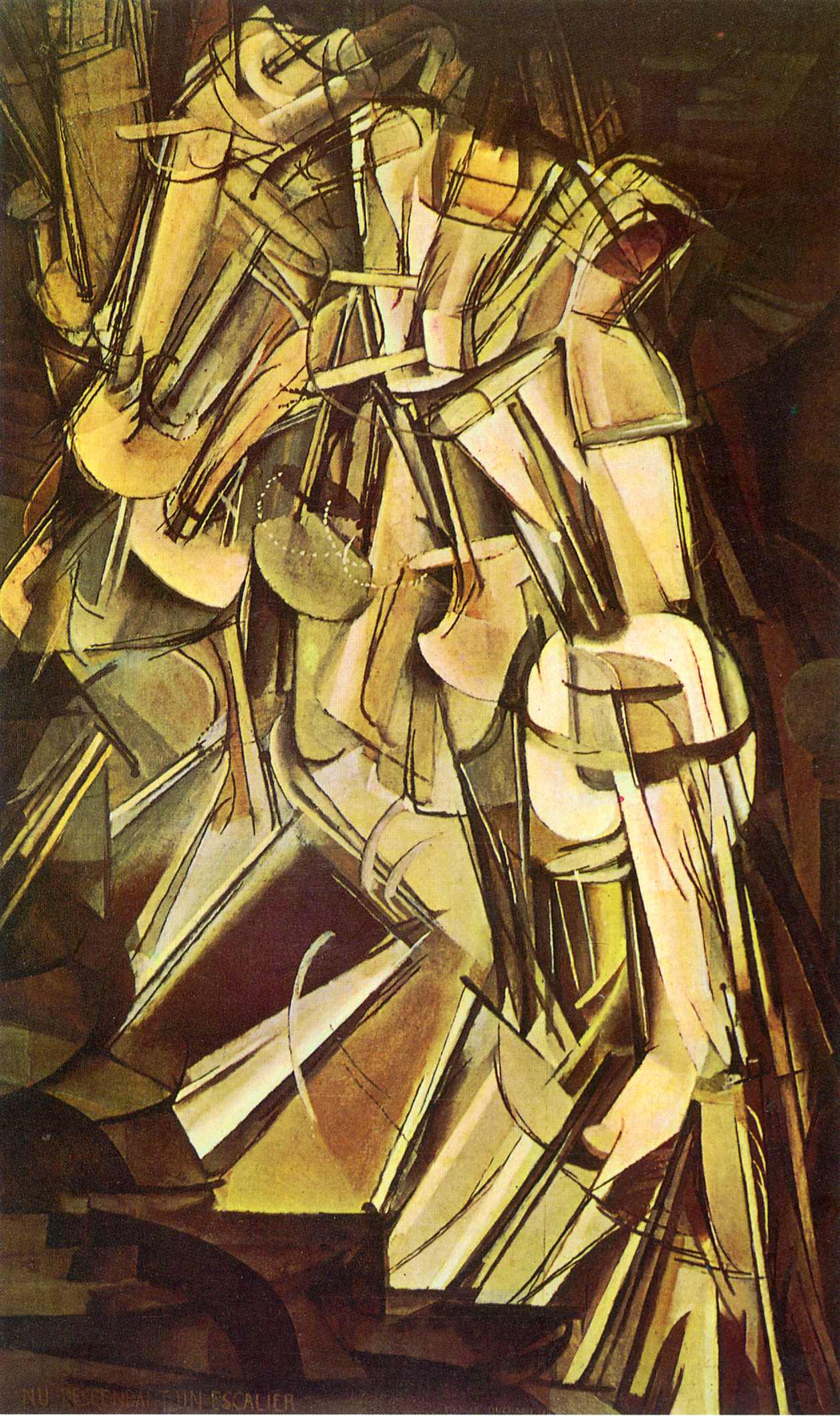
I have long been interested in exploring what a visual representation of phasing from minimalist music might look like so this is the direction that I am setting off in. Duchamp’s Nude Desending a Staircase is an interesting reference point here as well for me it has that same hypnotic, rhythmic, and evolving quality that It’s Gonna Rain has got.
Steve Reich – It’s Gonna Rain
In one of the workshops for DaDa we were shown a delay effect in Studio Artist that gave an interesting visual reminiscent of Duchamp’s painting.
I recorded a short section of the dancer with the difference effect applied from Isadora then took it into Studio Artist.
Difference in Isadora
Interesting effect produced in Studio Artist but really I wanted to see the movement evolve rather than happen randomly
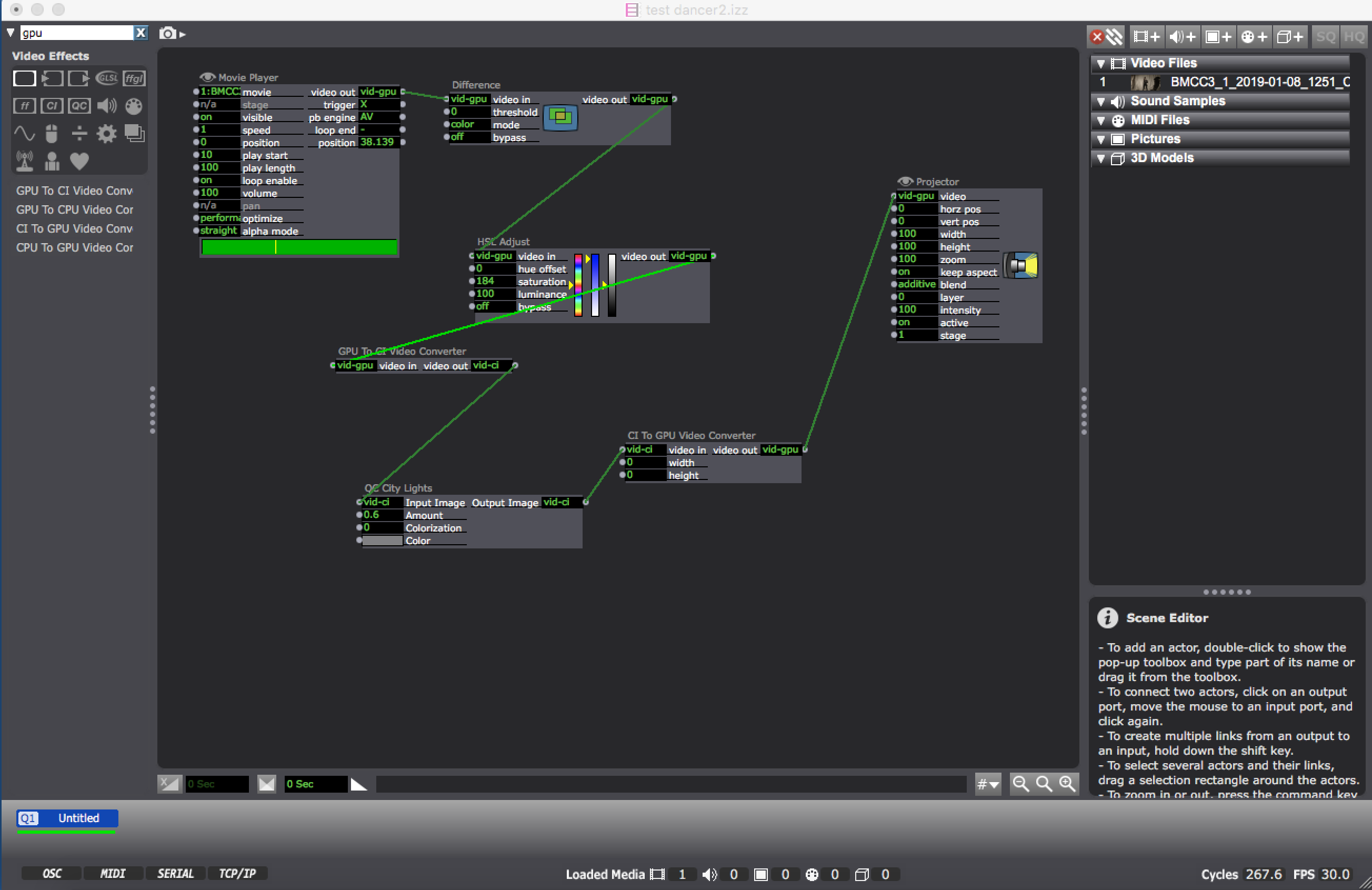
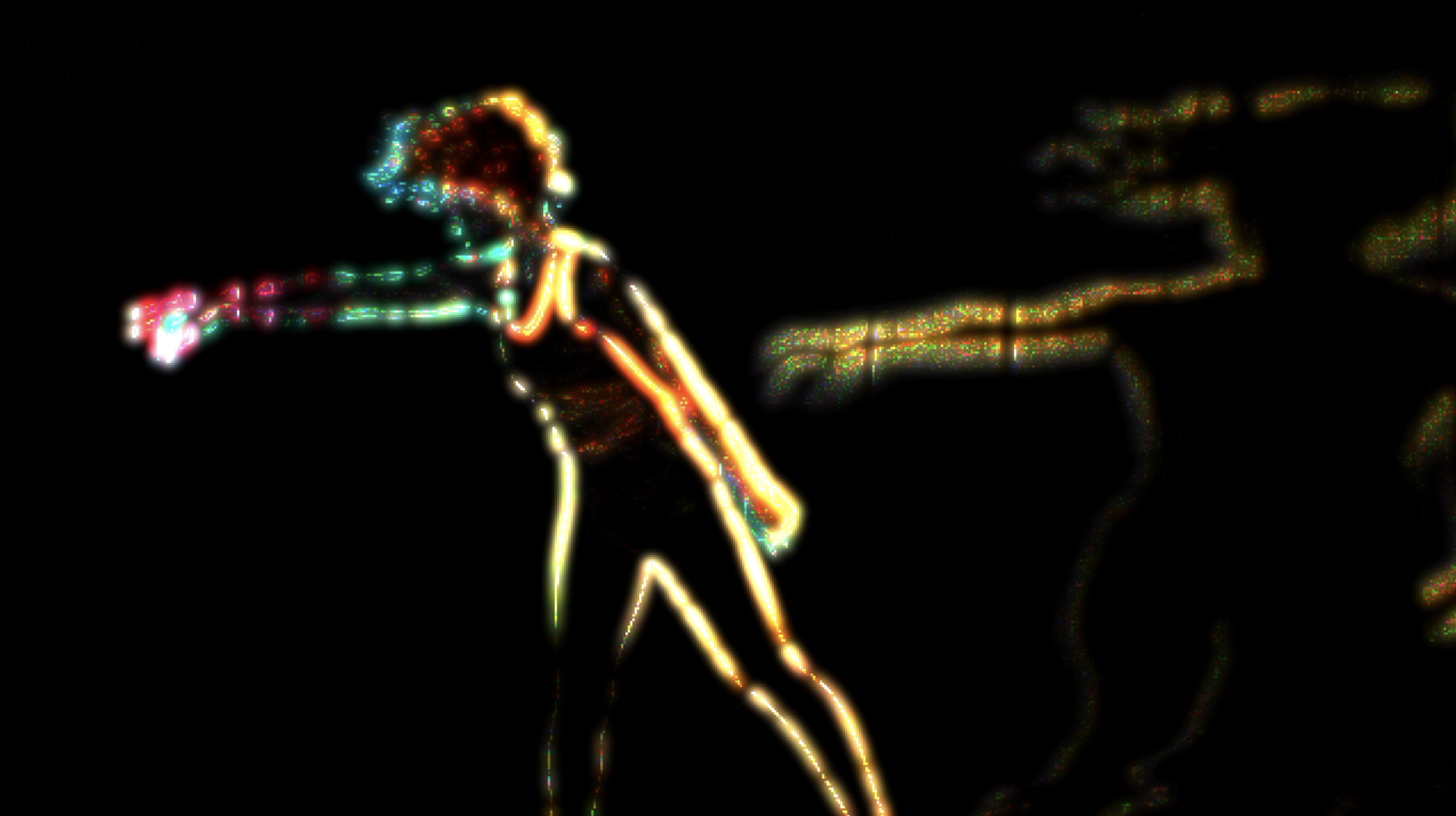
I did several more experiments with the footage with muted tones but wanted to represent the energy of the dance through colour. Going back to Isadora I took the saturation over the top and added the City Lights effect, that produced something that felt light neon lights.
Difference and HSL Adjust used to boost saturationThe QC City Lights actor needed a format conversionDifference, Saturation, City Lights in Isadora
I also recorded a series of short clips and pieced them together to produce a longer section of the dance, I then layered 252 times in After Effects with a series of delays and various lengths of dance loop.
255 layers of Dancer
Interesting effect but it lost something in the chaos of the middle. I went back to the idea of phasing.
The shorter length of loop in this version helps to show the repetition and time delay.
For the most recent experiment I did some maths on the length of the clips and the time stretching that would be applied to the second layer. By using a ration 8/9 I was able to make sure that the two versions came in and out of phase at multiple points during the 2 minutes. Again this was achieved in After Effects.





 mattprentice