This week Kino came to a close. I have really enjoyed this project, the experimental context allowed me to pursue theoretical ideas as a tangible practical outcome. Most of the audiences I have shown the film to have not ended up anywhere near the concepts that I wanted to address, but the process has been constructive.
Blogging the process for this project has been less structured than I would have looked as I wanted to explore so many ideas I ended up with a lot of long draft posts that I wanted to refine before publishing. For the movement project I really want to try and find a way of shortening each of the posts to give me a better chance of refining it in one sitting. I think this will really help me to manage the evolution of my ideas to structure how my first principals have become the realised artefact.
There are probably too many ideas in a three minute film, but how can we be sure of an audiences reading of a film when their eyes are scanning between two screens, there are so many variables. I think that the images and sounds have become loaded with so many concepts that in developing the project further I would consider ways to give the audience some sort of foothold to begin the climb.
Amongst the blank faces though I received one comment that made me feel like I was starting to approach something that I was concerned with. One of my peers commented that the long duration of the same image made him start watching the space between the screens. Something that I had wanted to achieve from my first ideas.
As I have mentioned previously I find the exploration of space vastly inspirational. I believe in publicly funding science, and education. I wanted to include this imagery into Kino. A bit of research starting with NASA’s Voyager missions led me to a series of images and animations created from the Cassini mission.
What would the Kinoks have thought of sending a machine to Jupiter to look at what was there in multiple wave lengths? A very mechanical eye.
I was hoping to avoid creating a narrative in the work that I was producing, I wanted to find a way to draw from the natural beauty of the images without adding a documentary narrative.
In my earliest explorations for Kino I had been looking at projecting images back into the environment, I had run into trouble with this due to the low refresh rate of the battery powered projector that I was using. After a brief detour looking at how I could find similar patterns to the planetary images in everyday objects (this did not fill me with wonder), I settled on projecting the images onto other surfaces so that they became reworked, but using a more powerful projector. I did a few tests with some cardboard models as the projection surface as I was thinking of looking at the link between pure blue sky exploration and the materials that enter our lives, but ultimately I settled on my own eyes as the canvas.
I really wanted to use the real Cassini images rather than similar images that I had generated because it is the visceral reality of a machine of our creation being up there that I find so engaging. I wanted to try and get some sense for myself of the randomness and luck involved in these missions with them being flown so remotely so once I had selected the clips that I like I used a random number generator to take small sections of the animations and put these onto a timeline. This randomness would be interesting to explore further in a future project. Below are the animations that were used for the source of the projection.
Kino has come at an interesting confluence for me, the anniversary of Bauhaus has lead to a number of retrospective articles and given me the opportunity to reflect on how our thoughts are shaped by experiences.
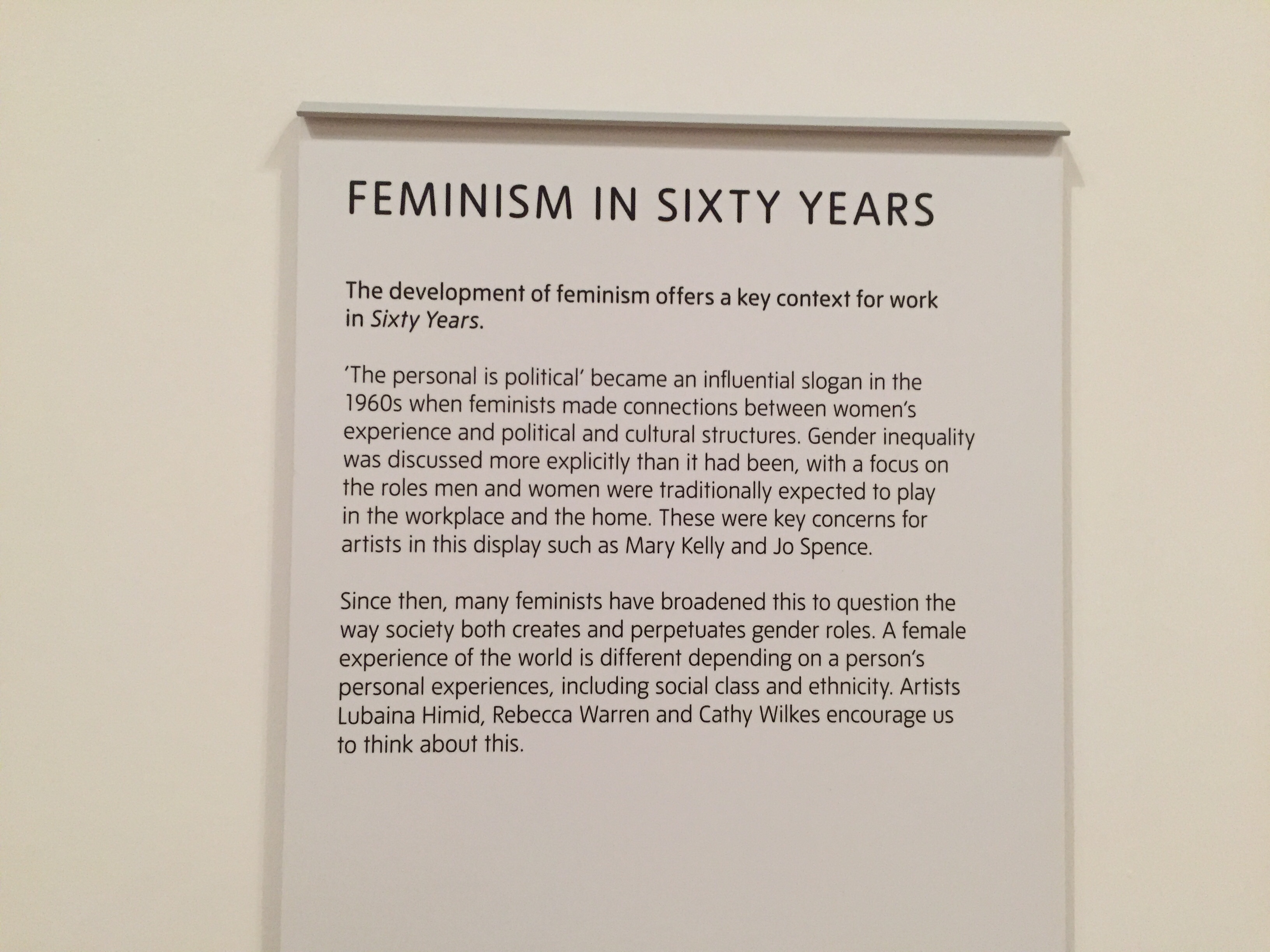
I had a lecturer during my undergraduate degree who was exploring ideas of Feminism through discussion of cleanliness. A single idea struck me profoundly during that lecture, it was the first time I encountered ‘The personal is political’ as a concept. It began an exploration of power, and social norms and values, this has developed for me into a broader rejection of elitism in the arts. I wrote my undergraduate dissertation on the cultural value of mainstream cinema, and the links between consumerism and identity. I came across a phrase in a translation of Michael Foucault, “Nodes on a network”, I have been referring to that idea for so long now that I can’t remember the original source. I can see the mustard yellow of the hardcover book, I can see the desk in the now demolished brutalist Birmingham Central Library.
Birmingham Central Library – Sadly departedBirmingham Central Library – Before the burger chain
Forward
The demise and loss of this modernist oasis first to fast food chains and then to wrecking ball for me has a deeper significance. The John Madin designed Central library was a grand vision of a cultural centre integrated into the heart of the city, it even had a bus garage for the basement. Cost implication never realised the original dream and it slowly fell into poor repair and had poorly planned additions stuck on to make better commercial use of the space. In 2016 it came face to face with Birmingham’s Motto – Forwards.
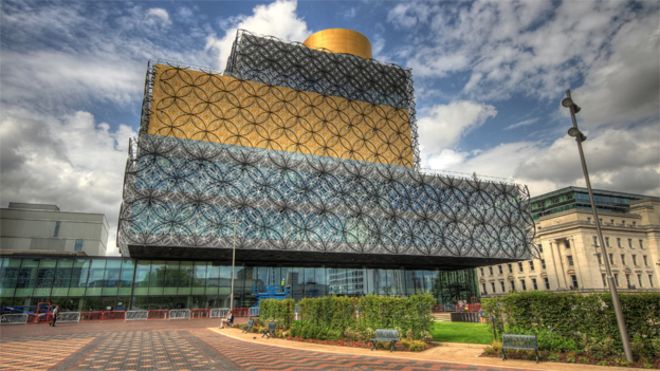
Library of Birmingham – look at me, look at me. Please!
The functions of the library have been replaced by the Library of Birmingham. But where the Central library was an upturned concrete pyramid in the centre of the city the Library of Birmingham sits apologetically off to the side of a square that has slowly lost its footfall as the centre of the city moves over, pulled by new shopping areas. The cladding of the library is reminiscent of Birmingham’s most famous building, the aluminium disk adorned Selfridges building. To me the library is pleading to still be seen as relevant.
Optimimism
When I first discovered the Bauhaus at art school I was drawn to what I saw as an optimistic philosophy. Science, technology, and design can evaluate us, that art is important to society. There are plenty of examples of where the Utopian dream of Modernism didn’t/doesn’t work, the central library is a good example, it was never finished, it was inflexible, it didn’t take into account changing use cases. But in the clean lines, lack of wasteful detail, and simple forms I see a very human honesty; this is the thing that I have made. To me there is hope in a lot of modern art; that new ideas, new technology will improve the world.
Spacerace
Another optimistic anniversary
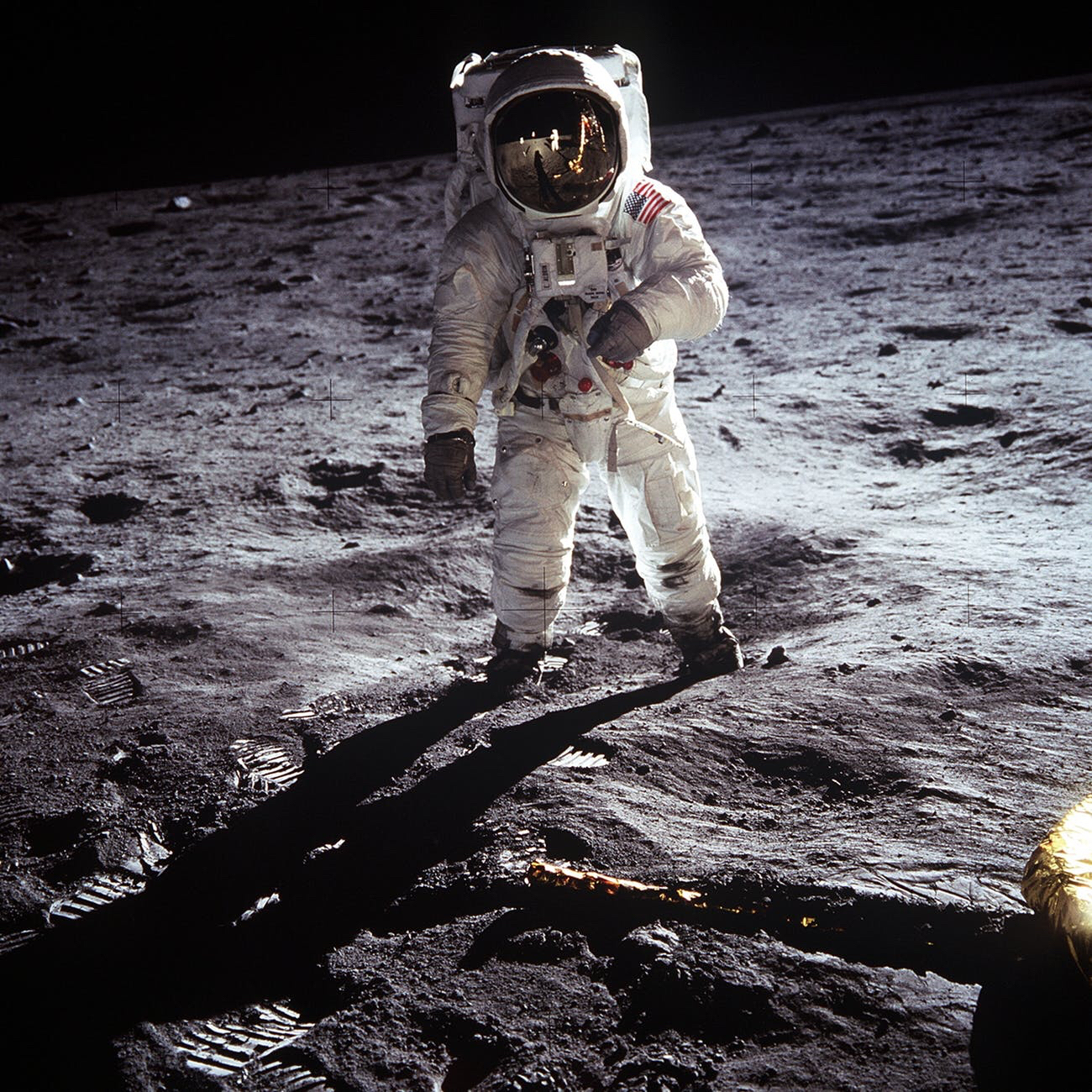
December 24 2018 was the 50th anniversary of the Earthrise image captured from Apollo 8. Much has been written about how this image has inspired the environmental movement, but for me it is more important as a record of human optimism; there was an idea to go to the moon, plans were made, we went. That is a hugely over simplified and naive statement but I believe that it gets at the optimism that was necessary to dream that it was possible.
Fear of Technology
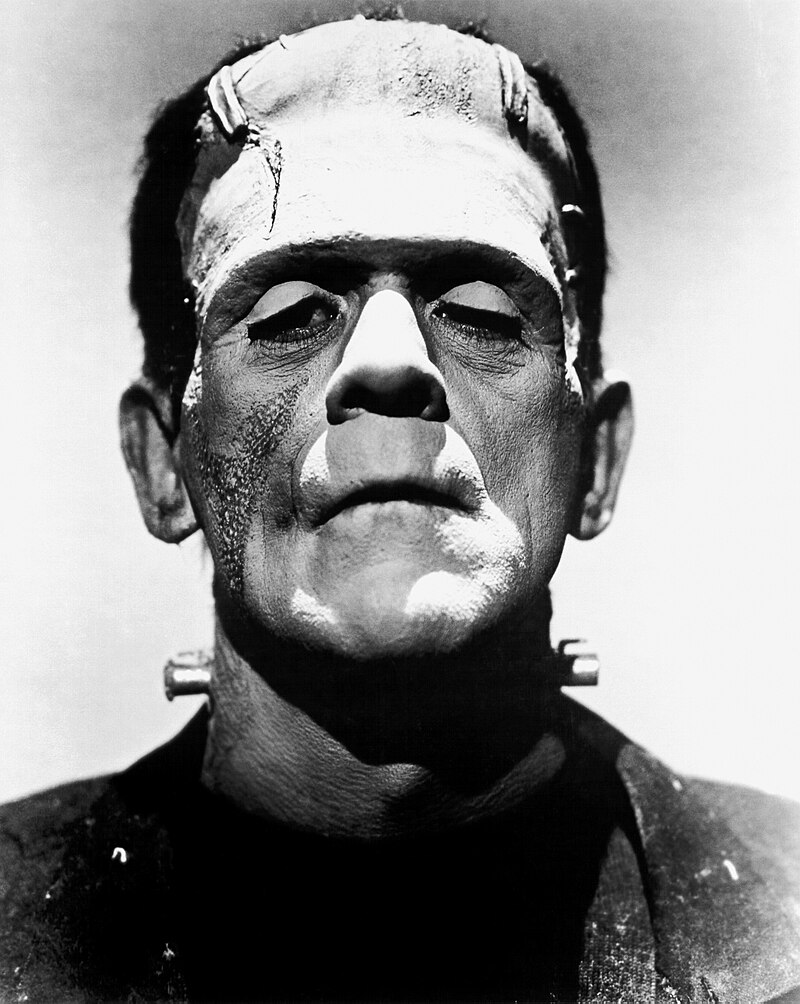
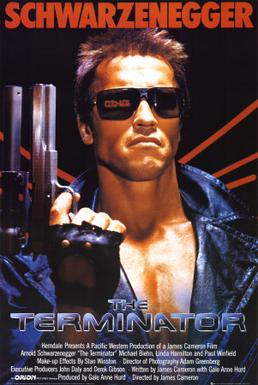
Whatever the causes this optimism in technological progress has in places been replaced by fear. I think that there is a lot of evidence (blame?) for the this in Science Fiction films. The Scientist always goes too far, they create a monster, it kills us all.
Science’s monster – Frankstein’s MonsterArtificial Intelligence will kill us all
The future of our species is in question like never before, which has made farsighted optimism an unusual challenge.
A predictable rejoinder, of course, is that in recent decades that same entity also has been implicated in a spectacular series of disasters: Hiroshima, the nuclear arms race, the American war in Vietnam, Chernobyl, Bhopal, the Exxon oil spill, acid rain, global warming, ozone depletion. Each of these was closely tied to the use or the misuse, the unforeseen consequences or the malfunctions, of relatively new and powerful sciencebased technologies. Even if we fully credit the technical achievements of modernity, their seemingly destructive social and ecological consequences (or side effects) have been sufficiently conspicuous to account for much of today’s “technological pessimism.
The high profile failures of technology have driven the narrative of fear which dominates the socially positive benefits such as hygiene and medicine.
Alternative Truth
Postmodern Pessimism
under the regime of largescale business enterprise the ostensible values of sciencebased technology (matter offact rationality, efficiency, productivity, precision, conceptual parsimony) were being sacrificed to those of the minority owners: profitability, the display of conspicuous consumption, leisureclass status, and the building of private fortunes.
Unchecked capitalism has shifted the narrative, the rise of populism in contemporary politics seems to suggest that the fear of technology is part of a general erosion of the concept of empirical truth. The ideas of the scientific process, repeated measurement, observation, logic that developed out of the Age of Reason are challenged by post-modern ideas of plurality. It seems that the very ideas that have been developed over the 20th Century that challenged centralised power have now been co-opted by the institutions of power.
The politics of power are so complex that it is difficult to begin to unpick the relationships in a blog post but for me the revivalism associated with post-modernism, looking backwards rather than forwards is inherently pessimistic. That is not to say that technological progress is always beneficial, or should be free from oversight, but is there still space for big dreams.
Diversifying Utopia
I need to make one final point before closing out this rambling post that relates directly back to my own practice and values.
I think importantly it is the experiences that seem small but come to dominate, exposure to the ideas of Feminism, Richard Dyer, and Stuart Hall (a very short list), I became acutely aware of the privileged position that I was fortunate to occupy in society, and also the lack of diversity in the Bauhaus, and amongst modernist thinkers in general. It forced me to question how inclusive these visions of the future were
In developing my response to Kino I want to address make specific acknowledgment of the privileged position of my point of view. By turning the camera back on my eyes, a literal male gaze obscuring the other ideas that I was address.
My audio for Kino underwent a circular process and ended up right back with my initial idea of using a mathematical sequence to derive a midi sequence which would in turn ‘play’ a software instrument.
Music detour
In between this I had a detour via the work of Laurie Anderson, having discussed my ideas and tests with a number of people I found that the ideas I was exploring were rather opaque (I eventually decided that this was ok). At this point I had a chance encounter with Laurie Anderson’s O Superman again.
The combination of spoken word and synthesised vocals sent me off down a path to produced a generated voiceover. I used a series of rules, based on sampling random sentences from my notebook, to develop a script for a voiceover that I then gave to the voice generator in Adobe Audition.
Once I had heard the first test I felt that I would be moving too far in the direction of having a narrative to the piece so I dropped the experiment at this point.
Return of Recamán’s Synth
At this point I was preparing for the main filming of the project so I spent some time away from the audio, whilst researching as much footage from NASA planetary probes as possible I started to consider the ideas I discussed regarding who made these discoveries, I realised that I would not be able to fit this into the already overloaded visuals of the project and realised this was pushing me back towards an algorithmic soundscape.
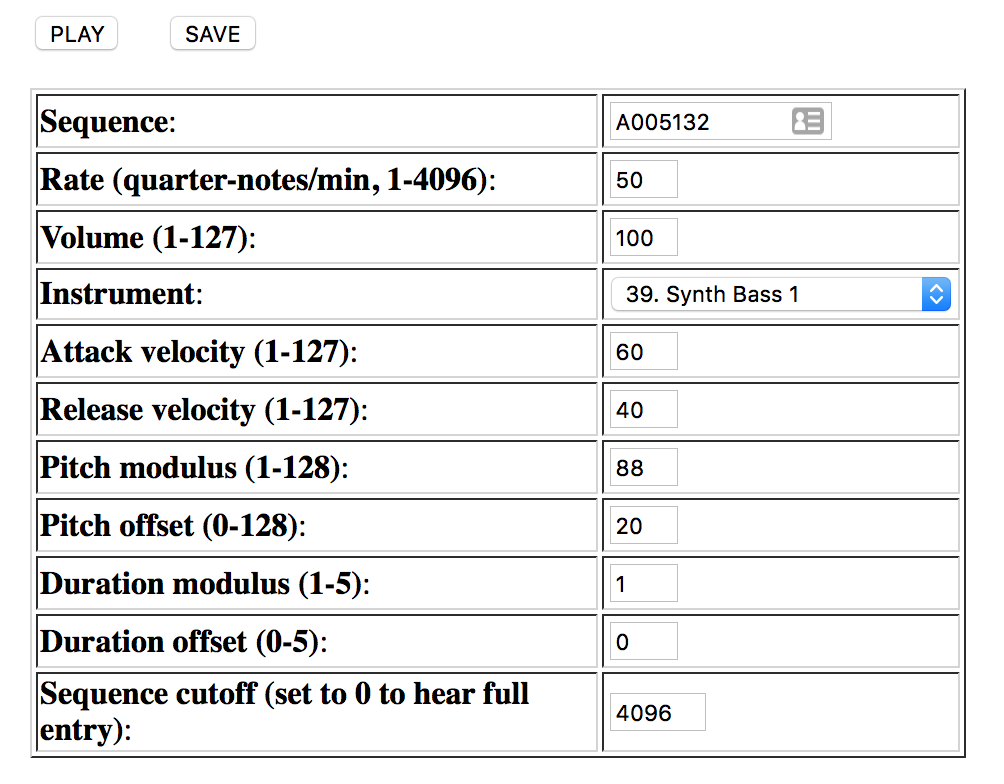
I came across Recamán’s sequence several years ago and became fascinated by the way it was both rigidly structured and unpredictable. There is a really useful feature at The Encyclopaedia of Integer Sequences where you can export a Creative Commons licensed midi file for any of the sequences of numbers. Recamán’s sequence can be found here.
Recamán’s sequence (or Recaman’s sequence): a(0) = 0; for n > 0, a(n) = a(n-1) – n if positive and not already in the sequence, otherwise a(n) = a(n-1) + n.
Recamán’s Sequence visualised as a graph – https://oeis.org/A005132/graphThe settings used to generate the midi sequence
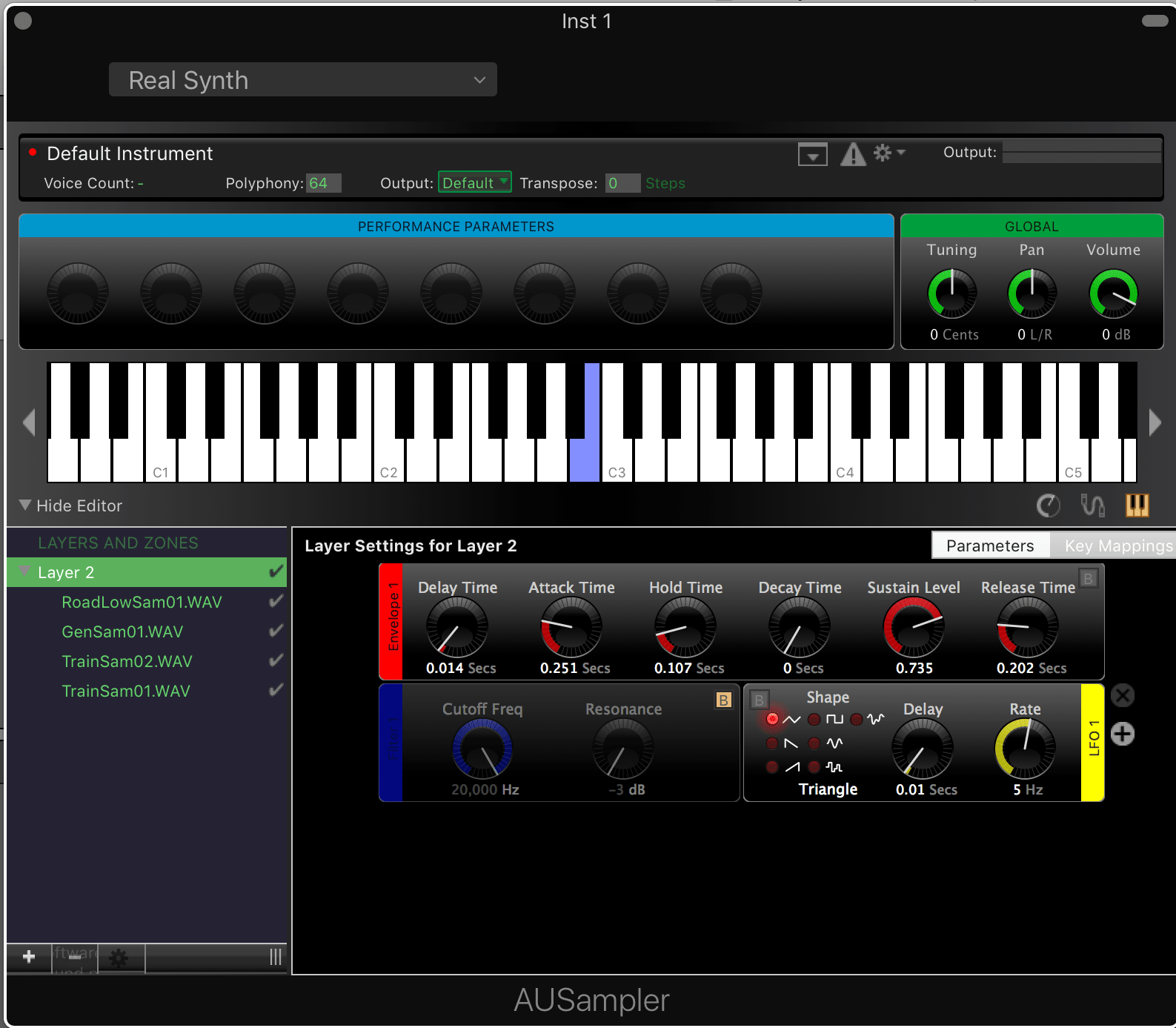
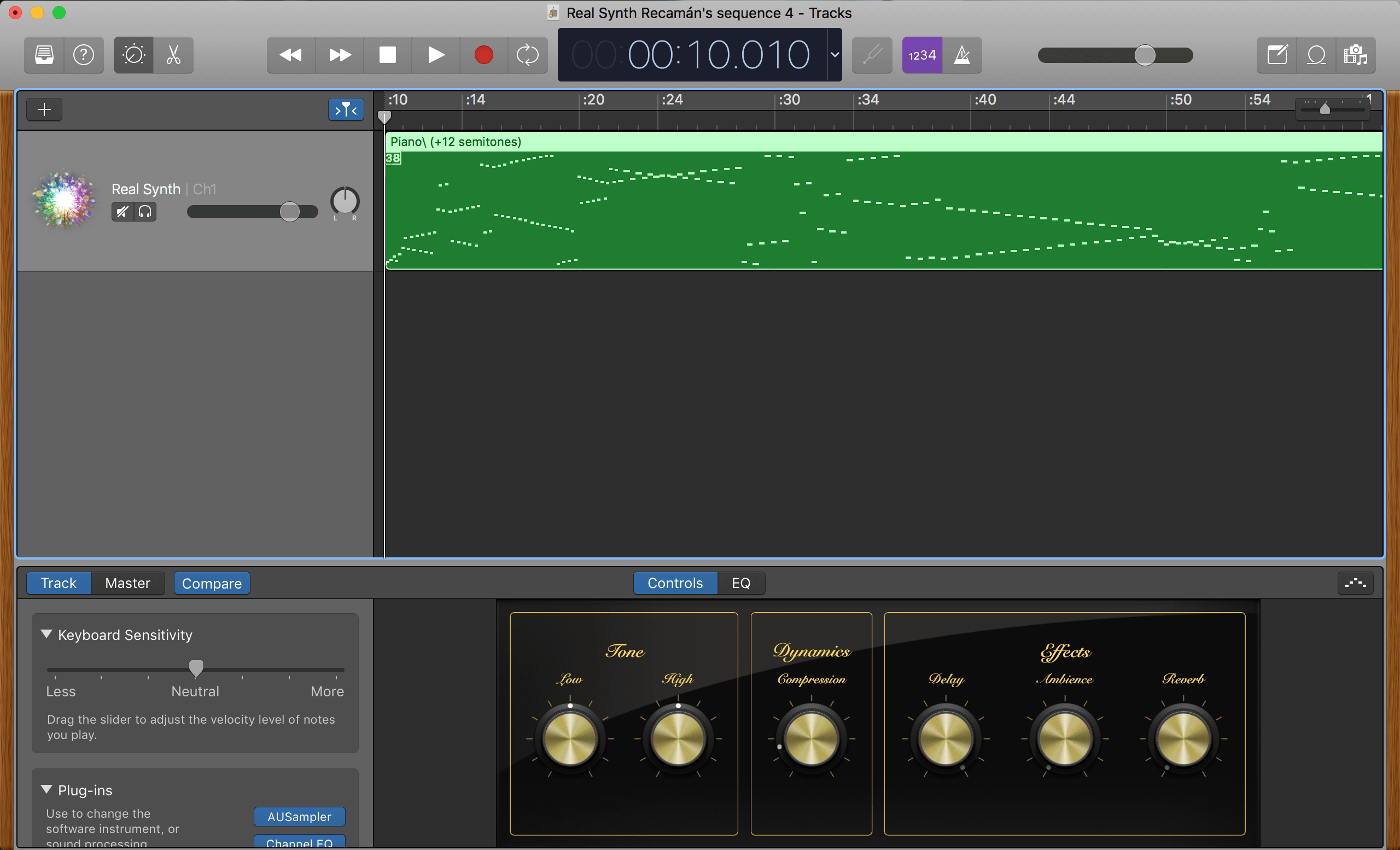
Once I had the midi file I went back to a project that I had been working on to create a software synthesiser using the Musique Concrete technique. In Garageband I created a software instrument using the AU Sampler plugin.
Four short audio samples mapped to the keys of AU Sampler
I specifically used samples that had a range of pitches as well as different audio textures.
AU Sampler Settings
Track settings with added reverb
Mathematically powered synthesis
I am hoping that the structures of soundtrack will reflect the structures of the visuals.
In my last post I was discussing my thoughts on the way scientific progress has allowed us to see further.
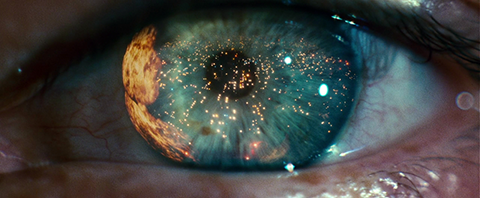
One of the central images of Blade Runner is the eye. In the film artifical life forms, Replicants, are a tool used by humanity but they are banned on earth, they an be identified from humans by their lack of empathic response as given away by their eyes. Personally I think it is very ambiguous if the are genetically engineered, machine or a mixture but I don’t think it matter, in fact I think the plot and narrative of Blade Runner largely make no sense. For me the power of the film is in the poetry of the images and how they are used to suggest themes, the combinations of images and sounds have and internal picture logic that explores what it mean to be human, for me Blade Runner is about humanity.
Eyes being ‘made’ in Blade Runner (1982, Ridley Scott)
In the scene pictured above one of the Replicants looking for more information on how he was made confronts a genetic designer who makes eyes.
I just do eyes, just genetic design, just eyes. You Nexus? I design your eyes.
Blader Runner (1982)
The designer, whilst fearful, is also perversely excited to see his creation living, like Dr. Frankenstein the designer is killed by his creation.
If only you could see what I have seen with your eyes.
Blader Runner (1982)
Along with the eye imagery this line from the lead replicant, Roy, has always stuck with me as being integral to the theme of the film. What makes us human, and how do our experiences play a part in this. It is reiterated in a more famous line from the end of the film.
I’ve see thing you people wouldn’t believe.
Blader Runner (1982)
As I was developing my response to Kino I began to ask myself the same questions about the images that the probes we have sent to other worlds have seen. The voyager missions have now left the influence of our sun, there are people who have dedicated their careers and lives to maintaining, tracking, and analysing the data from the missions. There are countless stories of the thrill of discovery as images or data came through. But can we say that this is our discovery, second hand with voyagers eyes?
As we increasingly use algorithms and machine learning to help sift through massive data sets, and select targets for telescopes are the observations that are made still ours to claim?
Referring back at discussions about Duchamp and intellectual provocations for work I am inclining back towards using a mathematical sequence to generate the soundscape for the Kino project.
I spent this morning capturing a more refined version of my idea for Kino, I recruited two crew members (thanks Callum and Alex) to help with the setup and filming as I wanted to be in the piece myself.
The filming only took six minutes after setting up and testing for over two hours. I was really hoping to achieve the effect that I was looking as close to down the lens of the cameras as possible which proved difficult as the shadow from the projection kept falling in shot. By raising the projector to a steep angle it moved the shadow down almost completely out of the frame but it is still slightly noticeable in the lower corners,I need to live with how it looks for a few days. Production is always compromised, I feel at the moment that I have made the right ones. I think the final direction that I appear to be looking works better than directly into the lens as it does not appear that I am looking at the viewer, this hadn’t occurred to me until I was editing this test together so I am happy that my original idea wouldn’t quite work. I am also please with how still we managed to get the shot without resorting to strapping my head down as I did not want it to appear that I was being forced to watch, but rather choosing to look through curiosity.
I am preparing a detailed post about the images that are being projected onto my face and how they were chosen and arranged.
The audio is reused from the concrete sound project but reversed, I am still working on the audio and wanted something to stand in.
After the complete disaster of the first Kino test I went back a few steps, I have been exploring the idea the science can physically change the way we see the world, smaller, further, into different spectrums. I am interesting in exploring how this ‘seeing’ reflects back on the watcher. I have projected a series of astronomical images onto the face and focused on how this changes the eyes.
I want to find a way to lock off the head so that the only movement is the eye and projection, I am also going to film both eyes simultaneously.
The sound is a continued exploration of Recamán’s sequence played through a software sampler that is using small sections of everyday sounds as the notes. I think this is far too jarring at present but there is something in not that I want to pursue. I really like the way that it is very procedural, it is hard for me to tell what will happen before I have run it through.
Kubrick mixed the fear, wonder and hope of science and technology in 2001: A Space Odyssey
I am currently exploring themes of hope in Kino and want to do this through the eye of scientific exploration.
I want to look at how our advances in vision have pushed our understanding of the physical world. Small, further, faster, brighter.
I am considering stretching one image over both of the screens as Bill Viola did in Mary. I am hoping that this will encourage thew viewer to consider the blind spot on the image, referencing what we can’t yet see and the blanks that ours own eye fills. I also want to explore this as I have noticed in some dual screen pieces that viewers tend towards comparing and contrasting rather than combining the images.
I and going to go back to the concrete sound project as a starting point for the soundscape but also want to explore sounds that recreate mathematical patterns.
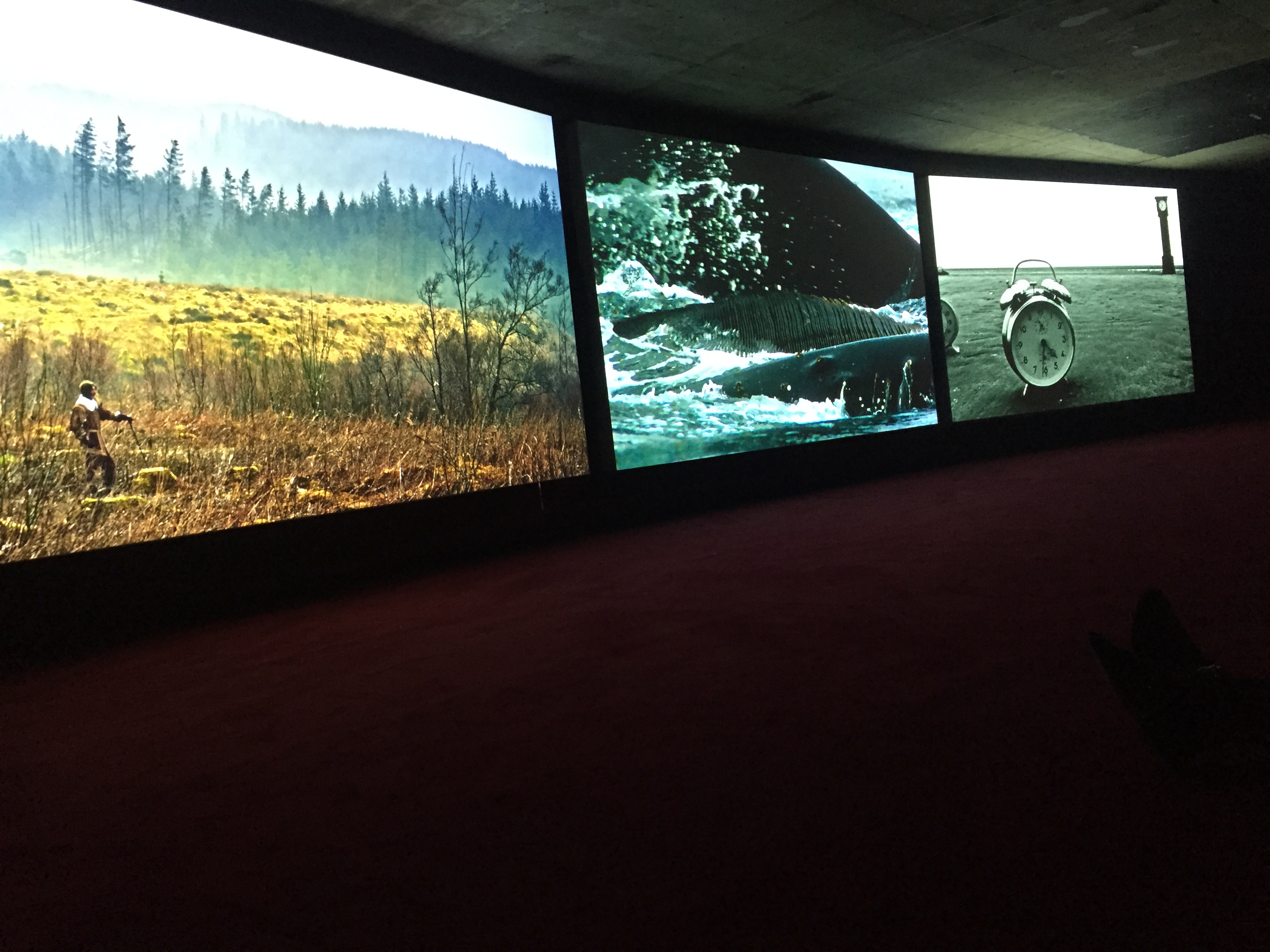
Vertov and his contemporaries wanted to explore the power of the camera’s mechanical eye to challenge existing ideas. I couldn’t help being reminded of this as I watch Vertigo Sea. What would would Eisenstein have thought about the interplay of three images and a rich multilayered soundscape? Fact, fiction, historical, contemporary, colour, text, word, music, sound.
What would would Eisenstein have thought of Vertigo Sea?
I felt the richness and vibrancy of Vertigo Sea created an experience as immersive as any Hollywood Action film but used this experience to challenge rather than dictating to an audience. So many questions are asked; political, cultural, environmental, all bound up with the framing device of the beautiful but violet sea.
Montage happing in space and time in Vertigo Sea
Whilst looking for a clip of Akomfrah’s work to illustrate my point I discovered this film of him talking about his creative process where he describes montage in his films, making reference to a dialectic between the images joined by a cut (or three screens) creating a new meaning.
For me Vertigo Sea pushes against but also acknowledges the the legacy of cinematic filmmaking techniques. Rather than outright rejection of the work of other filmmakers Akomfrah instead utilises and extends the techniques to tell a tapestry of stories that cinema is unsuitable for.
The way that images and theme repeat and evolve for me give Vertigo Sea parallels with the ideas of minimalism. Images want to tell us stories, even TH:EC:LO:CK found it difficult to break away from this, we seem to be driven to create linear narratives. For me, Akomfrah challenges this by repeating imagery and forcing us to be active viewers, ours eyes scanning across multiple screens, we pickup and drop the treads in different ways until the stands leave us with a net rather than a line.
I have been working on this post on and off since the seminar on the 18th October, there was some really interesting conversations in the seminar that I wanted to follow up on quickly but fell into the essay writing habit of lingering too long on them. I want to avoid this as I want this blog to be a record of the development of my thinking over the duration of this process rather than a summary at the end where inevitably I will omit (by mistake or design) some of the detours and dead ends that I explore. I am attempting to be conscious of Donald Schon’s work regarding reflection in and on action. So in this spirit here are the thoughts of the moment.
The seminar on 18th October left me returning to the question that I have gravitated since I started being interested in art, why do I want to say anything at all who am I to say it and why.
I want to say have hope be positive there is hope humans are brilliant. Most importantly I want to say this to everyone.
Yet Roope ended his doom-laden column with a rallying cry to designers: “This is perhaps the biggest challenge humankind has ever faced, and also perhaps its most exciting… let’s start designing the future that gives us a future. Now.”
I want to say it because I forget, and I want to remember. When I am stood at the bus stop reading an advert for a big brand wine, that promises to make your problems go away, get you a new partner and do the washing up, I want to remember we went to the moon.
Sometimes we are individually or collectively heinous, but sometimes we are sublime.
As I mentioned previously Brian Eno’s music has been highly influential on my approach to sound, but Eno’s thoughts on creative processes and the importance of art have been even more influential. When I’m stuck on a problem I reach for an oblique strategy. Eno’s 2015 BBC Music John Peel Lecture resonated with me in his framing of art as “all the things we don’t need to do” and the way that it can help us to safely explore new and frightening ideas in safety. I recently came across an article on the design website Dezeen where Eno’s thinking helped to clarify my reasoning for wanting to make art and how this relates to my personal and political philosophy.
Eno points to Mariana Mazzucato and Kate Raworth, economists who are redrawing how we measure value in society, and reframing the boundaries of economics to the scale of the planet. As Raworth says: “Today, I think ours is the generation that must raise its sights once again, beyond the household, the city and the nation to the planet: it’s time to take on the economics of the planetary household.”
This post has the tonal shifts of a meandering river because it has been written over many sittings and my thoughts really need the rest of my life to clarify so I am going to fall back on Brian Eno for now.
In researching Fernand Léger as part of the DADA project I was reacquainted with Ballet Mecanique from 1924. There is an interesting parallel between the pure experimental exploration of movement that I think is demonstrated in this film and use approach of using Studio Artist to explore the body in motion in the DADA project.
For us the joy of dancing saws in а sawmill is more familiar and easier to understand than the joy of human dancing.
D. Vertov, ‘Му. Variant manifesta’, Кino-Fot, по. 1, 25-31 August 1922, рр.11-12.
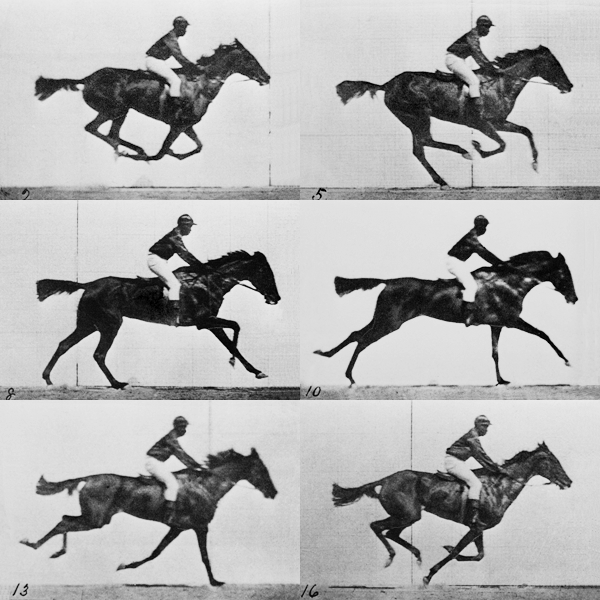
With the ubiquity of screens in 21st Century society it is easy to forget that the ability to capture and recreate an illusion of movement has been both a technological and artistic voyage. Being able repeat, slow-down, speed-up the motion of the natural world, and even generate movement where there is none has given rise to scientific, cultural and political transformations.
The impact of technology can only be measured after it has been created, often the consequences are unexpected. Discussions of the truth in still and moving images are as vital today as ever when video evidence is increasingly being used to record and repeat, and provide previous impossible views of the world.
When jurors are shown slowed-down footage of an event, the researchers said, they are more likely to think the person on screen has acted deliberately. While a slow-motion replay may allow jurors to see what is taking place more clearly, it also creates “a false impression that the actor had more time to premeditate” than when the events are viewed in real time.










 mattprentice