As I have noted during the development of other projects this year I am really interested in discussions of authorship and alternate voices. I have been looking for ways to explore this through the narration in the my current project. Rather than a specific point or idea that I want to express this project seems to be a series of questions that I want to ask.
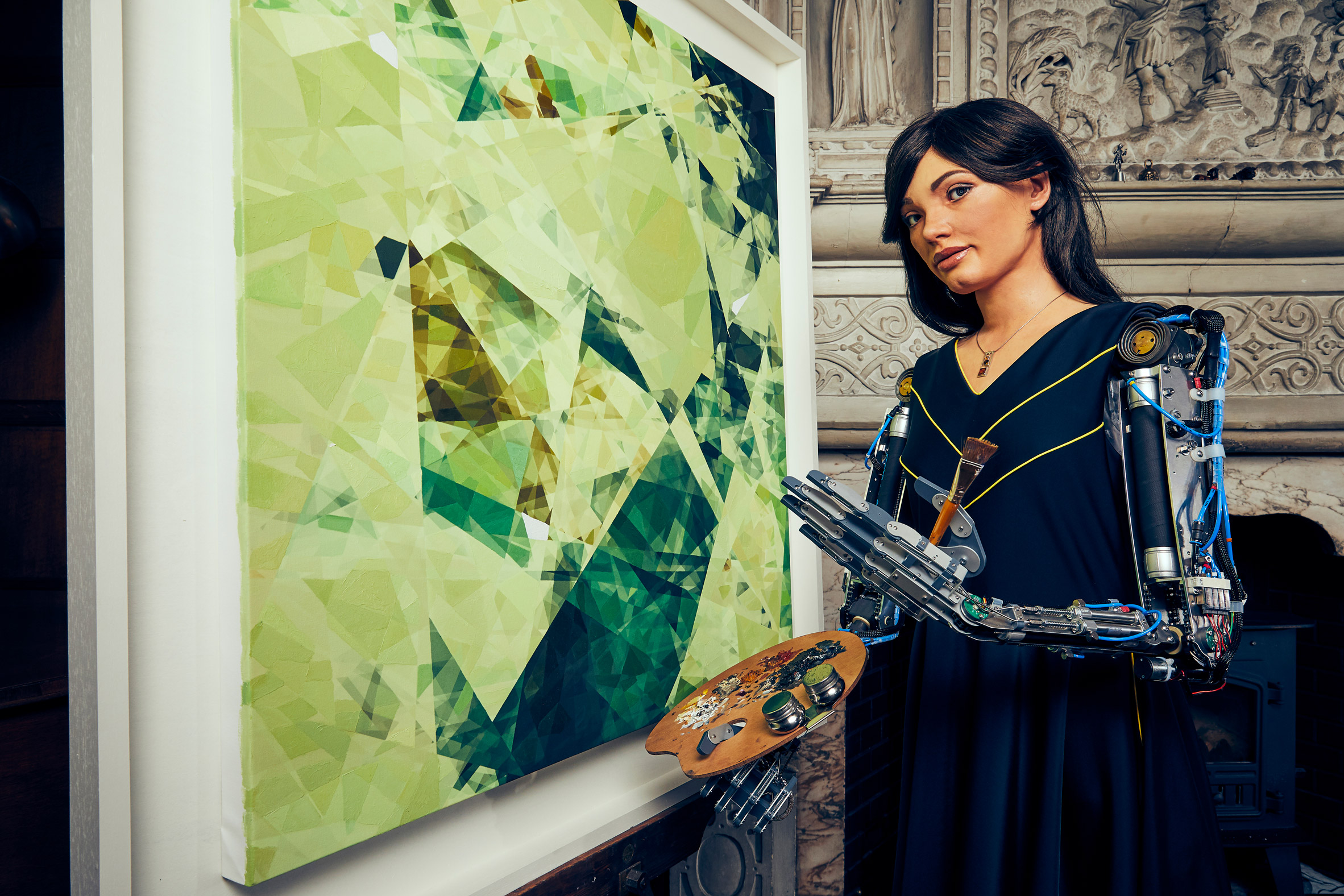
Photo by Nicky Johnston via Dezeen
I came across this article about an Artificial Intelligence Artist in my RSS feed.
Manufactured by a team of engineers specializing in robots with human-like features and using algorithms developed by scientists at Oxford University, Ai-Da captures images in front of her with a camera in her eye. A series of algorithms then send instructions to her robotic arm and hand, which was created by students based in Leeds, U.K. Ai-Da takes her name from Ada Lovelace, the world’s first female computer programmer
https://time.com/5607191/robot-artist-ai-da-artificial-intelligence-creativity/
The art on show includes drawings, paintings and sculptures rendered from her algorithmic instructions.
https://time.com/5607191/robot-artist-ai-da-artificial-intelligence-creativity/
This collaborative creation process reminded me of the question that I asked about the discoveries made by satellites, whose discoveries are they? The algorithms and robotics are designed and created by humans, it could be argued that Ai-Da is a complex paintbrush.

Victor Frankowski via Time
Algorithmic and process based artwork is not new, part of the quest of abstraction and conceptual art is the distancing of the artist from the work.
The complex visual output is printed onto canvas, where a human artist then paints over part of the canvas. “The potential for technology to augment the human potential for creativity, to expand the achievable horizons of creative expression and to possess its own creative potential as an entity of its own is so fascinating and exciting,” says Aidan Gomez, a researcher at Oxford working on the project.
https://time.com/5607191/robot-artist-ai-da-artificial-intelligence-creativity/
https://www.sfmoma.org/watch/andy-warhol-makes-a-silkscreen/
Duchamp used ready made objects, Warhol used techniques of mass production. What is it that makes this the work of an AI artist?
“What’s intriguing here [with Ai-Da] is that people get very taken in by a robot that looks human,” says Marcus du Sautoy, a professor of mathematics at Oxford University
https://time.com/5607191/robot-artist-ai-da-artificial-intelligence-creativity/
On a similar train of thought I found a podcast about an audioartist creating plant music.
The music is created by connecting four plants to different synthesisers via a midi interface. The changes in the plants biology are reflected in changes to the midi notes that play the synthesisers. Are the plants playing the music, or are they generating a random sequence that drives an instrument programmed by a human? The creators of the midi sprout suggest that changes in the environment, such as the presence of people, change the rhythm of the plant and this changes the performance.
I am not going to pursue this idea of automation or distance in the piece that I am working on at the moment, the opposite I want to be as hands on as possible with the creation of the sounds and images for this film. What I am inspired by here is how these questions inform the voice of the narrator from the end of the universe. The voice is that of an A.I created by humanity the has outlasted them and grown beyond them.

I’ve Seen thing you people wouldn’t believe.
Blade Runner – Ridley Scott (1982)
I want to use this perspective to question our relationship with what we make, how we live, the choices we make individually and collectively.
 mattprentice