I was searching for an anchor for the experimentation that I was undertaking in Isadora and came across a journal discussing the choreography of Anne Teresa De Keersmaeker and Steve Reich’s composition principals. Structure as Process: Anne Teresa de Keersmaeker’s Fase (1982) and Steve Reich’s Music
First of all, Reich is concerned with clarity of structure, which he feels can only be achieved by creating compositions in which structure (“process”) and musical content are identical. He has no use for hidden constructive devices that serve to obscure musical process. Secondly, musical processes, once set into motion, have a life of their own, and need no further meddling from the composer to progress; they are impersonal and objective procedures. Thirdly, improvisation can play no part in a musical process; on the contrary, one must subvert one’s own feelings and allow inexorable forward thrust of the process to take charge. Lastly, no matter how objective the process, unexpected events will still occur: these are the resulting patterns.
Steve Reich, “Music as Gradual Process, Part II,” in K. Robert Schwarz, Perspectives of New Music, vol. 20, no. 1/2 (Autumn 1981–Summer 1982), 226. in (Bräuninger, R. (2014) ‘Structure as Process: Anne Teresa de Keersmaeker’s Fase (1982) and Steve Reich’s Music’, Dance Chronicle, 37(1), pp. 47–62. doi: 10.1080/01472526.2014.877273.)
In this passage I found a strong correlation with the process that I was approaching with my work.
- I wanted to focus the view on the movement, the shapes of the body in motion – isolating it from a narrative or specific emotion
- I wanted to set up the initial conditions and parameters and let these play out over the piece – it will evolve over the duration
- Like an scientific experiment the rules of the test should not be manipulated once started – post processing invalidates the results
- The result will be the patterns that emerge – the interplay between sound, image and rules
By reducing the set of musical parameters, Reich narrowly focuses the listener’s attention, creating a meditative sense of contemplation, in spite of the mechanistic quality of the sound reflecting the cultural setting in which Reich lives.
(Bräuninger, R. (2014)
I would argue that our contemporary cultural setting, interconnected, digital, saturated with data and surveilling eyes, demands an even more mechanistic quality. When we consider the use of digital video rather than analogue music or performance an individual frame is already an individual unit. We can see this in Muybridge’s photographs of motion, continuous motion is atomised and then recombined to give an approximation of motion.
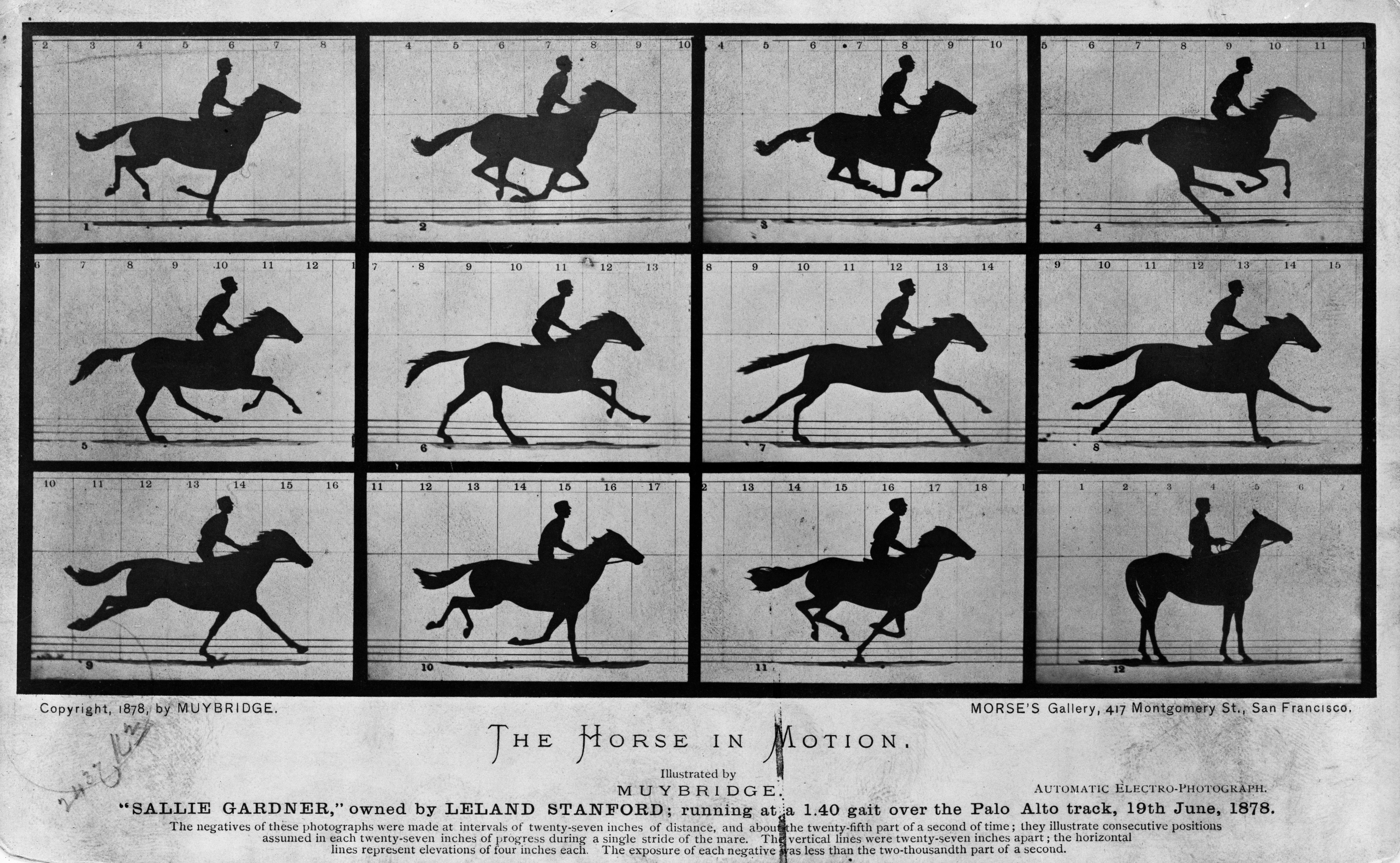
In filming a continuous sequence of dance it is frozen and shatter, information is lost but replaying the individual images in sequence we can recreate and restore an approximation of the original motion. Muybridge’s photographic sequences revealed details about the movement of animals that were unknown before, they made visible a new information.
De Keersmaeker was not aiming to find a visual equivalent to this detail in Reich’s music; instead, she sought to give her choreography its own distinct organization, influenced by Reich’s structured process but not a mere translation of it.
(Bräuninger, R. (2014)
I see a similar relationship between the way I am looking at using repetition of a sequence of frames of dance and Reich’s approach. I want to find a process for presenting the series of frames that makes up a distinct movement, I want to decoupled the shapes of a body in motion from the meaning of a body in motion.
When we watch Fase we no longer perceive events passing along a time-line, but are thrown into an endless continuum in which the here and now, the being in the moment, becomes central to our perception.
(Bräuninger, R. (2014)
As we listen to the repetition of the same patterns continuously rearranged, particular combinations of sounds emerge and we experience a sense of change within constant repetition.
(Bräuninger, R. (2014)
With a duration of 2-minutes it is unlikely that a sense of meditation will emerge, instead I am hoping that a suggestion of the repetition continuing after the end of the piece will remain.
 mattprentice