In my last post I was discussing my thoughts on the way scientific progress has allowed us to see further.
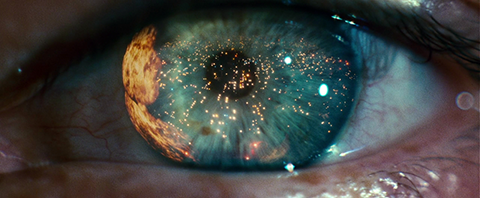
One of the central images of Blade Runner is the eye. In the film artifical life forms, Replicants, are a tool used by humanity but they are banned on earth, they an be identified from humans by their lack of empathic response as given away by their eyes. Personally I think it is very ambiguous if the are genetically engineered, machine or a mixture but I don’t think it matter, in fact I think the plot and narrative of Blade Runner largely make no sense. For me the power of the film is in the poetry of the images and how they are used to suggest themes, the combinations of images and sounds have and internal picture logic that explores what it mean to be human, for me Blade Runner is about humanity.

In the scene pictured above one of the Replicants looking for more information on how he was made confronts a genetic designer who makes eyes.
I just do eyes, just genetic design, just eyes. You Nexus? I design your eyes.
Blader Runner (1982)
The designer, whilst fearful, is also perversely excited to see his creation living, like Dr. Frankenstein the designer is killed by his creation.
If only you could see what I have seen with your eyes.
Blader Runner (1982)
Along with the eye imagery this line from the lead replicant, Roy, has always stuck with me as being integral to the theme of the film. What makes us human, and how do our experiences play a part in this. It is reiterated in a more famous line from the end of the film.
I’ve see thing you people wouldn’t believe.
Blader Runner (1982)
As I was developing my response to Kino I began to ask myself the same questions about the images that the probes we have sent to other worlds have seen. The voyager missions have now left the influence of our sun, there are people who have dedicated their careers and lives to maintaining, tracking, and analysing the data from the missions. There are countless stories of the thrill of discovery as images or data came through. But can we say that this is our discovery, second hand with voyagers eyes?
As we increasingly use algorithms and machine learning to help sift through massive data sets, and select targets for telescopes are the observations that are made still ours to claim?
Referring back at discussions about Duchamp and intellectual provocations for work I am inclining back towards using a mathematical sequence to generate the soundscape for the Kino project.
 mattprentice
2 comments